Read time
10
min
Danube Future Forum
The first Danube Future Forum was held in Belgrade on October 9, marking the Pupin Initiative’s third anniversary.

Danube Future Forum 2026
“The Danube is the development axis of the region”
The Pupin Initiative organized the Danube Future Forum 2026 in Belgrade on October 9 to open a conversation about the future of the Danube as one of the most important energy, infrastructure, trade, and geopolitical corridors of Central and Southeastern Europe. The Forum brought together representatives of state institutions, the diplomatic corps, international organizations and the business sector.
Across two keynote conversations and four panels, the discussions covered the Đerdap 3 (Iron Gate III) pumped-storage hydropower project, energy security, transport links from Rotterdam to Constanța, agriculture and food security, and the river’s role in the reconstruction of Ukraine. The shared message from participants was that the Danube is not just a waterway but a strategic corridor whose potential remains underused, and that Serbia, thanks to its geographic position, has a significant role to play in connecting European markets.
Serbia’s geography as a development opportunity
The Forum opened with addresses by Pupin Initiative President Vuk Velebit and the Chargé d’Affaires of the U.S. Embassy in Belgrade, Alexander Titolo.
Velebit said that since its founding, the Pupin Initiative has tried to follow the example of Mihajlo (Michael) Pupin — not only his achievements, but his understanding of patriotism. Pupin was deeply attached to Serbia yet open to the world, and he used his knowledge, reputation and international connections to help his country. That, Velebit stressed, is patriotism built on work, knowledge and connecting Serbia with international partners.
He explained that the Forum was launched to look at Serbia’s geographic position as a development opportunity. The Danube links Central Europe with the Black Sea and runs through Serbia, which makes it a natural foundation for stronger economic, infrastructural and political cooperation in the region. To make the most of it, he called for new bridges, railways, ports, energy interconnections and digital links that would make the Danube region more competitive and allow Serbia to play its full role in it.

“The Forum was launched to view Serbia’s geographic position as a development opportunity.” — Vuk Velebit, President of the Pupin Initiative |
Titolo thanked the Pupin Initiative for organizing the Forum and for its work so far, including the earlier Pupin Forum in Washington, which was attended by representatives of the U.S. administration. He described the Danube as a timely topic that matters for understanding cooperation between Serbia and the United States, and said it was the right time for the two countries to take a closer look at joint projects.
The river’s role in everyday life and in the economy, Titolo noted, is easily taken for granted — until droughts and low water levels disrupt transport, energy and other sectors. Cities like Belgrade grew along great rivers that for centuries provided water, food, energy and opportunities for trade. He singled out the Danube’s importance for electricity generation and welcomed the progress of the Đerdap 3 pumped-storage hydropower project, which he said could bring significant benefits not only to Serbia but to the entire region. Making joint use of the Danube’s potential, he added, can connect Serbia more closely with its neighbors and strengthen regional stability.

Three years of the Pupin Initiative
The Forum took place on the third anniversary of the Pupin Initiative. The organization’s founding date is tied to October 9 — the day in 1854 when Mihajlo Pupin, the Serbian scientist, inventor and one of the most prominent figures of the Serbian diaspora in America, was born. Drawing on that legacy, the Initiative works to strengthen relations between Serbia and the United States, develop international cooperation and connect experts and institutions around strategic questions, from energy and infrastructure to economic development and international partnerships.
Speaking about the road ahead, Velebit said the goal is to build a serious and independent institution that brings together people from Serbia, the United States and other countries around a shared idea: that Serbia should be open, connected and capable of building long-term partnerships. He placed particular emphasis on investing in new generations with knowledge, self-confidence, international experience and a sense of responsibility toward their country, and called for a serious debate on the future of Serbia’s economy, industry, infrastructure and energy — and on the role Serbia wants to play on the international stage.
Energy security through diversification
KEYNOTE CONVERSATION · Serbia’s Energy Future – Diversification & Iron Gate III
One of the Forum’s central themes was Đerdap 3, a major hydropower project for the future energy stability of Serbia and the region. Serbia’s Minister of Mining and Energy, Dubravka Đedović Handanović, spoke about the country’s energy future, the diversification of the sector and the potential of Đerdap 3 in a keynote conversation moderated by Vesna Damjanić of Bloomberg Adria.
The Minister said Serbia had made significant progress over the past four years in diversifying its gas supply and in developing renewable energy. For the first time, Serbia has diversified its gas supply routes, reducing its dependence on any single route. She announced that construction of the Serbia–North Macedonia gas interconnector would begin the following week, while options for gas supply from the direction of Greece continue to be developed.
Renewable capacity has grown from about 400 MW in 2022 to roughly 1,300 MW today, with further growth expected; changes to the legal framework, she said, have opened the way for greater private-sector participation. At the same time, Đedović Handanović cautioned that the energy transition is neither simple nor fast: new capacity has to be carefully balanced with existing plants — above all thermal power plants, which still play an important role in security of supply.

Đerdap 3 and the strategic partnership with the United States
Describing the Danube as the development axis of the region and energy as the foundation of new investment and stronger international connectivity, the Minister said Serbia aims to be not only a market for international investment, but a place where projects of wider regional significance are developed. That, she said, requires reliable partners, modern technologies, long-term planning and infrastructure that links Serbia with the energy systems of Central and Southeastern Europe.
In her view, the strategic partnership between Serbia and the United States in energy is the basis for more concrete cooperation among state institutions, companies and financial partners, particularly on large infrastructure projects. The Agreement on Strategic Cooperation in Energy with the United States opens space for a greater presence of American companies, advanced technologies and the linking of capital and know-how — and it is important that this cooperation delivers concrete results. She named Đerdap 3 as one of the projects that could do so.
Đerdap 3 should contribute to the stability of the power system, better use of renewable sources and a more secure electricity supply, while also driving significant economic activity, engaging Serbia’s construction and electrical industries and creating new jobs. Beyond generation and navigation, she noted, the Danube can serve as an energy corridor and a source of energy storage capacity.
The project, however, requires thorough analysis of its technical, economic and environmental aspects, as well as cooperation with Romania, with which Serbia shares the Danube and a long tradition of successful hydropower cooperation. Recalling the Danube’s record-low water level this summer, she stressed that analyses must determine the optimal capacity of the future plant, so that energy security is achieved while the river is protected.
Looking further ahead, the Minister said today’s decisions should be judged by the results they bring in the coming decades — from new generation capacity and energy storage to gas infrastructure and preparations for the possible use of nuclear energy. A successful transition, she concluded, means building a system that is reliable, flexible and competitive, which requires developing new capacity, modernizing infrastructure and strengthening expertise at the same time.
“The Danube is the development axis of the region.” — Dubravka Đedović Handanović, Minister of Mining and Energy of the Republic of Serbia |
A view from the Lower Danube
KEYNOTE CONVERSATION · A Perspective From the Lower Danube
Former Bulgarian Prime Minister Kiril Petkov, in conversation with Pupin Initiative President Vuk Velebit, spoke about the Danube’s strategic importance for Europe as a route for transport and trade that links the region with the Black Sea and the rest of the world. The war in Ukraine, he noted, showed how valuable the river is as an alternative transport route, as Danube ports took on a much larger role in Ukrainian exports. Through its connection to the Black Sea, the Danube also opens trade with more distant markets, including North Africa.
Petkov argued that the lower Danube countries are not using the river’s potential and need new bridges, modernized ports and a well-maintained waterway. He illustrated the problem with an episode from his talks with Romanian officials: his advisers had prepared a brief setting out conditions for Bulgaria’s cooperation on bridges and navigability — and his Romanian counterpart had been handed a similar brief with the opposite conditions. Comparing the two, they asked themselves why such an approach persists in a Europe that strives for free movement and the removal of borders.
The lesson, Petkov said, is that the countries of the region must overcome mutual obstacles and pursue joint infrastructure projects rather than narrow national interests. Better cooperation between Bulgaria and Romania could make far more efficient use of the Danube and connect Southeastern Europe more strongly with European and global markets.

Đerdap 3 beyond Serbia’s borders
PANEL I · Iron Gate III — Utilizing the Danube’s Energy Potential
The first panel brought together Josh Baker, Principal Vice President and Balkans Region General Manager at Bechtel; Dušan Živković, General Director of Elektroprivreda Srbije (EPS); and Alina Arsani, Head of Energy Systems at the Energy Policy Group, a Romanian policy institute. Moderated by Kaush Arha, Senior Advisor at the Pupin Initiative, the discussion examined how Đerdap 3 could change Serbia’s energy mix, strengthen the security of electricity supply and deepen cooperation between Serbia, Romania and the United States.
Baker said a project of this complexity requires an exchange of experience and knowledge between Serbia and the United States. He pointed to Bechtel’s long experience in the region and in large dam, water-management and pumped-storage projects, and noted that international cooperation can also help other countries facing similar energy-security challenges. Because the Danube matters for transport and regional connectivity as well as for electricity, he argued, new hydropower capacity should be planned as part of wider infrastructure that makes the energy system better connected and more resilient.
Živković recalled that developing hydropower on the Danube in the 1960s was a visionary project, and said this century needs a vision of its own: Đerdap 3 and its capacity to balance renewable energy. Serbia and the region have major solar and wind potential, he noted, but a stable grid and a secure supply also require balancing capacity. Beyond generating electricity, Đerdap 3 would provide exactly that, supporting the development of renewables in Eastern Europe and contributing to a more stable electricity supply.
This year’s historically poor hydrology on the Danube, he said, showed why Đerdap 3 is worth building, since a pumped-storage plant can store surplus water and generate electricity during droughts. The dry summer left Serbia short of water for cooling its thermal power plants, and neighbors downstream on the Danube faced the same problem at their nuclear plants; in such periods, water stored at Đerdap 3 could offset low river levels and make up the cooling water missing at the nuclear plants downstream. Full energy independence is hard to achieve today, Živković added, but energy security can be strengthened through diversified sources and supply routes, a range of technologies and regional cooperation — which, he said, requires the region to change the way it thinks about its resources and to look to the future rather than the past.
“Đerdap 3 would change the strategic importance of the Danube and further strengthen Serbia’s position as a regional energy hub.” — Dušan Živković, General Director of Elektroprivreda Srbije (EPS) |
Arsani said the project’s regional significance stems from the rapid growth of solar power. Midday surpluses of cheap electricity already lead to curtailment and additional costs, which makes storage increasingly important for grid stability; estimates for Romania point to a need for several gigawatts of new storage capacity in the medium term. Pumped-storage plants can absorb such surpluses and release the energy when demand peaks. She emphasized the joint work of experts and energy companies from both countries, including EPS and Romania’s Hidroelectrica, around a river the two countries share.
Panelists agreed that the potential of Đerdap 3 should be assessed beyond Serbia’s borders: new storage capacity, a stronger grid and cooperation with regional partners could make electricity supply more reliable and integrate the energy systems of Southeastern Europe more closely.

From Rotterdam to Constanța
PANEL II · Connecting Europe From Rotterdam to Constanța
The second panel, also moderated by Kaush Arha, looked at the Danube as a transport and logistics corridor connecting Europe from Rotterdam to Constanța — navigation, links between river ports and the road and rail networks, and transshipment capacity. The speakers were Vuk Mijanović, Executive Director for Logistics Excellence and Development at Nelt Group; Sebastian Schäffer, Director of the Vienna-based Institute for the Danube Region and Central Europe (IDM); Jakov Devčić, Director of the Konrad-Adenauer-Stiftung (KAS) in Serbia and Montenegro; and Filip Simović, President of AHK, the German-Serbian Chamber of Commerce.
Simović, who also heads a logistics company operating across the Balkans, highlighted Germany’s position as one of Serbia’s most important economic partners, with trade in goods reaching around €10 billion in 2025. Yet the Danube, he said, is still not used enough as a transport route. Mijanović argued that, alongside large infrastructure investments, more attention should go to small, practical improvements, pointing to problems in rail transport across Europe and the need for better coordination between river, rail and road.
Participants stressed that the obstacles are not only physical. Besides better navigability, particularly on the lower Danube, the administrative and regulatory barriers that complicate cross-border transport must be addressed. They pointed to a historical paradox: in some periods, linking trading centers along Europe’s rivers was simpler than it is today, despite modern European integration.
Schäffer recalled the long tradition of European cities and trading centers connected along great rivers, and called for the economic and social interests of the Danube countries to be linked more closely again — while respecting the different priorities of the upper and lower Danube. Devčić observed that interest in the EU Strategy for the Danube Region and in regional integration was stronger some fifteen years ago, when German states such as Bavaria and Baden-Württemberg actively supported it, and called for renewed political commitment. Better-coordinated border procedures and joint controls alone, he said, could save around €800 million a year — but only with clear political backing.
The panel concluded that the Danube can become a far more efficient transport and economic corridor if investment in infrastructure goes hand in hand with simpler administrative procedures and stronger cooperation among states.

Southeastern Europe as an agricultural hub
PANEL III · Southeastern Europe’s Agricultural Hub
The third panel, moderated by Petar Ivić, Policy Expert at the Pupin Initiative, addressed the Danube’s importance for agriculture and food security — exports of grain, fertilizers and other products, and the impact of climate change, rising transport costs and geopolitical crises on supply chains.
Milan Zorić, CEO of CHS Serbia, said that Serbia, Romania, Bulgaria and Croatia together farm about 10 million hectares and produce roughly 60 million tons of agricultural products, much of it for export — which makes reliable transport on the Danube decisive for the region’s competitiveness. Nenad Ristić, Senior Chemical Engineer at Elixir Group, explained that the company’s operations depend both on conditions in the Black Sea and on the Danube’s water level, since droughts and limited navigability strain port and transport capacity. Diversifying suppliers, shortening supply chains and developing alternative transport routes are key, he said, but reliable infrastructure remains a precondition for security of supply.
Mihailo Janković, CEO of MK Group, argued that the region’s agricultural potential is not fully used, as it still largely exports raw materials and basic products. More investment, new technologies, and higher quality would allow producers to achieve better prices, and moving toward higher value-added processing is one of the key opportunities for the agricultural sector in Serbia and the region. Veljko Jovanović, Director of the Agricultural Division at the Chamber of Commerce and Industry of Serbia, warned that transport costs can rise by as much as 25 percent, threatening the profitability of exports of goods whose value is low relative to shipping costs. With climate change and droughts making adaptation more urgent, he called for better intermodal links between river, rail and road.
The panel concluded that the Danube is a major resource for agriculture and trade in Southeastern Europe, but that its potential can only be fully realized with more reliable infrastructure, more stable supply chains and greater investment in modernization and processing.

The Danube and the future of Ukraine
PANEL IV · The Danube as Ukraine’s Artery of Integration and Reconstruction
The closing panel, moderated by RTS journalist Zoran Stanojević, brought together Ukraine’s Ambassador to Serbia Oleksandr Lytvynenko, Romania’s Ambassador Silvia Davidoiu and Germany’s Ambassador Anke Holstein to discuss the Danube’s importance for Ukraine’s economic resilience during the war, its European integration and its post-war reconstruction.
Lytvynenko said that Russian attacks on Ukrainian cities and civilians aim to weaken the country, destroy its economy and force people from their homes, and that preserving hope is essential for Ukraine’s survival and future. When traditional maritime routes were threatened, Danube ports became a vital alternative for exporting grain, agricultural products and raw materials. Defending the country, he stressed, is not only a matter of military security, but also of preserving the economy, trade links and prospects for the future.
Davidoiu described how Romania and Ukraine have worked together to develop the Danube corridor as logistics routes shifted because of the war, and called for further improvements to infrastructure, border procedures and information systems — needed both for the current needs of Ukraine’s economy and for its long-term integration into European transport and trade flows. Holstein stressed that the future of the Danube is a European, not merely a regional, question: connecting the countries along the river supports shared development and stability, and helping Ukraine rebuild its infrastructure matters for all of Europe.
Participants agreed that the Danube has been key to sustaining Ukraine’s trade during the war and will be key to its reconstruction and European integration — provided that international cooperation continues, ports and transport infrastructure are modernized, and administrative barriers to cross-border traffic are removed.

From a shared river to shared projects
The Danube Future Forum 2026 presented the Danube as a strategic space where energy, infrastructure, trade, agriculture, security and European integration meet.
The same message ran through every session: the river’s potential is far from fully used, and unlocking it will require investment in infrastructure, simpler procedures and stronger cooperation among the countries along its course.
For Serbia, which occupies an important position on this corridor, developing the Danube’s potential is an opportunity to strengthen its regional role and its connection with European markets — turning geography into development, from a shared river to shared projects.
The Danube Future Forum was organized by the Pupin Initiative to open a discussion on the future of the Danube as a strategic corridor of Central and Southeastern Europe. Participation by speakers does not imply support for any political position, and the views expressed during the Forum belong to their authors.
Other Activities

Read time:
2
min
Oct 16, 2026
Meeting with Robert Doar, President of the American Enterprise Institute
Vuk Velebit and Srđan Todorović met Robert Doar to discuss U.S.–Serbia ties and Serbia’s role in European security and transatlantic relations.

Read time:
2
min
Sep 30, 2026
Meetings on Capitol Hill in Washington, D.C.
Series of meetings with congressional staff on U.S.–Serbia relations, the Strategic Dialogue, and opportunities to strengthen bilateral cooperation.
Read time:
2
min
Sep 30, 2026
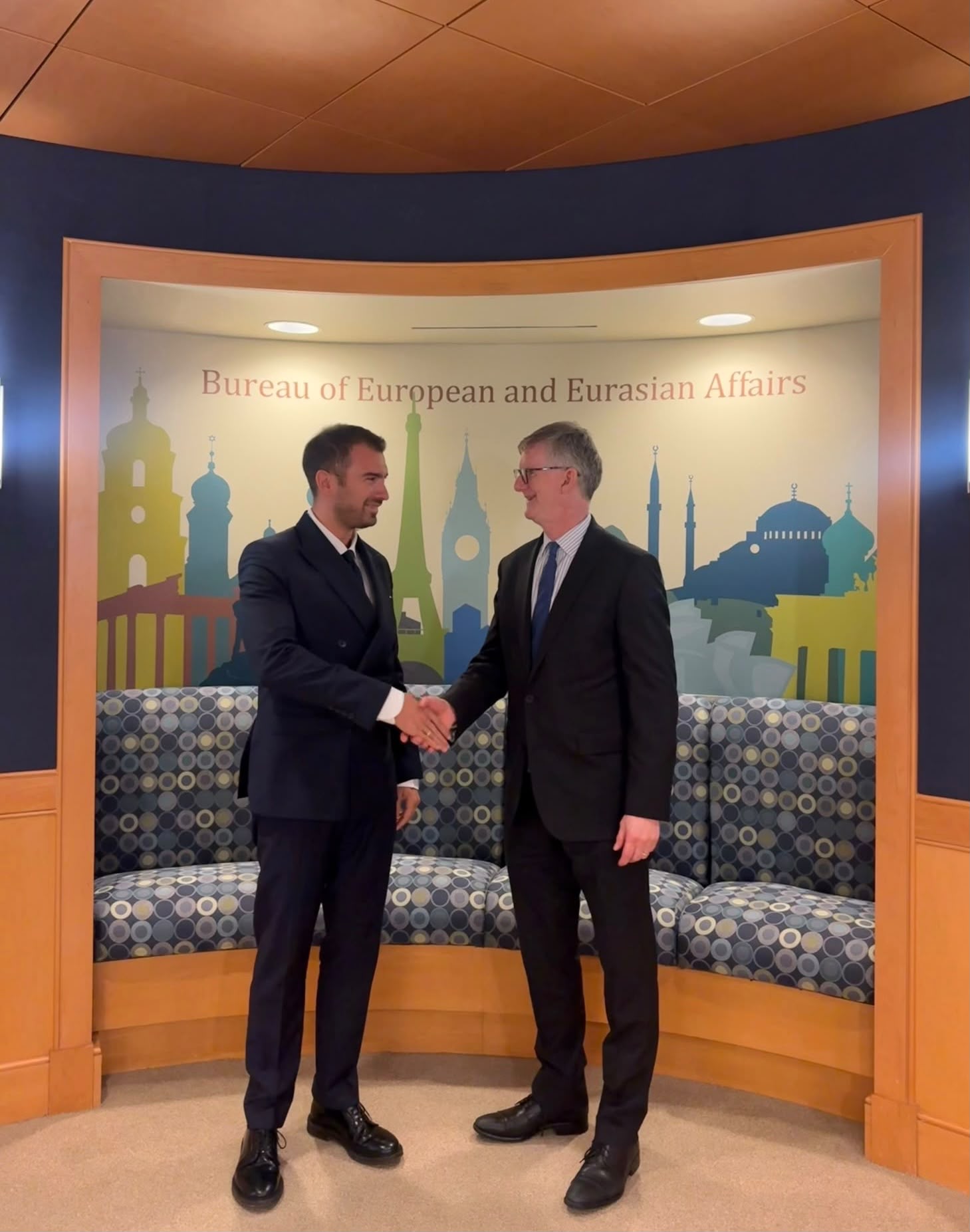
Meeting with Deputy Assistant Secretary Daniel Lawton
Pupin Initiative President Vuk Velebit met with Deputy Assistant Secretary Daniel Lawton to discuss the U.S.–Serbia Strategic Dialogue.