Vuk Velebit, Petar Ivić, Aleksa Jovanović
Serbia’s Strategic Depth in Central Asia: A C5+1+ Approach
How Serbia’s partnerships with Central Asia boost energy security, trade, and connectivity
Introduction
Central Asia is no longer a peripheral theater in Eurasian geopolitics. It is emerging as a decisive space of energy optionality, corridor competition, and great-power balancing, where infrastructure routes, supply chains, and regulatory standards increasingly function as strategic instruments. For Serbia, the region’s relevance is not about symbolic diplomacy or expanding its list of partners. It is about expanding strategic depth, the ability to increase national resilience by widening the portfolio of viable energy sources, trade routes, and institutional relationships that shape Serbia’s long-term security and economic positioning.
This logic underpins what can be framed as Serbia’s C5+1+ approach: a quiet but structured engagement with Central Asian partners, Kazakhstan, Uzbekistan, and Turkmenistan, that operates alongside, and functionally overlaps with, the U.S.-led C5+1 architecture. The objective is pragmatic and operational. Serbia seeks to secure near-term hard flows (energy and trade), insert itself into emerging Eurasian corridors linking Central Asia through the Caspian basin and South Caucasus to Türkiye and Europe, and build a rules-based cooperation layer compatible with U.S. and EU expectations, without transforming Central Asia into a theater of geopolitical alignment.
This strategy is already translating into concrete outcomes. Energy security has become the immediate anchor: Serbia has shifted the bulk of its crude oil imports toward Kazakhstan (approximately 60 percent in 2025), while new pipeline access is bringing non-Russian Caspian gas into the Serbian system via Azerbaijan. In parallel, a diplomatic breakthrough with Uzbekistan in late 2025 produced more than ten bilateral agreements spanning investment, advanced technologies, labor mobility, and sectoral cooperation, marking a transition from exploratory diplomacy to structured partnership. Engagement with Turkmenistan is developing more cautiously but purposefully, focused on political dialogue and selective economic cooperation, particularly in energy and trade. Across all three tracks, Serbia emphasizes sovereignty, reciprocity, and institutional continuity, principles reinforced by Central Asian states’ consistent support for Serbia in international fora, including their non-recognition of Kosovo’s independence.
At the strategic level, Belgrade is positioning Serbia as a connectivity partner between Central Asia and Europe. Regional leaders increasingly view Serbia as a credible inland node for the Middle Corridor, the Trans-Caspian trade route linking Asia to European markets, given Serbia’s geographic placement and expanding logistics infrastructure. Taken together, Serbia’s Central Asia engagement pursues three interconnected objectives: energy diversification, economic expansion, and geopolitical relevance through connectivity. This analysis examines how Serbia’s C5+1+ engagement translates into concrete gains across energy, geopolitics, trade, and corridors, and what policy choices are required to convert emerging momentum into lasting strategic depth.
Rapprochement as Strategic Depth: Serbia’s Central Asian Play
In the wake of Russia’s war in Ukraine and the ensuing global energy reordering, Serbia’s turn toward Central Asia comes at a pivotal moment. Historically, Serbia (and former Yugoslavia) had limited interaction with the Central Asian republics, which were part of the Soviet Union until 1991. But today’s geopolitical currents have created both incentives and openings for a Serbian-Central Asian rapprochement. Europe’s urgent quest to replace Russian energy imports has elevated the importance of Caspian and Central Asian suppliers, while Central Asian states themselves are pursuing “multi-vector” foreign policies that welcome new partnerships beyond their traditional ties to Moscow and Beijing. This convergence of interests sets the stage for Serbia to step in as a modest but meaningful player in the region.
One foundation of goodwill is political: Central Asian countries have consistently supported Serbia’s territorial integrity in international forums. Not one of the five has recognized Kosovo’s unilaterally declared independence, and Uzbekistan’s stance is emblematic – President Aleksandar Vučić publicly thanked Tashkent for “always [standing] by Serbia, even when it was extremely difficult,” noting Uzbekistan remained neutral on sensitive votes despite pressures in the Islamic Cooperation bloc. Such reciprocity (Serbia, in turn, backs Central Asian partners in the UN and other bodies) provides a solid diplomatic bedrock for deeper cooperation. It signals that Serbia and the C5 share a principle of respecting sovereignty and mutual “political support at all levels, in all international organizations”, as President Vučić described after meeting Uzbekistan’s leader. This political alignment was further underscored during President Vučić’s recent two-day visit to Astana, where meetings with Kazakhstan’s leadership reaffirmed mutual support for sovereignty and non-recognition principles in international forums. Beyond symbolic reaffirmations, the visit translated diplomatic goodwill into concrete discussions on expanding cooperation in the defense industry, energy, and advanced technologies, reinforcing the strategic dimension of Serbia–Central Asia ties.
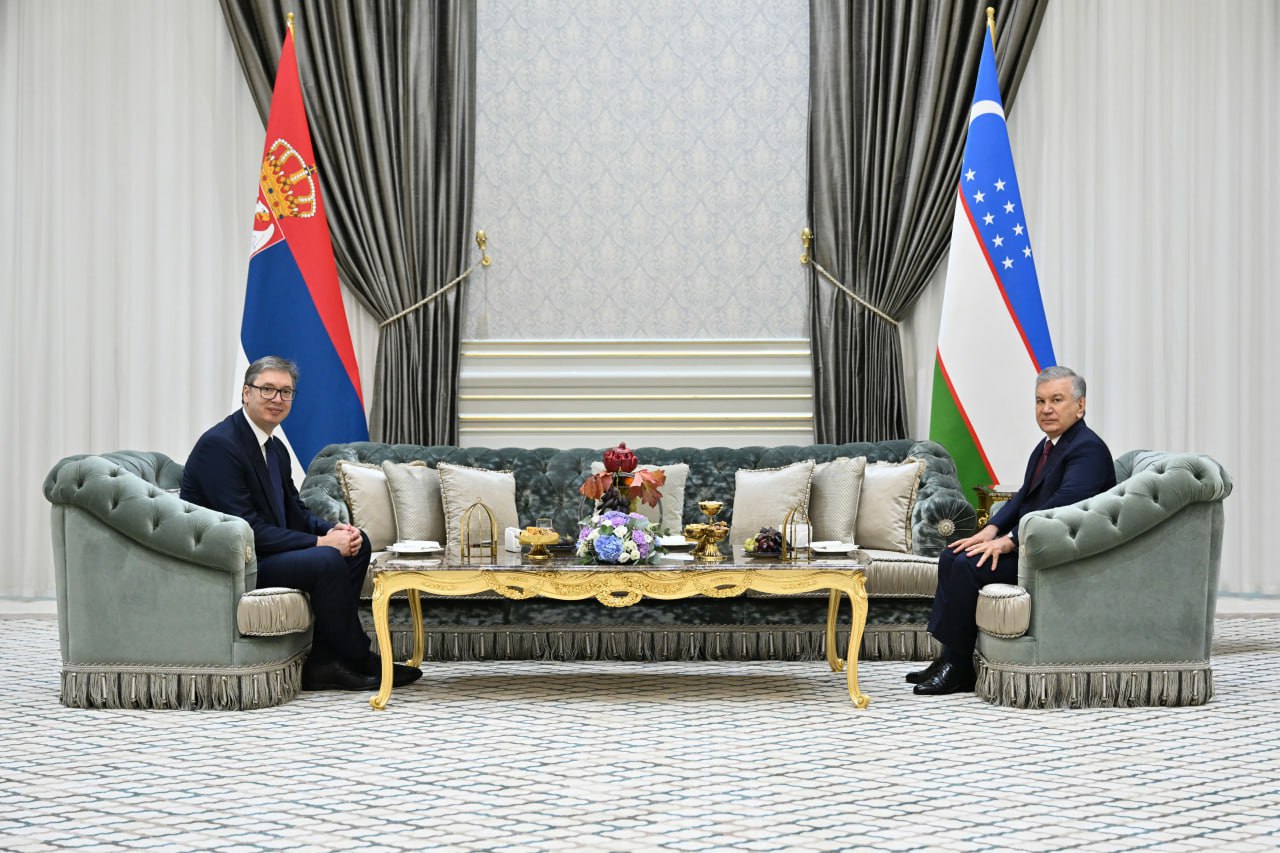
On October 28, 2025, President of Uzbekistan Shavkat Mirziyoyev and President of Serbia Aleksandar Vučić held talks at the Kuksaroy residence with the participation of official delegations.
Another driver is Serbia’s longstanding policy of non-alignment and diverse partnerships. Belgrade has adroitly balanced relations with the EU, U.S., Russia, China, Turkey, and others – a necessity for a small state navigating great-power rivalries. Engaging Central Asia extends this balancing act into a new geography. Crucially, it does so in a manner that complements Western interests rather than conflicting with them. The United States and European Union have launched their own “C5+1” dialogues with Central Asia, aiming to bolster these states’ independence and link them with global markets. Serbia’s outreach aligns with this trend: by helping connect Central Asia to Europe’s energy and transport networks, Serbia indirectly supports Western goals of a more integrated Eurasia that is less dependent on Russia. In short, Serbia’s neutrality and reliability make it an acceptable partner across the geopolitical spectrum, allowing it to insert itself into Central Asia’s evolving dynamics without provoking alarm.
Economically, Serbia’s growing interest in Central Asia comes as both sides seek diversification. Serbia’s economy has been oriented toward the EU (its top trading partner) and heavily reliant on Russian energy. Now Serbia is motivated to diversify its energy imports and export markets to enhance resilience. The Central Asian states, for their part, are diversifying their external ties to attract new investment and reduce overreliance on any single big neighbor. Initial trade volumes are modest, but trends are positive: for example, Serbia’s exports to Uzbekistan more than doubled from 2022 to 2023 (albeit to only around $20 million), and Serbia now enjoys a growing trade surplus with Tashkent. With new cooperation agreements in machinery, chemicals, IT, agriculture, and more, these figures are poised to rise. Similar potential exists with Kazakhstan and Turkmenistan, especially in niche sectors where Serbian know-how (e.g., agricultural machinery or pharmaceuticals) meets Central Asian demand.
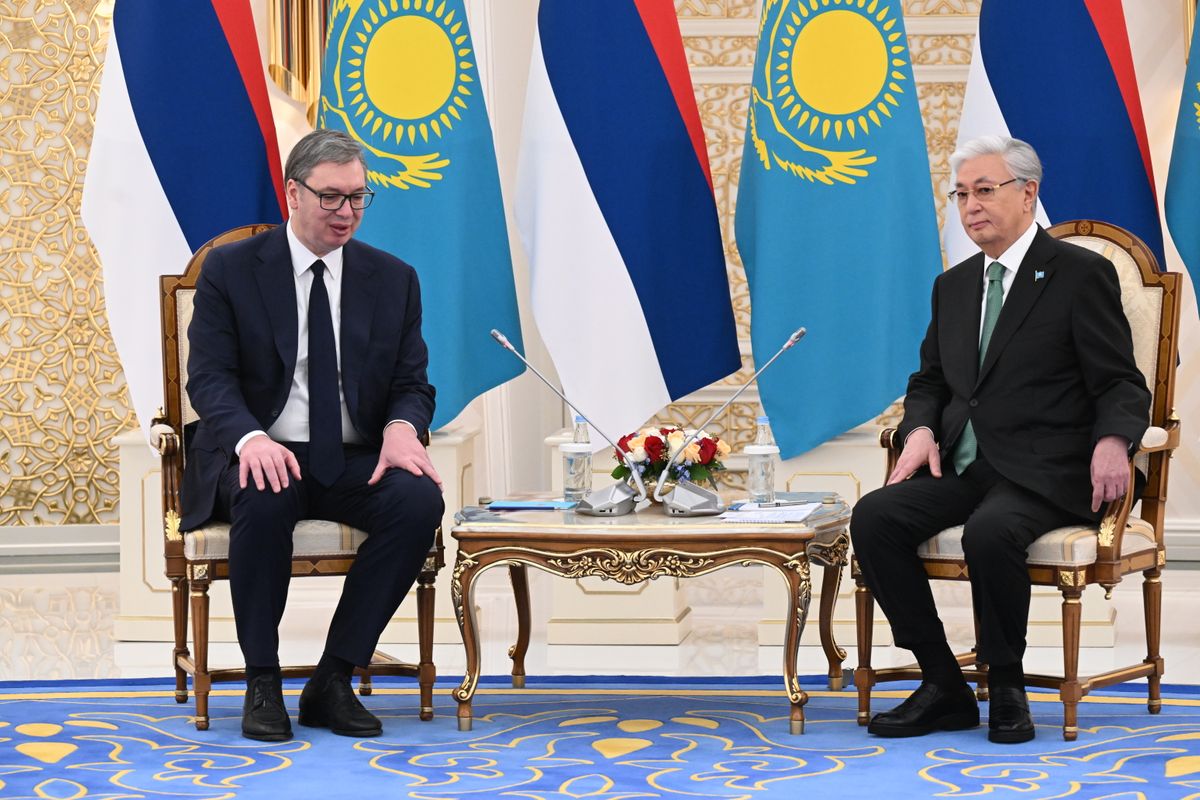
The President of the Republic of Serbia, Aleksandar Vučić, paid a two-day official visit in late February to the Republic of Kazakhstan, during which he was received in Astana with the highest state and military honors.
Finally, the physical connectivity context has evolved to Serbia’s advantage. Major infrastructure projects are knitting Serbia into trans-European corridors, which can extend toward Asia. The EU is financing modern railways from Belgrade toward the Bulgarian border (connecting onward to Turkey), slashing transport times. Air Serbia has been rapidly expanding its flight network eastward – direct routes to Baku and Tbilisi opened in 2023, with a new service to Kazakhstan imminent and plans for a connection to Uzbekistan (Samarkand or Tashkent) under evaluation. These links, alongside Serbia’s Danube river transport and existing road corridors, position the country as a logistical gateway. Central Asian officials have noticed: Kazakhstan’s government explicitly invited Serbia to explore the Trans-Caspian “Middle Corridor” for routing cargo to Europe via Belgrade. In essence, what is emerging is an integrated vision whereby Serbia is not an isolated Balkan endpoint, but a forward base of European engagement reaching into the heart of Asia.

As part of the visit, President Vučić toured a military exhibition at the Besqaru facility, where he was briefed on the achievements of Kazakhstan’s defense industry and the latest technological solutions in the fields of defense and security.
Strategic Multiplier: Why Central Asia Matters for Serbia
Serbia’s engagement with Central Asia is best understood as a strategic multiplier, a deliberate effort to expand national resilience by widening access to energy, markets, and geopolitical options. The underlying logic is simple: by deepening ties with the Central Asian five, Serbia multiplies its room for maneuver in a rapidly fragmenting international system. This is a play for connectivity and relevance. Belgrade is signaling that it intends to be more than a bystander in Eurasia, it aims to be a connector and beneficiary.
At the core of this approach lies pragmatic reciprocity. Serbia gains concrete advantages: diversified energy supplies, new export markets, investment inflows, and diplomatic backing on issues of national importance. In return, it offers Central Asian partners a reliable European gateway and a partnership unburdened by historical baggage. Unlike larger powers, Serbia enters these relationships on an equal footing, emphasizing sovereignty and mutual respect. As one Uzbek assessment observed, cooperation is “based on mutual trust” and increasingly “taking on a strategic character”, a telling indication that both sides see long-term value in the relationship.
Energy security provides the clearest illustration of this two-way strategic depth. For Serbia, reducing dependence on Russian supplies has become urgent; partnerships with Kazakhstan, Azerbaijan, and potentially Turkmenistan offer a practical pathway forward. For Central Asian producers, Serbia represents a stable European entry point and an additional transit option westward. The Serbia–Azerbaijan energy partnership has already integrated Belgrade into Azerbaijan’s export system through gas deliveries and planned green electricity links. Serbia has begun receiving non-Russian natural gas from Azerbaijan since 2024, marking a significant step toward diversification and reducing dependence on a single supplier. President Vučić has described Azerbaijan as a “reliable partner” in Serbia’s energy strategy, underlining the importance of alternative flows even as Russian gas contracts continue. The Caspian pivot thus operates as a win-win: Serbia strengthens its resilience, while Central Asian producers consolidate their European footprint.
Energy: Securing New Sources and Routes
Kazakh oil – a lifeline for Serbia’s refineries. Serbia’s Pančevo refinery long relied on Iraqi and Russian crude, leaving supply routes exposed to geopolitical risks. This began shifting in 2022–2023 as importers turned to Kazakhstan’s oil. By mid-2025, Kazakhstan became the largest supplier of crude to Serbia, accounting for nearly 60% of Serbia’s imports, up from roughly one-third only a few years earlier. The Energy Ministry confirmed that “since the beginning of this year, most crude oil imports have come from Kazakhstan,” noting that NIS sources crude wherever market conditions are favorable. The shift reduced exposure to Middle Eastern routes such as the Strait of Hormuz. Kazakh crude, shipped via the Black Sea or Mediterranean to the Adriatic pipeline system and sold as the sanction-compliant KEBCO blend, provides a safer alternative. When a tanker carrying 1 million barrels of Kazakh crude arrived in Croatia for Serbia in October 2025, it underscored Kazakhstan’s role as Serbia’s oil lifeline.
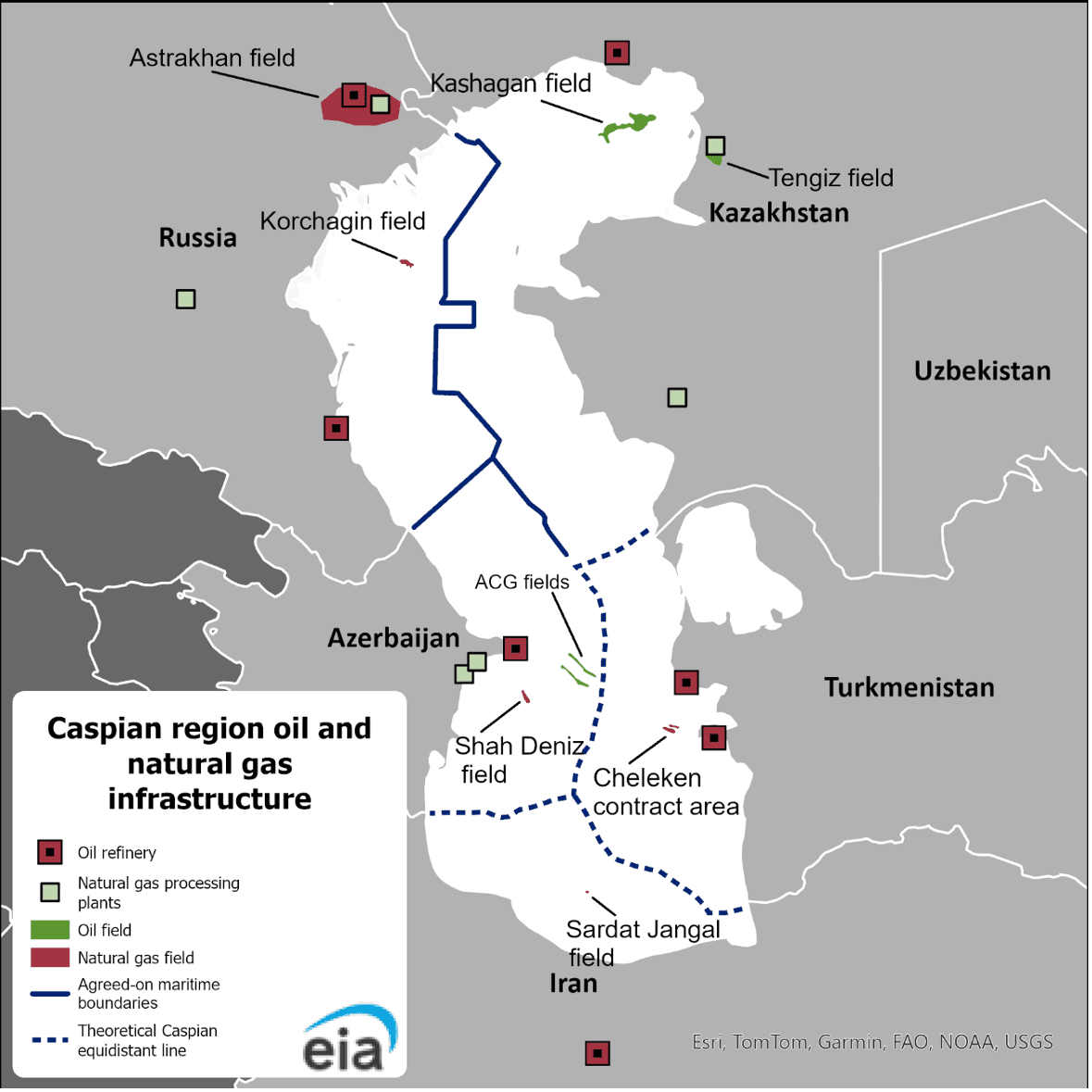
Caspian gas – integrating Serbia into a new supply chain. Serbia’s gas diversification came through Azerbaijan and the Southern Gas Corridor. The Bulgaria–Serbia Gas Interconnector, completed in late 2023, connects Serbia to Azeri gas from Shah Deniz. With 1.8 bcm annual capacity, the pipeline can cover about 60% of Serbia’s gas demand. By January 2024, Azerbaijani gas began flowing to Serbia under a 2023 contract for 400 million m³ annually, marking Serbia’s first access to non-Russian pipeline gas after years of dependence on a TurkStream branch. President Vučić announced imports would double by 2025 and reach full capacity by 2026, effectively making Serbia the Balkan endpoint of the Southern Gas Corridor.
The network may expand further through Turkmenistan’s gas reserves. In August 2023, Turkmenistan signed its first deal to supply gas to an EU country (Hungary), expected at about 1 bcm annually through swaps via Iran and the Azeri-Turkish system. Parallel three-way swaps, delivering Turkmen gas to Iran and onward to Azerbaijan and Turkey, reached about 1.3 bcm in 2025 with potential to rise to 2 bcm per year. These mechanisms gradually integrate Turkmen gas into Europe’s energy system, meaning that future Southern Gas Corridor expansion, or a Trans-Caspian pipeline, could eventually bring Turkmen volumes to Serbia. Even during disruptions, Azerbaijan proved reliable: during a technical outage in early 202,5 it ensured Serbia additional deliveries of 1 million m³ per day through alternative routes.
Beyond oil and gas, Serbia and Central Asian partners are exploring renewable and nuclear cooperation. Kazakhstan, the world’s leading uranium producer with expanding renewables, and Turkmenistan, a major gas exporter with large solar potential, align with Serbia’s interest in modular nuclear reactors and green energy corridors. Serbia has already joined a Green Energy interconnection concept with Azerbaijan to transmit wind power via the Black Sea. Future steps could include Serbian investment in upstream projects such as Kazakh oil fields or joint gas storage with Azerbaijan, alongside Central Asian investment in Serbian refining and petrochemicals, deepening energy interdependence and strengthening Serbia’s long-term energy security.
Serbia’s Geopolitical Balancing Through Central Asia
Partner / Vector | Serbia’s Approach | Strategic Effect |
|---|---|---|
EU / United States | Aligns with Western priorities on energy diversification and trade corridors. EU officials have welcomed the Serbia–Azerbaijan gas link as part of efforts to bring Caspian gas to Europe. Serbia’s participation in forums such as the Indo-Mediterranean connectivity conference in Trieste alongside Central Asian delegations signals contribution to Western-led connectivity initiatives. | Strengthens Serbia’s EU candidacy narrative by positioning Belgrade as a contributor to European energy security and Eurasian connectivity, not merely a beneficiary. |
Russia | Maintains relations while quietly reducing dependence through alternative energy sources and Central Asian partnerships. Serbia avoids sanctions but demonstrates it will not be isolated if Russian supplies are curtailed. Moscow appears tolerant of diversification (including Kazakh oil transiting Russian infrastructure) and has proposed workarounds to keep Serbia supplied. Serbia–Kazakhstan trade under the EAEU framework further cushions tensions. | Gradually lowers Russian leverage without provoking confrontation, preserving political stability while expanding Serbia’s strategic autonomy. |
Türkiye | Builds on improving bilateral ties as Türkiye promotes the Middle Corridor and gas cooperation with Turkmenistan. Serbia’s growing role as a transit point for Turkish goods into Europe creates mutual economic benefit. Ankara has become more openly supportive of Serbian positions, including on Kosovo in some contexts. | Creates a Turkey–Azerbaijan–Serbia connectivity axis that enhances Serbia’s regional standing and embeds Belgrade in Turkic Central Asia outreach rather than competing with it. |
Central Asia (internal dynamics) | Treats all Central Asian states with parity, focusing primarily on Kazakhstan, Uzbekistan, and Turkmenistan while maintaining diplomatic engagement with Kyrgyzstan and Tajikistan. Serbia adopts a neutral, business-first posture and avoids involvement in regional rivalries. As an outsider without imperial legacy, Serbia is viewed as a benign partner. | Builds soft power and trust across the region, positioning Serbia as a neutral European gateway and giving Central Asian states an additional option to balance relations with Russia and China. |
Economic Diversification: Trade, Investment, and Technology
Economic ties underpin Serbia’s Central Asia strategy, linking diplomacy with trade expansion, investment flows, and technology exchange. Although trade volumes remain modest, recent agreements indicate strong growth potential and a push toward diversified economic partnerships.
Trade growth from a low base
Trade with Central Asia has historically been limited but is rising. With Kazakhstan, the region’s largest economy, bilateral trade reached around $100 million, with Serbian exports such as pharmaceuticals, machinery, and food products making up a significant share. Serbia’s Eurasian Economic Union free trade agreement (2021) eliminated many tariffs with Kazakhstan, improving Serbian exporters’ competitiveness. Trade with Uzbekistan remains smaller but is expanding quickly: in 2,023 Serbia’s export surplus with Uzbekistan doubled. The agreements signed in October 2025, covering economic cooperation, investment protection, and an Intergovernmental Commission on Trade, aim to accelerate this growth. Vučić also expressed interest in a future free trade agreement with Uzbekistan. Trade with Turkmenistan remains minimal, but Serbia has identified opportunities in agricultural machinery, seeds, fertilizers, and food exports to Turkmen markets. Connectivity improvements are supporting this expansion, including planned direct flights and simplified visa regimes, with Belgrade–Tashkent flights expected to boost people-to-people exchanges.
Investment and finance partnerships
Investment cooperation is still emerging but gaining momentum. In the technology sector, Serbia and Uzbekistan agreed to establish a $1 million joint venture capital fund supporting Uzbek startups entering Europe and Serbian startups expanding to Central Asia. Plans also include a joint IT enterprise in Serbia to deploy Uzbek digital technologies such as Palm ID, with Uzbekistan offering infrastructure investment and engineers. Larger investments may follow: Kazakhstan’s sovereign wealth structures could target Serbian sectors such as banking or real estate, while Central Asian construction firms may participate in Serbian infrastructure projects. Conversely, Serbian companies could bid on transport and energy infrastructure projects in Kazakhstan or Turkmenistan, reflecting Serbia’s experience in engineering and construction.
Sectoral cooperation and joint ventures
Recent agreements demonstrate broad economic cooperation. With Uzbekistan alone, signed documents cover mechanical engineering, pharmaceuticals, chemicals, IT and digitalization, agriculture, tourism, education, science, and culture, among other areas. These sectors allow for joint production, technology exchange, and market access. Educational and cultural initiatives, including training of diplomatic personnel, reinforce long-term institutional cooperation.
One innovative area is labor mobility. Serbia and Uzbekistan signed a Memorandum on organized labor migration, creating legal channels for Uzbek workers in Serbia. The agreement sets quotas for Uzbek workers, alongside recruitment, training, and social protection mechanisms. This addresses Serbia’s labor shortages while providing employment opportunities for Uzbekistan’s young workforce, replacing informal arrangements that sometimes led to worker exploitation. Serbia thus positions itself as an early European destination for Central Asian labor and talent.
Overall, economic diversification is mutual. Serbia reduces dependence on traditional markets, while Central Asian economies expand partnerships with Europe through Serbia. Joint ventures in technology, manufacturing, and services enable Serbian firms to access Central Asian markets while allowing Central Asian businesses to use Serbia as a gateway to the EU.
Corridors and Connectivity: Linking Eurasia’s Heartland to Europe
Connectivity is the most strategic dimension of Serbia’s engagement with Central Asia. By linking itself to Eurasia’s emerging transport networks, especially the Middle Corridor, Serbia aims to become a gateway between Asia and Europe.
The Middle Corridor and Trans-Caspian route
The Trans-Caspian International Transport Route (TITR), or Middle Corridor, connects China through Central Asia, across the Caspian Sea to Azerbaijan and Georgia, then via Turkey into Europe. During the 3rd Kazakh-Serbian Intergovernmental Commission in Belgrade (September 2024), Kazakhstan’s Deputy Prime Minister Serik Zhumangarin proposed that Serbia explore using the corridor to channel Kazakh and Chinese goods into Europe. With improved logistics, Serbia could receive freight from Central Asia via the Black Sea or Turkey and forward it to EU markets. Air connectivity also plays a role: Kazakhstan already permits 14 passenger flights weekly under an open skies regime, raising the possibility that Serbia could serve as an air cargo hub to Europe.
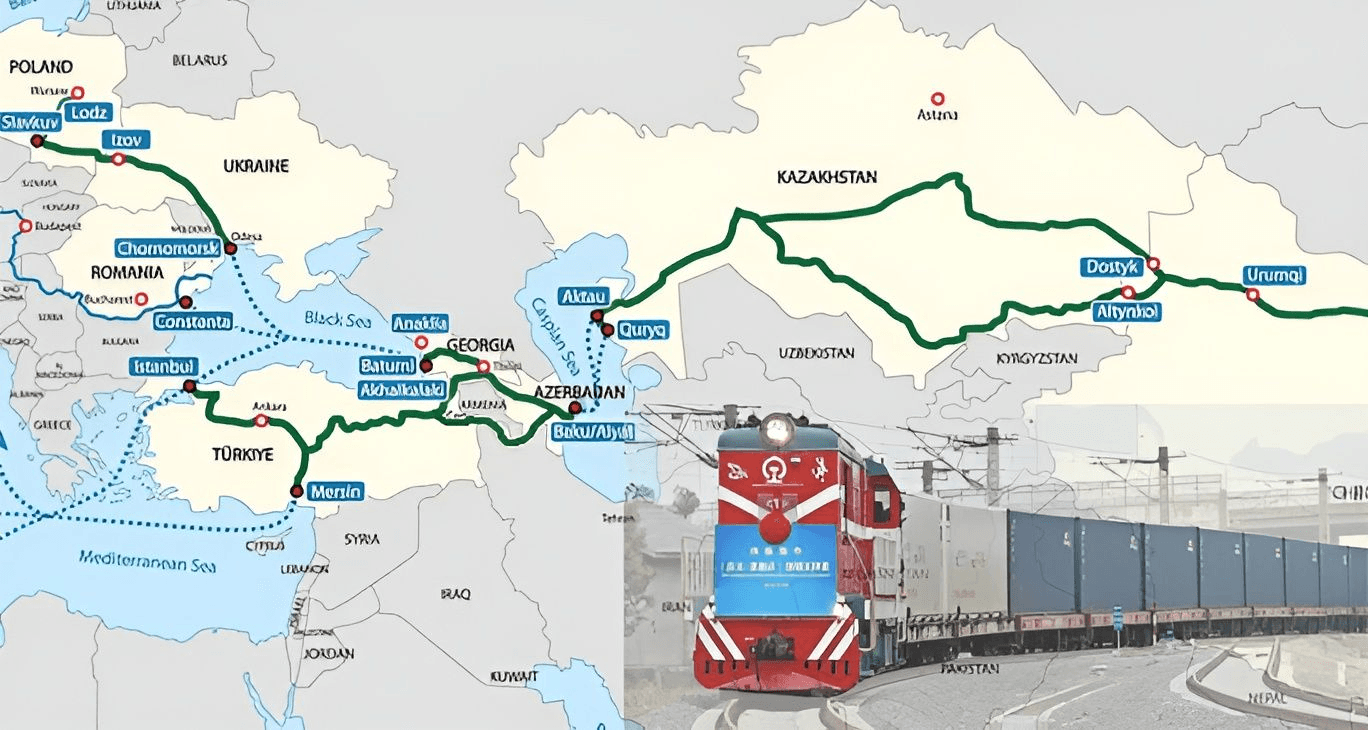
To support this role, Serbia is modernizing its infrastructure. Rail upgrades on Corridor X and electrification of the Niš–Dimitrovgrad railway will facilitate freight from Turkey, while improved highways and logistics networks expand Serbia’s transit capacity. Goods from ports such as Aktau or Baku could reach Western Europe via Belgrade using upgraded rail routes.
Serbia’s position at the intersection of Pan-European corridors VII (Danube), X (north-south rail and road), and VIII (east-west) strengthens its role as a logistics hub. Belgrade is also reconnecting with the Adriatic port of Trieste, which our analysis describes as a gateway to emerging trade routes, including IMEC. By linking Balkan logistics networks with these corridors, Serbia aims to ensure it becomes a central node rather than a peripheral route in future Eurasian trade flows.
Energy and digital corridors
Connectivity also includes energy and digital infrastructure. Serbia has been invited to participate in the Green Energy Corridor, a Black Sea submarine cable project connecting Azerbaijan, Georgia, Romania, and Hungary. Participation would allow Serbia to import renewable electricity from the Caspian region and distribute it across the Balkans. Additional concepts include expanding oil supply routes for Kazakh crude via the Black Sea and Adriatic pipeline system, potentially involving Kazakh investment in storage or pipeline capacity to secure deliveries to Pančevo.
Digital connectivity is emerging as another frontier. Serbia and Uzbekistan’s IT cooperation points toward a digital corridor linking Central Asia and Europe. Joint IT companies and the deployment of Uzbek technologies in Serbia could enable startups and digital services to expand across regions. As Eurasian fiber-optic infrastructure develops, Serbia could become part of new data routes connecting Asia and Europe, strengthening technological and innovation exchanges.
Logistical partnerships and Middle Corridor positioning
Serbia is also building partnerships with Middle Corridor countries in logistics and transport. Serbian companies are exploring cooperation with Kazakh and Azerbaijani logistics firms, while policymakers are considering participation in TRACECA (Transport Corridor Europe-Caucasus-Asia) initiatives. Another proposal involves establishing regional distribution hubs or dry ports in Serbia, where Central Asian goods could be consolidated and forwarded into EU markets. Intergovernmental commissions are also working to simplify customs procedures, with potential MoUs on customs cooperation and transit, reducing administrative barriers to cross-continental trade.
Energy and digital corridors
Connectivity isn’t only about containers and trains; it also encompasses energy and digital flows. Serbia’s role in the evolving “Green Energy Corridor” is one example: Azerbaijan, Georgia, Romania, and Hungary have agreed on a Black Sea submarine cable to transmit Caspian-region electricity to Europe. Serbia, through its Azerbaijan partnership, has been invited to participate in this initiative. If realized, Serbia could import clean energy (wind/solar) from Azerbaijan (and potentially Kazakhstan, which is investing in renewables) and distribute it in the Balkans, effectively extending the energy corridor into its grid. Similarly, Serbia might partake in future oil transport solutions from Central Asia. With Russian routes less reliable, one concept is an oil pipeline or expanded swap to bring Kazakh oil via Azerbaijan/Georgia to the Black Sea, then by tanker to the Adriatic pipeline that feeds Serbia. In fact, discussions are likely in progress on how Serbia can guarantee long-term Kazakh crude supply beyond the current ad hoc shipments, possibly by Kazakhstan buying into storage or pipeline capacity in Croatia/Serbia to secure a corridor for its oil to reach Pancevo. Such an arrangement would make Serbia a fixed node in Kazakh oil exports, deepening interdependence.
On the digital front, the IT cooperation with Uzbekistan reveals a vision of a “digital corridor” between Central Asia and Europe through Serbia. By implementing Uzbek digital solutions (like the Palm ID e-government tool) in Serbia and creating joint IT companies, the two countries are establishing an information highway of sorts. Moreover, knowledge process outsourcing agreements mean that IT talent in Uzbekistan could remotely service European clients via Serbian partnerships. In the big picture, as Central Asia improves internet connectivity (e.g., laying fiber optic cables across Eurasia), Serbia could benefit if data routes from Asia to Europe are diversified (currently many run via Russia or subsea cables). A future where a fiber optic line runs from Azerbaijan to Europe via the Black Sea and Balkans is not far-fetched; Serbia would happily be a landing point. Indeed, digital connectivity was part of the discussions, with projects in digitalization and public service software being shared. By adopting each other’s tech and linking startup ecosystems, Serbia and its partners essentially also connect their innovation corridors.
Logistical partnerships and Middle Corridor positioning
Serbia has actively courted logistical partnerships with Middle Corridor countries. Aside from state-level talks, Serbian logistics companies are exploring cooperation with counterparts in Kazakhstan and Azerbaijan for multimodal transport solutions. There is talk of Serbia joining the TRACECA program (Transport Corridor Europe-Caucasus-Asia), which was an EU-backed initiative including Central Asian and Caucasus states to improve trade routes. While not currently a member, Serbia’s participation as an observer could materialize as it becomes more involved. Another concrete step is the idea of dry ports or logistical hubs: Serbia could host a regional distribution center for Central Asian goods entering Europe. For instance, a hub in Belgrade’s free economic zone could receive bulk shipments (say, Kazakh cotton yarn or Uzbek fruits) and then process and forward them under streamlined customs to the EU. Conversely, European goods bound for Central Asia could consolidate in Serbia before being shipped out via the corridor. The intergovernmental commissions have highlighted the need to simplify customs and transit procedures, expect new MoUs on customs cooperation and transport to be signed, easing the bureaucratic frictions for cross-continental trade.
Strategic Recommendations
The following steps represent the optimal way in which Serbia can maximize such an opportunity:
1. Institutionalize the C5+Serbia Dialogue: Serbia should establish a formal dialogue platform with the five Central Asian states, similar to the US C5+1 framework. An annual Serbia–Central Asia Forum, rotating between Belgrade and regional capitals, would bring together foreign ministers or leaders to coordinate policy and review progress. Supporting working groups on energy, trade, and cultural cooperation should meet regularly to ensure implementation.
2. Expand Diplomatic Footprint: Belgrade should strengthen its diplomatic presence in the region. Opening a resident Serbian Embassy in Tashkent would be a priority, while Kazakhstan’s importance justifies considering a diplomatic presence in Astana or Almaty. At the same time, Serbia should encourage Central Asian states to open or upgrade embassies in Belgrade and appoint a Special Envoy for Central Asia to coordinate policy across ministries.
3. Leverage Multilateral and Western Support: Serbia should align its Central Asia strategy with broader international initiatives. Participation in projects linked to the EU Global Gateway could help finance transport and digital infrastructure connecting the region with Serbia. Cooperation with Turkey and Azerbaijan as transit partners is also crucial, including possible trilateral transport initiatives. Quiet engagement with the United States on the Middle Corridor infrastructure could further strengthen Serbia’s role in Eurasian connectivity.
4. Execute Flagship Connectivity Projects: Belgrade should prioritize a few flagship initiatives that visibly connect Serbia with Central Asia. These could include launching direct flights between Belgrade and Tashkent (or Samarkand), establishing a logistics hub in Serbia for Central Asian trade, and opening a Serbia–Uzbekistan technology innovation center in Belgrade. Visible projects create credibility and demonstrate the practical value of the partnership.
5. Strengthen Energy Infrastructure and Agreements: Energy cooperation should be reinforced through long-term supply agreements and joint investments. Serbia should secure stable crude oil deliveries from Kazakhstan and explore joint storage or refinery cooperation. On the gas side, Belgrade should coordinate with Azerbaijan and Turkmenistan to access future volumes if Turkmen swap flows expand beyond 2 bcm annually through the Southern Gas Corridor. Participation in infrastructure projects, such as TANAP or Aegean LNG terminals, would further enhance supply security.
6. Deepen Defense and Military-Industrial Cooperation: Serbia should institutionalize cooperation in the defense industry with Kazakhstan and Uzbekistan. This could include working groups on military technology cooperation, joint production, and modernization of legacy Soviet-era equipment. Opportunities exist in areas such as UAV systems, ammunition production, and armored vehicle upgrades, while regular participation in defense exhibitions and joint ventures would build long-term strategic ties.
7. Promote People-to-People Links: Sustainable partnerships require deeper societal connections. Serbia should expand scholarship programs, student exchanges, and research cooperation with Central Asian universities. Cultural diplomacy initiatives such as “Serbia Week” in Tashkent or “Central Asia Week” in Belgrade would raise awareness and support tourism and business exchanges. Facilitating visa-free travel and direct flights would further strengthen these links.
8. Monitor and Mitigate Risks: Given geopolitical and logistical risks, Serbia should establish joint coordination mechanisms with partners. Energy security working groups could manage supply disruptions, while customs and transit cooperation can reduce bottlenecks along the Middle Corridor. Preparing contingency plans for scenarios such as sanctions or political instability will help ensure resilience.
9. Communicate Success Stories: Finally, Serbia should actively promote the achievements of its Central Asia engagement. Publicizing milestones, new trade flows, infrastructure projects, or joint ventures will strengthen domestic support and attract investors. Presenting Serbia as a “Eurasian connector” between Central Asia and Europe can enhance the country’s international profile and strategic relevance.4
Other Analysis

Read time:
20
min
Sep 17, 2026
text
Why the USA and Serbia Need a Tax Treaty?
How a tax treaty and totalization agreement can deepen the growing U.S.–Serbia economic partnership.
Read time:
45
min
Sep 10, 2026
text
Silence Is Not Safety: Rights Before Politics in Kosovo
Rights Before Politics: Protecting the Serbian Community and Religious Heritage in Kosovo

Read time:
4
min
Aug 25, 2026
text
Membership Without Benefits: Serbia’s Place in WAICO
Why Serbia’s WAICO membership creates alignment risks, with no clear economic or strategic benefits.