Vuk Velebit, Aleksa Jovanović
The India–Serbia–Israel Triangle: An Engineering Partnership for European Markets
India, Serbia, and Israel are building a new industrial bridge to European markets.
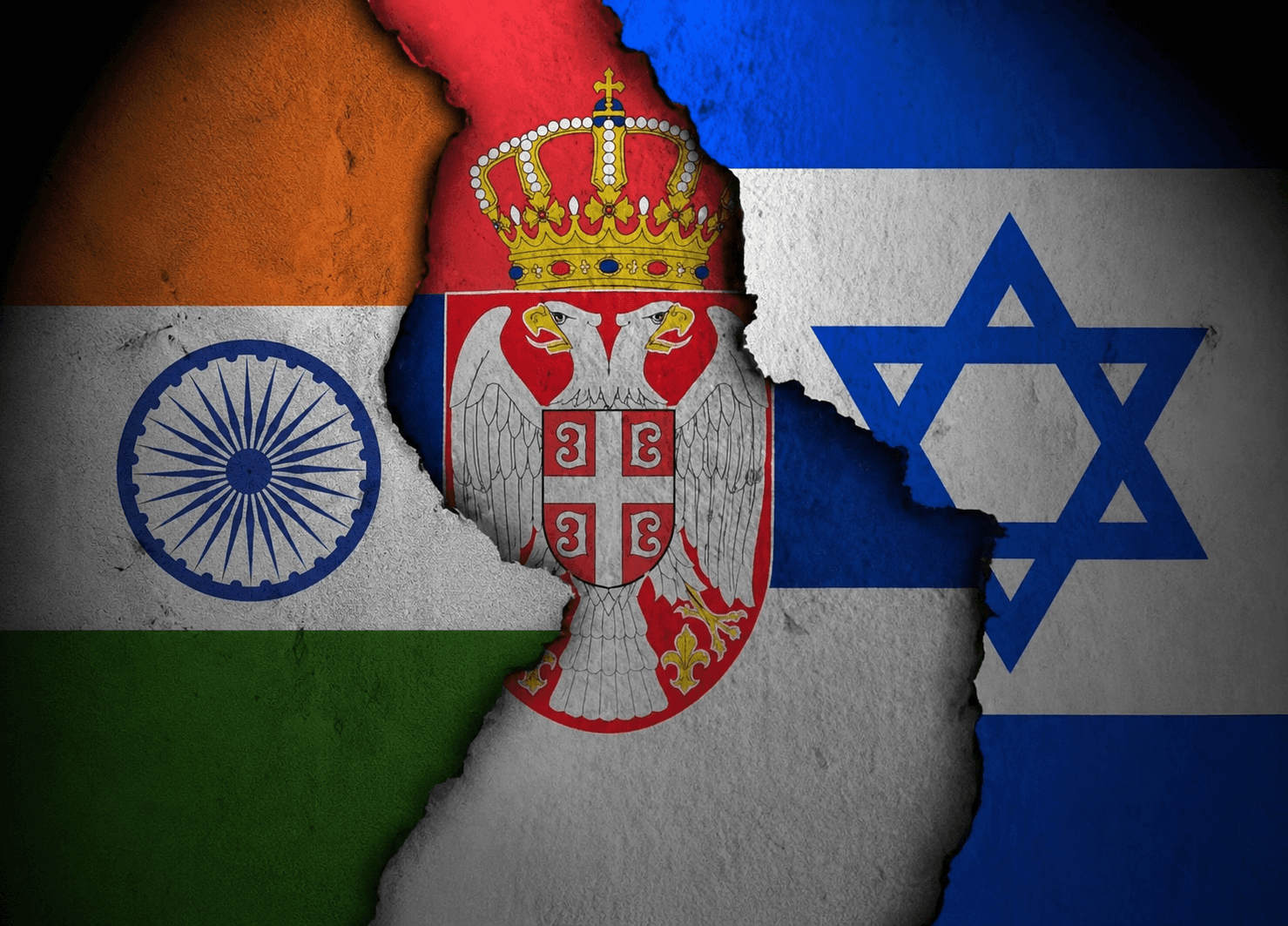
(Conceptual architecture for a trilateral industrial alliance built on innovation, scale, and near-market production)
The European Demand Signal
Any serious analysis of this trilateral concept must begin not with the supply side, the capabilities of the three partner economies, but with the demand side: what European industrial buyers and policymakers are actually seeking. The answer, in 2026, is increasingly clear. Europe wants more resilient supply chains, shorter logistics cycles, and reduced single-source dependencies in strategic sectors. The language of "nearshoring," "friendshoring," and diversification has moved from op-ed pages into binding legislation.
The most instructive institutional signal is the European Chips Act, whose explicit objectives include reinforcing the European semiconductor ecosystem, improving supply chain resilience, and reducing external dependency. This is not a niche procurement preference, it is a structural reorientation of European industrial policy with billions in public support attached. The logic it embodies extends far beyond semiconductors: in automotive components, industrial automation, medical devices, and defence-adjacent electronics, European buyers and supply chain architects are applying similar heuristics.
What this means in practice is that the pathway into European value chains in 2026 is not primarily about possessing the lowest cost or the most advanced technology in isolation. It is about demonstrating four things simultaneously: competitive unit economics, predictable quality and certification, short logistics and service cycles, and regulatory alignment, whether that means EU AI Act compliance, dual-use export controls under Regulation 2021/821, or medical device standards under the Medical Device Regulation (EU) 2017/745. Regulatory discipline, in other words, has become a market access condition, not a bureaucratic afterthought.
It is precisely this four-dimensional demand that the trilateral model is designed to meet. No single economy among the three can satisfy it alone. Together, the argument runs, they can. The following sections examine the factual basis for each partner's contribution.
"The bridge into European value chains is not just technology, it is manufacturing discipline and regulatory alignment."
Three Complementary Industrial Profiles
Israel: The Innovation Anchor
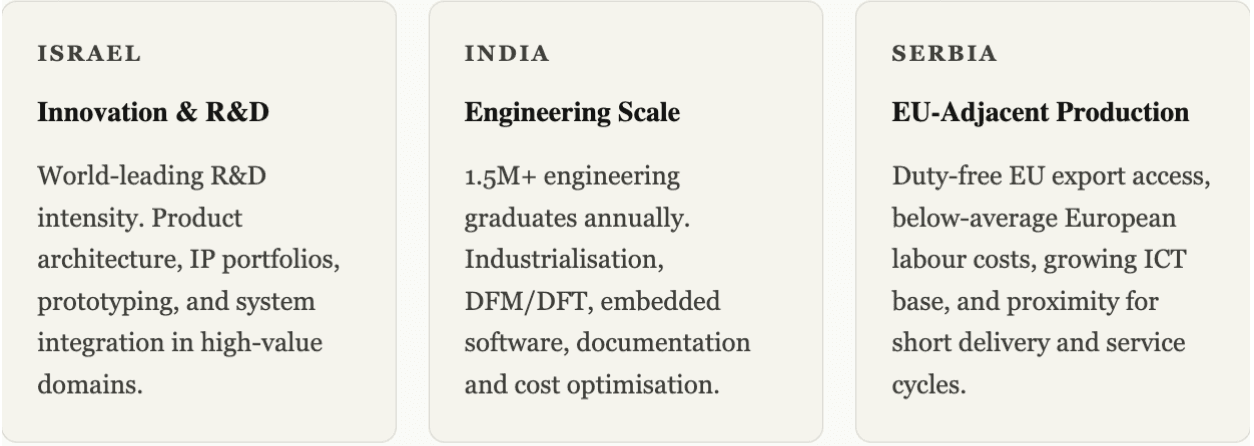
Israel's position as the partnership's research and development anchor rests on verifiable data rather than reputation alone. According to the Israeli Central Bureau of Statistics, national expenditure on civilian R&D as a share of GDP reached 6.1% in 2022, among the highest levels recorded globally. The OECD's 2025 Economic Survey of Israel corroborates this with a gross domestic expenditure on R&D figure of 5.6% of GDP for 2021, extraordinary by international comparison when the OECD average hovers near 2.7%. The World Bank consistently places Israel at or near the top of its R&D expenditure rankings across available years.
The Global Innovation Index 2025, published by the World Intellectual Property Organisation, places Israel among global leaders in innovation, ranked approximately 14th globally, with top-tier scores across R&D intensity and venture capital activity indicators. In the specific domains most relevant to this partnership, embedded systems, cybersecurity, agritech, medical devices, and industrial sensors, Israeli companies and research institutions carry genuine global standing built over decades.
The practical implication for partnership architecture is direct: Israel is the natural carrier of applied R&D, product architecture, IP portfolio development, prototyping, and product-market fit validation in sectors where value is generated not on a production line but in design, algorithm development, and systems integration. Israeli partners would define the product, own or co-own the core intellectual property, and determine the technical specifications that cascade downstream to engineering and production partners.
India: The Engineering Engine
India's contribution to the partnership is not simply a matter of labour volume, though that dimension is relevant. The IndiaAI portal reports that India produces over 1.5 million engineering graduates annually, a figure corroborated by Forbes India analysis and consistent with AICTE data showing approximately 1.49 million approved B.Tech seats for 2024–25. This is not merely a workforce statistic, it represents a deep talent pipeline for embedded systems, firmware, product documentation, and design-for-manufacture optimisation.
Equally significant is India's industrial policy orientation. The India Semiconductor Mission (ISM) offers fiscal support of up to 50% of project cost on a pari-passu basis for the establishment of semiconductor fabs, with separate schemes for display manufacturing and advanced packaging, assembly, testing, marking, and packaging (ATMP) facilities. The ISM 2.0 programme announced in 2026 extends and deepens these incentives, with specific focus on strengthening the design ecosystem and component-level manufacturing. This institutional backdrop means that Indian partners can bring not only engineering capacity but subsidised industrialisation infrastructure to the partnership.
India's role in the trilateral model is the industrialisation of design: translating Israeli-developed concepts and prototypes into manufacturable, scalable products through rigorous design-for-manufacture and design-for-test engineering, software and firmware development, documentation, and, for larger volume programmes, full-scale production at competitive cost.
Serbia: The European Gateway
Serbia's value in this construct is frequently mischaracterised as a simple cost arbitrage play. That is an incomplete and ultimately unstrategic reading. While labour cost differentials are real, Eurostat data for 2024 shows average hourly labour costs in the EU at €33.5, with Serbian wages substantially below even the lowest EU member state figure based on Serbian Statistical Office December 2024 data showing average net wages of 108,312 RSD, they are a single element of a more complex value proposition.
The more structurally significant advantage is Serbia's trade architecture with the EU. As documented by the EU Delegation in Serbia, Serbian manufacturers have exported effectively duty-free to the EU since 2000, with the European Union accounting for approximately 59% of Serbia's total trade in recent years. The legal foundation is the Stabilisation and Association Agreement (SAA), which provides the framework for progressive tariff elimination and the creation of a free trade area between Serbia and the EU.
Complementing this are Serbia's growing ICT capabilities. According to official Serbian government reporting, ICT services and product exports reached €3.44 billion in 2023, with continued record growth through 2024. This software and embedded systems base, already oriented toward European clients, is precisely the competency that the trilateral model needs in its Serbian node, not merely assembly capacity but genuine engineering talent capable of handling product integration, validation, and documentation to European regulatory standards.
Sector-Specific Fit Analysis
The partnership concept is most credible when grounded in specific sectors rather than stated at an abstract level of "complementarity." The following assessment identifies the domains where the trilateral division of advantages translates most directly into commercially viable products and programs.
Area | Explanation |
|---|---|
Industrial automation & advanced manufacturing | European manufacturers require local suppliers able to deliver subsystems, spare parts, and service in short cycles. The trilateral model maps cleanly: Israeli-developed process optimisation algorithms and sensor systems; Indian-engineered embedded electronics and firmware; Serbian-based integration, subsystem manufacturing, cabling, testing, and local service delivery. |
Semiconductor components & packaging | The realistic near-term entry point is not front-end fabs but components, ATMP packaging, test equipment, power supplies, sensors, and subsystems. India’s ISM explicitly covers packaging/ATMP and sensor manufacturing with significant fiscal support, while the European Chips Act signals sustained demand for regionally resilient supply. Target niches include PCB assemblies for industrial and transport applications, edge computing gateway devices, and test fixtures. |
Medical devices & bio-engineering | European market access for medical equipment requires strict adherence to MDR (EU) 2017/745. The rational partnership division is: Israeli prototyping and clinical concept development; Indian engineering elaboration, scaling, and documentation; Serbian quality management systems, manufacturing under QMS, and preparation for conformity assessment and harmonised standards audits. Medical devices represent the strongest case for Serbia to position itself as a value-added engineering hub rather than a low-cost assembler. |
Agritech & water technology | Israeli institutions carry well-documented expertise in precision irrigation, water network optimisation, and agricultural sensing systems. The partnership model here centres on modular system design: smart irrigation combined with sensor networks and cloud platforms (Israeli design), mass adoption and production scaling (Indian side), and demonstration farms, regional manufacturing, and European export logistics (Serbian side). Water scarcity pressures across Southern and Central Europe make this category particularly timely. |
AI, embedded systems & software | The EU AI Act introduces risk-based obligations, particularly for high-risk applications, covering data governance, risk management documentation, transparency requirements, and post-market monitoring. Products must be designed with these obligations embedded from the outset. Serbia’s existing ICT export base provides a foundation for embedded and software engineering capacity; Israeli R&D provides the core algorithms and system architecture; Indian engineering industrialises the full-stack solution at scale. |
Dual-use & defence-adjacent engineering | This domain carries the highest value but also the strictest regulatory requirements. EU dual-use export controls under Regulation 2021/821 impose rigorous obligations on classification, end-user verification, and brokering activities. Any partnership activity in this space must treat compliance as a structural element of the product architecture, not a legal opinion obtained on request. Focus should be on dual-use components with clear civilian applications, such as communications and sensing subsystems, that can enter European value chains as standardised civilian systems. |
Industrial Architecture: The Design–Engineer–Build Model
The most realistic institutional form for the trilateral partnership is not a single integrated company but a consortium architecture: multiple firms and institutions with clearly defined responsibility boundaries, an explicit IP regime, shared quality standards, and contractual interoperability. The single-entity model introduces coordination complexity and jurisdictional ambiguity that would likely collapse the arrangement before it generates revenue.
The underlying operational logic follows a Design–Engineer–Build division. The Israeli partner defines the product, develops the core intellectual property, architects the system, and validates product-market fit. The Indian partner industrialises the design: DFM/DFT engineering, firmware and software development, documentation to ISO or IEC standards, and production scaling supported by ISM fiscal incentives. The Serbian partner operates the near-market node: pilot production lines, assembly, testing, validation, and European customer deliveries with short logistics cycles, leveraging the SAA trade framework and the Pan-Euro-Mediterranean (PEM) Convention on cumulation of origin.
A key feature of this architecture is its modularity. The production locus can be shifted between Serbia (for European-proximity, regulatory-sensitive, or short-cycle programmes) and India (for higher-volume, cost-optimised runs with longer logistics tolerance) depending on series size, customer requirements, and programme timelines. This flexibility is a structural competitive advantage rather than a design compromise.
The PEM Convention deserves particular attention because it directly determines whether products manufactured in Serbia qualify for preferential tariff treatment when entering EU markets. The convention enables diagonal cumulation of origin across EU and Western Balkan territories, meaning that components sourced from India or Israel can, under certain conditions, be incorporated into Serbian-manufactured products that qualify for preferential EU access, provided "sufficient transformation" criteria are met. Any supply chain design must therefore incorporate rules-of-origin analysis from the earliest planning stages, not as a post-hoc legal check.
"The production locus can shift between Serbia and India depending on series size, customer requirements, and logistics tolerance, structural flexibility, not design compromise."
Talent Mobility and the EU–India Skills Corridor
The partnership's human capital dimension is supported by an existing, if underutilised, institutional framework. The Common Agenda on Migration and Mobility (CAMM), signed between India and EU member states in 2016, established objectives including improved management of regular migration, facilitation of student and researcher mobility, and alignment with labour market needs and skills availability. The European Commission's DG HOME explicitly notes that the EU–India strategic roadmap emphasises efforts to facilitate movement of students, researchers, and professionals. Practical programmes addressing skills and mobility, including the EU–India Initiative in Skilling and Mobility for the ICT Sector, developed with ILO involvement, have operationalised some of these commitments.
Serbia is not a party to the EU–India CAMM framework and cannot automatically benefit from it. However, there is a realistic and commercially logical path to positioning Serbia as a complementary node in these talent flows. Three instruments are particularly relevant. First, streamlined residence and work permit procedures for highly skilled engineers from India and Israel under Serbian domestic law, tied to documented employment in certified production facilities or test laboratories, reducing the administrative friction that currently deters short- and medium-term technical assignments. Second, certification and training programmes aligned with European regulatory requirements, particularly in quality management, conformity assessment, AI documentation, and medical device standards, that produce portable competencies relevant across European supply chains. Third, structured university-industry partnerships that generate demonstrable engineering competencies: accredited test laboratories, industrial internship pipelines, and co-developed curricula in embedded systems, firmware, and regulatory engineering. Serbia's existing ICT export base demonstrates that the talent and institutional foundations for this are already partially in place.
Risk Architecture and Compliance Framework
Trilateral industrial partnerships of this type face predictable failure modes that must be addressed structurally rather than left to contractual improvisation. The following four risks represent the most consequential points of potential collapse.
Intellectual property governance is the most immediate and most frequently underestimated risk. Without a rigorous foreground/background IP agreement in place before joint development commences, the partnership is likely to fracture at the point of commercialisation, precisely when it has generated something worth fighting over. Israeli partners, who typically contribute the highest-value IP, are accustomed to sophisticated licensing structures; Indian and Serbian partners may not be, and asymmetric expectations produce disputes. The IP architecture must be designed in parallel with the commercial architecture, not deferred.
Export control and dual-use compliance represents a distinct category of institutional risk. The EU's Regulation 2021/821 governing dual-use items is not self-executing, it requires organisations operating in potentially controlled domains to develop and maintain internal compliance programmes, classify products against control list annexes, screen end users, and manage brokering and transit activities. The cost of getting this wrong, in the form of export licence denial, reputational damage, or regulatory sanction, is far higher than the cost of building compliance infrastructure from the outset.
EU regulatory compliance for AI and medical applications is a third structural requirement. The AI Act and the MDR both impose design-phase obligations, not just market-access documentation requirements, that affect architecture decisions made early in the product development cycle. Building a product and then attempting to reverse-engineer regulatory compliance is technically possible but commercially expensive and often results in delayed or denied market access.
Rules of origin and trade treatment, as discussed above, is the fourth area requiring front-end design attention. The preferential tariff benefits that make Serbian-based manufacturing commercially attractive depend on meeting specific origin criteria, and those criteria are determined by supply chain design choices made in the engineering phase. A supply chain optimised for cost without regard for rules of origin may produce goods that forfeit the preferential treatment that justified the Serbian production node in the first place.
A Phased Commercial Roadmap
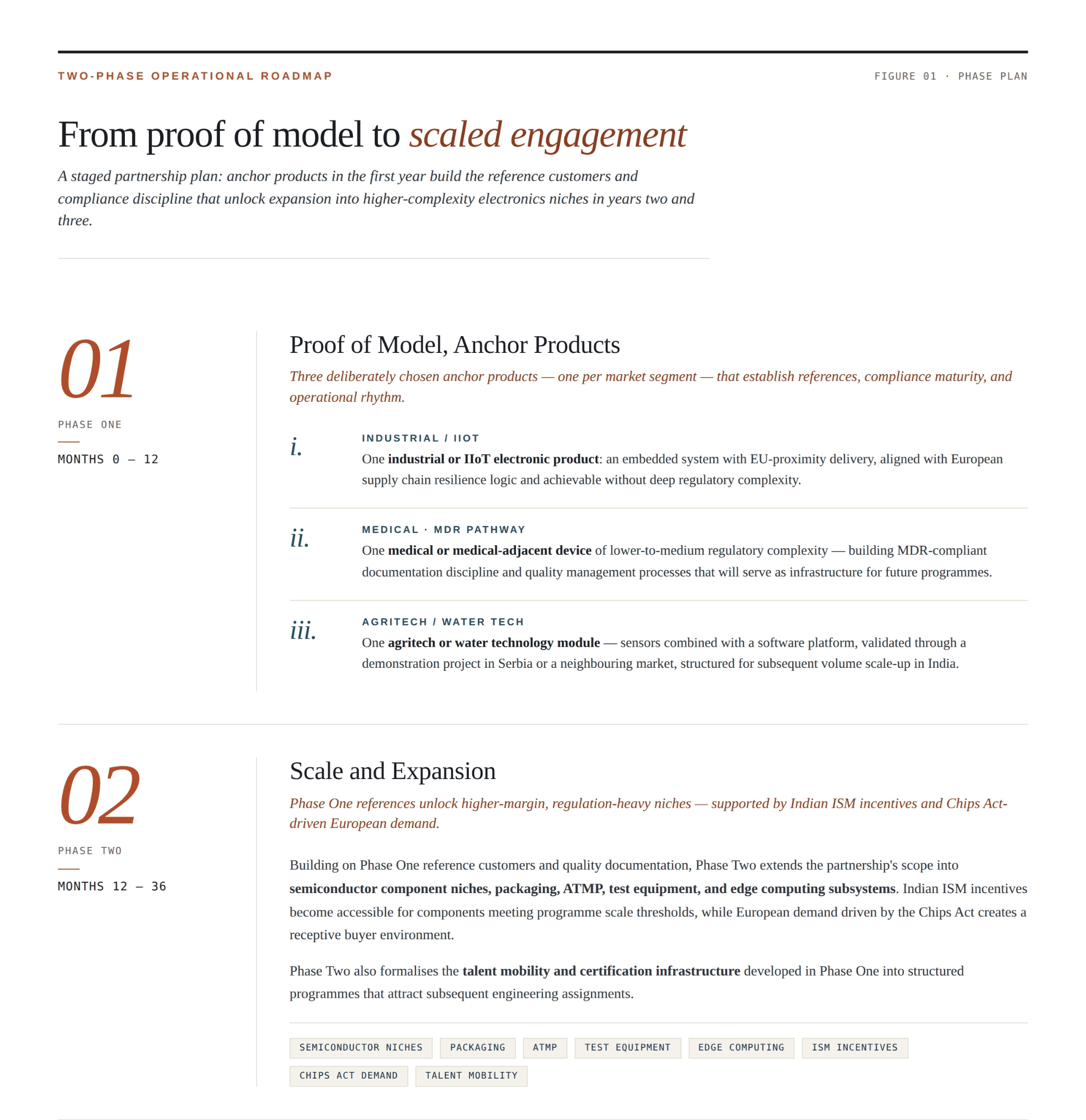
The partnership concept is commercially strongest when initiated through a small number of anchor products rather than spread simultaneously across all six sector categories identified above. Attempting to build presence in ten domains at once produces shallow engagement in each and fails to generate the reference customers and quality track record that European buyers require before scaling commitments. The recommended approach concentrates initial resources on two to three anchor programmes, proves the model, and expands from a position of demonstrated competence.
Serbia's Strategic Interest: From Gateway to Hub
The distinction between Serbia functioning as an export gateway and Serbia functioning as an engineering hub is not merely semantic, it determines the economic quality and durability of Serbia's participation in this model. A gateway role implies that Serbian value-add is limited to geographic position and trade architecture: components arrive, minimal processing occurs, and goods depart under preferential tariff treatment. This role is commercially replicable and strategically fragile.
An engineering hub role, by contrast, means that Serbian facilities perform test, validation, quality management, embedded integration, compliance documentation, and technical service, activities that require genuine competency, generate higher-wage employment, build institutional knowledge, and create switching costs that make the Serbian node difficult to replace. The ICT export figures, €3.44 billion in 2023 with continued growth through 2024, demonstrate that Serbian engineering talent is already operating at a level of sophistication that supports this more demanding role.
For Serbia, the strategic case is straightforward. The partnership, if structured as proposed, generates more engineering employment with higher value-added than pure assembly, deepens integration into European value chains that already dominate Serbian trade and investment, and builds the certification infrastructure and laboratory capacity that will attract subsequent programmes from both Indian and Israeli partners. The Pupin Initiative framing, referencing Mihajlo Pupin's synthesis of Serbian intellectual tradition with world-class applied science, is apt precisely because this model asks Serbia to contribute engineering rigour and regulatory discipline, not just geography and cost.
Conclusion
The India–Serbia–Israel trilateral partnership concept rests on a factual foundation of complementary industrial profiles meeting a real and growing European demand signal. Israeli R&D intensity, documented at globally exceptional levels, provides the innovation and IP anchor. Indian engineering scale, supported by explicit industrial policy for electronics and semiconductor manufacturing, provides the industrialisation and production infrastructure. Serbian EU trade architecture, growing ICT competency, and geographic proximity provide the near-market node that European supply chain architects are actively seeking.
The concept is not an abstraction. It maps onto specific sectors, industrial automation, electronic components, medical devices, agritech, AI-embedded systems, where the trilateral division of function produces commercially viable products that no single partner economy could bring to European buyers alone. The institutional risks, IP governance, export control compliance, regulatory alignment, and rules-of-origin design, are real but manageable with front-end structural investment.
The partnership will be strongest when it treats compliance not as a cost of market access but as a competitive differentiator: the thing that separates a credible European supply chain partner from a vendor that European buyers would prefer to avoid. That reframing, from compliance as burden to compliance as capability, is the central strategic insight that should guide the partnership's design from its first working session.
Other Analysis

Read time:
20
min
Sep 17, 2026
text
Why the USA and Serbia Need a Tax Treaty?
How a tax treaty and totalization agreement can deepen the growing U.S.–Serbia economic partnership.

Read time:
45
min
Sep 10, 2026
text
Silence Is Not Safety: Rights Before Politics in Kosovo
Rights Before Politics: Protecting the Serbian Community and Religious Heritage in Kosovo

Read time:
4
min
Aug 25, 2026
text
Membership Without Benefits: Serbia’s Place in WAICO
Why Serbia’s WAICO membership creates alignment risks, with no clear economic or strategic benefits.