Vuk Velebit
The Open Space Serbia Can Build
How Serbia can turn its CEFTA strength into shared corridors connecting the Balkans to wider Europe?

Serbia's CEFTA surplus proves its regional economic weight. The larger opportunity is to turn that weight into shared infrastructure – and become a catalyst connecting the Western Balkans with the Danube, the Carpathians and wider Europe.

*Trade figures: SORS. Border-hours estimate cited by the CEFTA Secretariat. Goods trade only.
Economic weight is not yet strategy
In the first half of 2026, Serbia exported EUR 2.37 billion in goods to its CEFTA partners and imported EUR 782 million, producing a surplus of EUR 1.59 billion. For every euro of goods it bought from the region, it sold more than three. In 2025, the surplus approached EUR 3 billion. After the European Union, CEFTA is Serbia's second-most important trading group and the nearby market in which its productive strength is most clearly visible.
These are not the figures of a peripheral economy. Serbia's strongest export positions extend across cereals and beverages, road vehicles, pharmaceuticals, medical products and electrical machinery. This is not dependence on a single commodity, but a supply base that combines agriculture, consumer goods and mid-tier manufacturing. Serbia's influence in the Western Balkans is therefore not only a political claim or a consequence of its size. It is reflected in what the country produces and supplies to the economies around it.
A like-for-like monthly comparison adds an important qualification. In the first half of 2026, CEFTA exports averaged EUR 395.1 million per month, 2.9% below the 2025 monthly average, while imports were 18.6% lower. The monthly surplus still increased by 7.4%. The coverage ratio above 300% therefore reflects a persistent regional advantage, but not a new export surge.
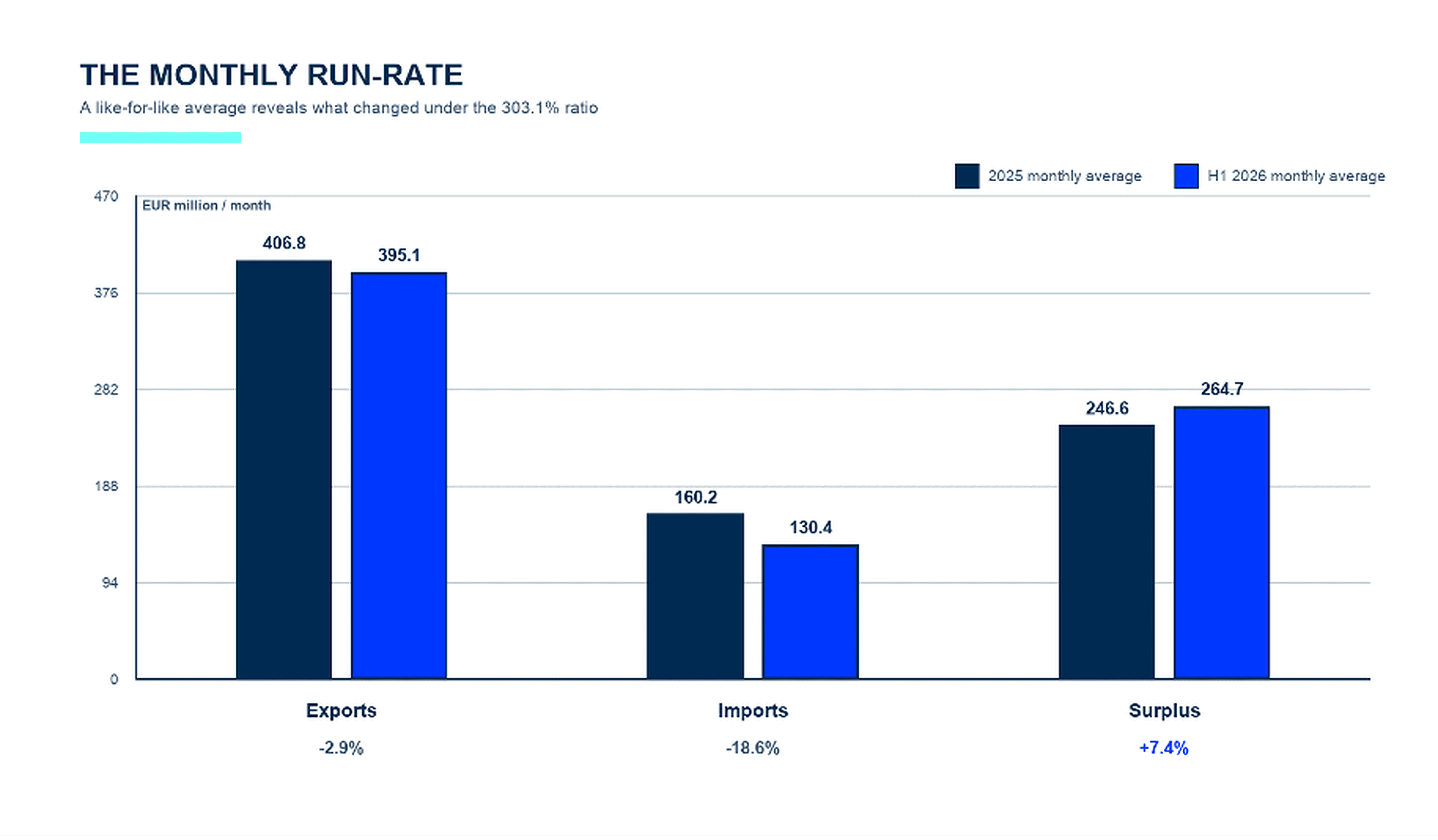
Figure 1. The monthly run-rate explains the higher coverage ratio. EUR millions per month. H1 2026 compared with the 2025 monthly average. Seasonality means the H1 run-rate is not a full-year forecast. Source: SORS; author calculations.
Yet a surplus is not a strategy. If regional integration means only that one country sells more finished goods to its neighbours, Serbia may lead the ledger without changing the economy around it. Persistent imbalance can generate dependence and resistance as easily as influence. The more valuable move is to convert Serbia's existing advantage into shared economic infrastructure: faster borders, reliable corridors, regional supply chains and a market in which firms from neighbouring economies can also produce, invest and grow.
That is the difference between being the largest economy in a region and becoming its catalyst. A leader occupies the centre; a catalyst expands what is possible for everyone connected to it.
From free trade to a working market
Seen this way, CEFTA and Open Balkan are not rival diplomatic projects. They perform different functions within the same integration process. CEFTA supplies the broad legal foundation for regional trade in goods. Open Balkan attempts to deepen in practice what free-trade agreements establish in principle.
The remaining barriers are increasingly found beyond tariffs. They are measured in waiting times at border crossings, duplicated inspections, certificates that are not automatically recognised, incompatible data systems and delivery schedules that firms cannot predict. For a large exporter, these frictions raise costs. For a small company entering a neighbouring market for the first time, they can determine whether exporting is commercially viable at all.
The scale of the problem is measurable. At a 2024 meeting published by the CEFTA Secretariat, regional officials cited estimates of more than 20 million hours lost annually at Western Balkan crossing points, at a cost of around EUR 300 million. CEFTA also reported that Green Lanes and the SEED electronic data-exchange system reduced average waiting time by seven minutes per truck in 2023 compared with 2022. Separately, eleven planned crossing-point projects developed by the Transport Community and CEFTA could reduce waiting times by up to 70% once fully implemented. The distinction matters: seven minutes is an observed result; 70% is prospective project potential.
World Bank modelling points to the larger economic prize. Average border waiting times in the Western Balkans are around three hours longer than in high-income OECD economies. Reducing that gap through coordinated trade and transport reforms could generate welfare gains of approximately 2% for Serbia over the medium term. This is a scenario rather than a forecast, but it demonstrates how strongly time and predictability affect economic performance.
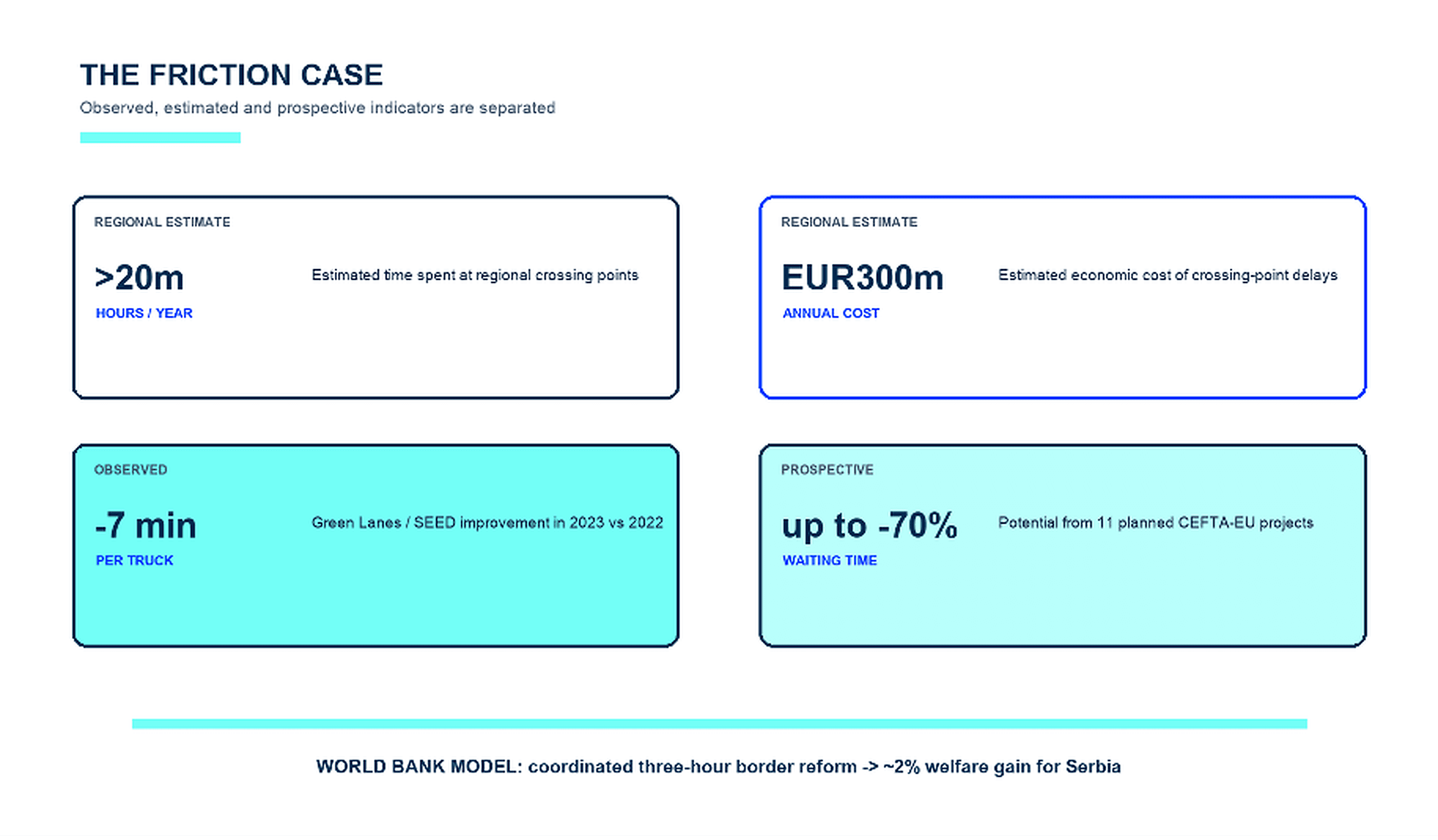
Figure 2. The economic case for implementation. Observed results, regional estimates and modelled or prospective gains are labelled separately. Sources: CEFTA Secretariat and World Bank.
Open Balkan matters in this context because its smaller membership – Serbia, Albania and North Macedonia – allows willing participants to test joint controls, green lanes, mutual recognition of documents and easier movement of workers and services. A 2023 assessment presented by the American chambers of commerce in the three participating economies reported that procedures for food products had been reduced by up to 50%, some direct fees and charges by up to 80%, and trade within the initiative had increased by almost 30%. These figures should be treated as an attributed business assessment, not as an independent causal evaluation. Even so, they capture the practical test that matters: integration becomes credible when firms experience it as lower cost, shorter waiting time and greater predictability.
The Common Regional Market and Green Lanes offer a route for extending successful practices beyond the three Open Balkan participants and towards the European Union. Serbia, in turn, can make implementation measurable. Its Customs Administration can publish route-level data on average waiting times and their variability. The ministries responsible for trade and transport can focus investment on crossings, rail links and intermodal terminals that create the greatest network value. The Serbian Chamber of Commerce can track whether smaller exporters survive in regional markets, graduate towards the EU and purchase more inputs from suppliers in neighbouring economies.
If these institutions work with their regional counterparts, Serbia's surplus will acquire a different meaning. It will no longer represent only the country's ability to sell into neighbouring markets. It will become the foundation of a regional platform capable of producing, trading and negotiating with Europe at greater scale.
The Carpathian opening
A more integrated Western Balkans is still only the first circle of Serbia's opportunity. Its larger strategic value lies in connecting that market with the Danube, Central Europe, the Black Sea and the emerging economic geography of the Carpathians.
Serbia already sits at the intersection of road, rail and river routes linking the Western Balkans to Hungary, Romania and Austria, the lower Danube to the east and Adriatic-facing networks to the west. This position is often described as a natural bridge. But geography is not a strategy. A bridge defined by delays, incompatible systems or politically dependent routes is a point of friction rather than a strategic asset.
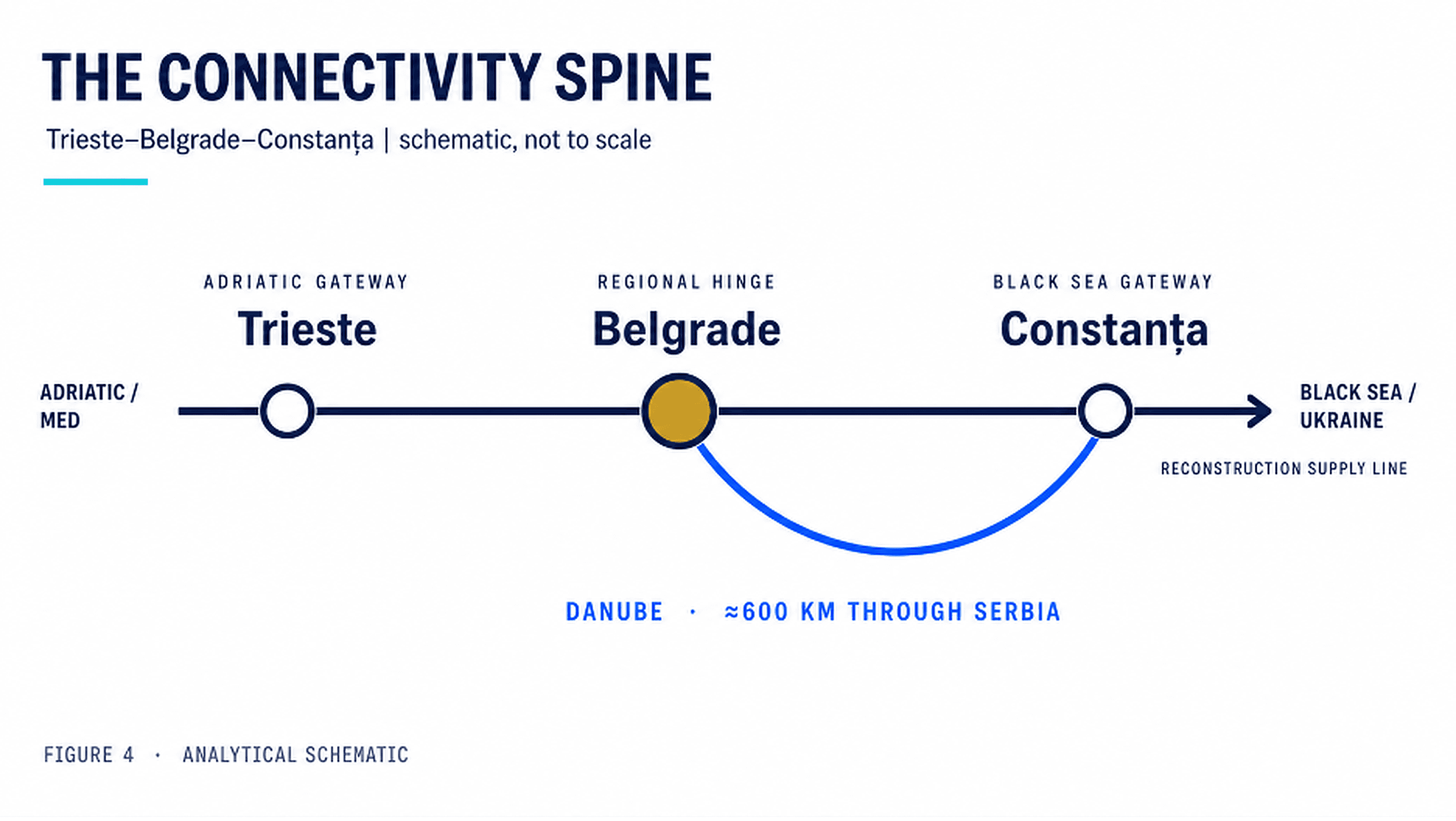
Figure 3. The connectivity spine (schematic, not to scale). Serbia sits on the land bridge between the Adriatic-facing corridor and the Black Sea, with ~600 km of controlled Danube waterway feeding the reconstruction supply line.
The Carpathian Integration Initiative could give this geography a wider purpose, but its status must be described honestly. Unlike CEFTA, it is not an established trade framework. Unlike Open Balkan, it has not yet generated a body of operational practice. Ukraine is developing the format around cooperation among its regions and European partners and preparing an international forum of the Carpathian macroregion. It is therefore a strategic opening, not a finished institution.
That difference in maturity makes the concept more interesting, not less relevant. Serbia does not need to wait for a new secretariat or treaty to identify where it can contribute. The future reconstruction of Ukraine will require construction materials, electrical equipment, machinery, medical products and energy systems – areas in which Serbia and other Western Balkan economies possess relevant capacity. It will also require redundant routes that continue to function when a port, energy node or border crossing is disrupted.
Reconstruction is only one application. The broader objective is to enable a company from North Macedonia, Bosnia and Herzegovina or Montenegro to participate in a supply chain that moves through Serbia towards Hungary, Romania, Ukraine or the Black Sea under predictable rules and compatible standards. Serbia's value would then come not simply from sitting between regions, but from enabling those regions to function as a connected economic space.
Free and open – but not geopolitically weightless
What gives these layers coherence is not another institution, but a principle. Kaush Arha, president of the Free & Open Indo-Pacific Forum, describes Free and Open Spaces as sovereign and connected regions governed by transparent rules and linked through trusted infrastructure rather than divided into exclusive spheres of control.
The concept is not geopolitically neutral. In Arha's formulation, connecting free and open spaces advances American and allied interests, creates more resilient supply chains and limits the ability of China, Russia and other authoritarian powers to dominate strategic routes, infrastructure and technologies. Applying that framework to Serbia while ignoring the country's actual foreign-policy position would create an obvious contradiction.
Serbia remains an EU candidate whose accession process is incomplete. At the same time, it is deepening infrastructure, industrial and technological cooperation with China, including through a Belt and Road action plan for 2026–2028. It maintains important political and energy links with Russia, while the normalisation process with Kosovo remains unresolved. These relationships cannot be wished away, nor should a connectivity strategy be reduced to a demand that Serbia simply choose one external patron over another.
This is precisely why Free and Open Spaces should be presented not as a description of Serbia's current position, but as a standard against which its future connectivity strategy can be tested. Are infrastructure contracts transparent and open to scrutiny? Can customs, energy and digital systems interoperate with European networks? Do new corridors expand Serbia's choice of routes and partners, or create dependence on a single financier, technology or market? Can firms participate under published rules rather than political loyalty?
For Serbia, openness should mean strategic room to act – but also rules that make that autonomy credible to others. Trusted connectivity is not achieved by declaring neutrality between competing systems. It is achieved by building infrastructure and institutions that multiple partners can use, audit and rely upon.
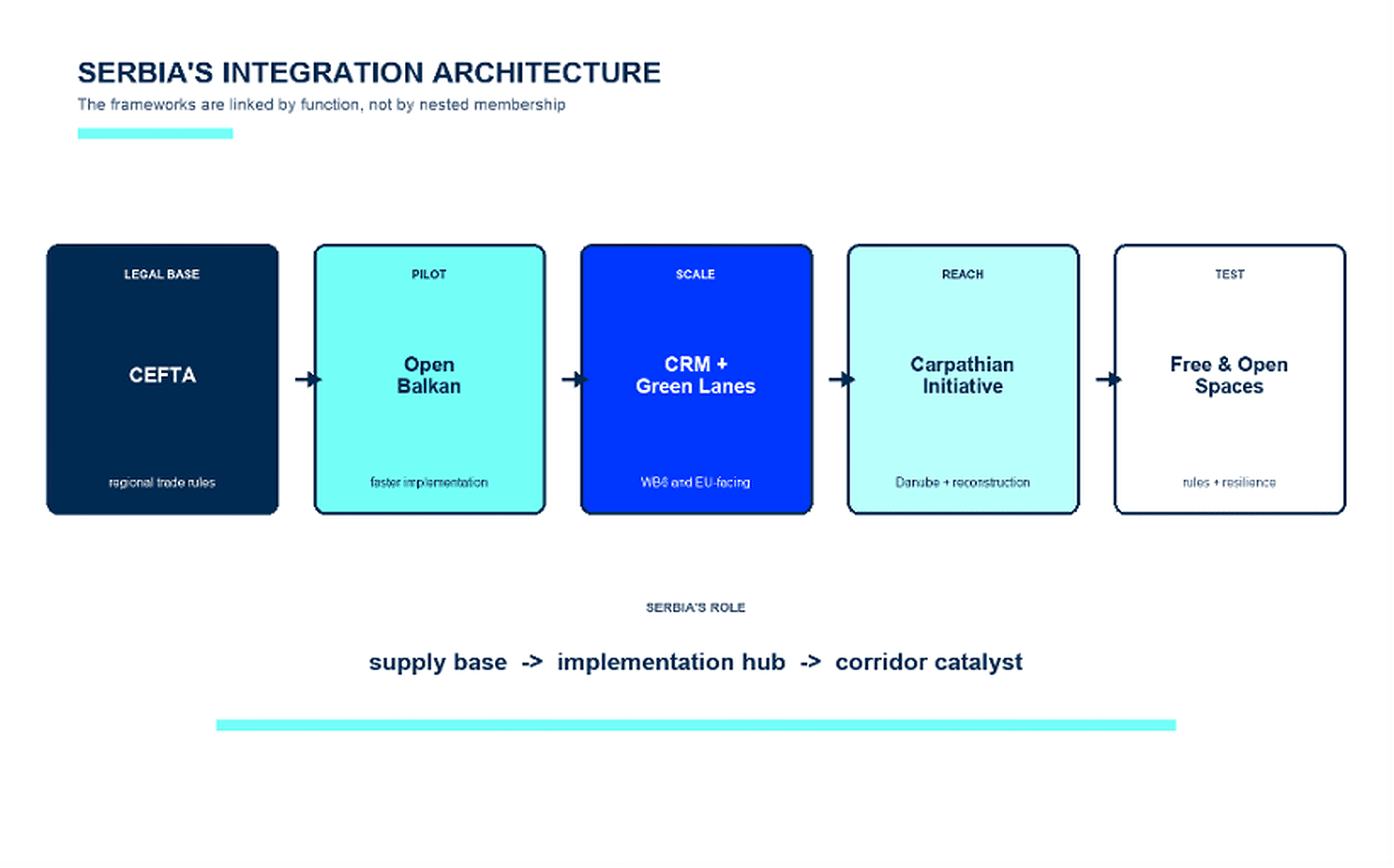
Figure 4. A functional architecture, not nested memberships. The frameworks perform different jobs: legal base, pilot, regional scale, corridor reach and normative test. The diagram is analytical, not an institutional chart.
From regional leader to economic catalyst
This is why catalyst describes Serbia's opportunity better than the familiar language of regional leadership. Leadership implies hierarchy: the largest economy, the strongest exporter or the country at the centre of the map. A catalyst is judged by a harder standard – whether it reduces the cost of other firms' participation, connects markets that were previously separated and turns national infrastructure into shared productive capacity.
On the Western Balkans, Serbia can provide the scale that a fragmented region lacks. In the Danube and Carpathian space, it can connect that regional base with Central and Eastern Europe and the Black Sea. In the wider international context, it can demonstrate a practical form of openness: cooperation without coercion, connectivity without exclusive dependence, and integration that preserves sovereignty through transparent and interoperable rules.
The result must be visible in outcomes rather than declarations: shorter and more predictable border times, more small exporters that remain successful after entering regional markets, greater use of neighbouring suppliers by Serbian producers, more two-way investment and transport, energy and digital links that operate as parts of one system. The decisive measure will not be the size of Serbia's surplus alone, but the additional trade, investment and productive capacity it generates across the space around it.
Serbia's CEFTA results show that it begins from a position of genuine economic strength. Open Balkan offers a mechanism for converting formal market access into practical integration. The Carpathian direction presents an opportunity to give that integrated base a wider European reach. Free and Open Spaces provides the demanding standard that can hold the argument together.
Serbia's strategic task is not to proclaim itself the leader of another region or the indispensable bridge between East and West. It is to become the place where different economic spaces can meet and function together.
The open space Serbia can build will be judged by what can move through it, how reliably it connects to the rest of Europe – and how many others can prosper within it.
Остале анализе

Време читања:
20
минута
17. 9. 2026.
текст
Why the USA and Serbia Need a Tax Treaty?
How a tax treaty and totalization agreement can deepen the growing U.S.–Serbia economic partnership.
Време читања:
45
минута
10. 9. 2026.
текст
Silence Is Not Safety: Rights Before Politics in Kosovo
Rights Before Politics: Protecting the Serbian Community and Religious Heritage in Kosovo

Време читања:
4
минута
25. 8. 2026.
текст
Чланство без користи: место Србије у WAICO-у
Чланство Србије у WAICO носи ризике по западно технолошко усмерење, а не доноси јасну корист Србији.