Michael Stewart
Why the USA and Serbia Need a Tax Treaty?
How a tax treaty and totalization agreement can deepen the growing U.S.–Serbia economic partnership.

Introduction
The first U.S.-Serbia Strategic Dialogue created a framework for closer cooperation in energy, security, technology, and investment. And yet, the two countries still lack basic legal instruments that almost every mature bilateral economic relationship possesses: an income tax treaty and a totalization agreement. That gap does not prevent investment or professional mobility, though it makes both more expensive, more complex, and more dependent on private workarounds.
The U.S.-Serbia relationship has spent the past decade accumulating transactions without building legal infrastructure. Serbia's ICT-services exports reached a record approximately $5.2 billion in 2025, a tenfold increase since 2012. According to the Pupin Initiative's 2025 Annual Report on Serbia-U.S. Relations, the United States is Serbia's largest ICT export market, with estimates suggesting a U.S. share in the range of 40–50% of total ICT services exports, a value on the order of $2.1 to $2.6 billion at 2025 export levels. (All euro figures converted at approximately $1.14 per euro, the mid-2026 rate). U.S. investment banks underwrote an approximately $2.2 billion Telekom Srbija Eurobond in May 2026, generating $13.87 billion in investor demand, the largest corporate bond issuance in Southeast and Central-Eastern European history. The U.S. EXIM Bank finalized a $50 million 5G financing agreement with Telekom Srbija, the first time a U.S. government institution has financed a 5G rollout for a European telecom operator. Two major Serbian technology companies, Nordeus and 3Lateral, were acquired by U.S. buyers for $378 million and an undisclosed sum.
The relationship still lacks the legal infrastructure that makes bilateral economic relationships durable. Some Serbian professionals in qualifying cross-border employment arrangements may face overlapping social security contributions, and workers whose careers span both countries cannot combine coverage periods toward benefit eligibility.
Three developments make it the perfect time for such a tax agreement:
The NIS divestiture, which delayed the formal Dialogue for more than a year, is nearing its final stage, removing the geopolitical complication that blocked formal engagement.
SEETAC, the IMF's fiscal advisory center for Southeast Europe, becomes operational in January 2027, providing institutional support for the fiscal governance reforms a tax treaty would require and reinforce.
The bilateral ICT relationship is at peak integration: the United States is Serbia's largest ICT trade partner, and that relationship has never had more at stake.
The Legal Baseline
The 1976 Treaty Is a Dead Letter
A 1976 income tax convention between the United States and the Socialist Federal Republic of Yugoslavia exists in the historical record. Its status as applied to today's Serbia is, at best, disputed, and in practice both governments operate as though no treaty applies. The IRS "United States Income Tax Treaties — A to Z" page lists the U.S. treaty network by country name. Serbia does not appear, with no U.S. authority ever issuing a ruling applying an income tax convention to a Serbian taxpayer or entity. Oppositely, the Serbian Ministry of Finance lists 64 active bilateral tax treaties per KPMG Serbia's May 2025 Tax Alert, with the United States not among them. And the U.S. Treasury's press release on the U.S.-Slovenia income tax treaty describes it as "the first between the United States and a country in the former area of Yugoslavia," confirming the 1976 convention has not been treated as extending to any Yugoslav successor state. A joint administrative clarification from Treasury and Serbia's Ministry of Finance would eliminate remaining ambiguity for regional tax advisers and corporate clients.
Serbia's Position in the U.S. and Global Treaty Networks
Among former Yugoslav states, only Slovenia has a U.S. income tax treaty in force, having signed in 1999 and achieved entry into force in June 2001. Croatia signed its first U.S. income tax treaty in December 2022; it remains pending Senate advice and consent as of mid-2026. Serbia has neither signed a treaty nor entered negotiations. The gap has persisted under every government since Yugoslav dissolution, across Serbia's independence since 2006, and in every bilateral engagement since.
China already has what the U.S. lacks: a China-Serbia DTT capping withholding at 5% on dividends and 10% on ordinary interest and royalties. Without a U.S. treaty, Serbia's domestic 20% rate applies to dividends, interest, royalties, and specified service fees paid to U.S. residents, subject to the payment's legal characterization and applicable exemptions. This disparity is especially consequential in ICT services, where the United States is Serbia's largest ICT trade partner. Figure 1 illustrates the practical result.

Figure 1. Serbian source-country withholding: current law and treaty benchmarks. The 2016 U.S. Model is a negotiating baseline, not a Serbia forecast. Made with Plotly in Python. Sources: Serbian Corporate Income Tax Law, Art. 40; China–Serbia DTT, Arts. 10–12; 2016 U.S. Model Income Tax Convention, Arts. 10–12.
Why Both Sides Would Agree
Signing a tax treaty requires both governments to accept lower withholding rates on cross-border income. The immediate revenue effect may still be smaller than the statutory-rate comparison suggests because some investors already operate through treaty-covered jurisdictions: U.S. capital often routes through Dutch or Luxembourgish holding structures that access Serbia at whatever rate those jurisdictions' treaties with Serbia provide. A bilateral agreement could simplify those structures and reduce compliance costs, with comparable or better revenue from a cleaner transaction.
Serbia's broader fiscal calculation concerns investment volume more than withholding margin. A treaty that removes transfer pricing uncertainty, provides MAP access, and eliminates holding-company requirements could generate additional corporate income tax, employment tax, and VAT-generating commercial activity from expanded U.S. operations. Those potential gains should be weighed against reduced withholding revenue rather than assumed to exceed it automatically.
For the United States, the gains are concrete, e.g., improved market access, lower compliance burden for U.S. firms and individuals with Serbian-source income, and an Article 26 framework that supplements existing FATCA reporting with broader treaty-based information exchange and administrative cooperation. Both sides also gain a Mutual Agreement Procedure, a shared tool for resolving disputes that currently have no resolution path.
Where Tax Friction Bites
The ICT Sector: The Anchor Relationship
Serbia's ICT services exports reached approximately $5.2 billion in 2025, ten times their 2012 level, and the United States is the sector's largest individual foreign market. The Pupin Initiative's 2025 Annual Report estimates the U.S. share at 40–50% of total ICT exports, roughly $2.1 to $2.6 billion annually. Microsoft, Databricks, NCR Voyix, and Oracle anchor the U.S. presence; Oracle's cloud region at the Kragujevac State Data Center is the first in Southeast Europe.
Transfer pricing uncertainty is central for U.S. companies operating Serbian subsidiaries. Intercompany charges for software, engineering, IP licensing, and management services can be challenged by either tax authority. Without a MAP, the IRS and the Serbian Tax Administration have no formal mechanism for resolving conflicting assessments.
Serbian professionals may encounter U.S. tax exposure when services are physically performed in the United States or when their activities create another U.S. tax nexus. Ordinary remote services performed entirely from Serbia, however, are generally foreign-source for U.S. federal income-tax purposes. The treaty gap is therefore most relevant to mobile workers, cross-border employees, and disputes over tax residency or business nexus, not ordinary Serbian contractors serving U.S. clients remotely.
U.S. cloud and AI companies licensing software to Serbian clients face 20% domestic withholding on qualifying royalty payments, roughly double the 5–10% rates EU treaty partners pay. The aggregate friction across ICT licensing, AI software contracts, and IP transfers is material, though the bilateral royalty base cannot be precisely quantified from publicly available data.
Marjanović et al. (2026) (International Journal of Economic Sciences, Vol. 16, No. 1) surveyed 300 foreign investors that entered Serbia between 2001 and 2019. Globally oriented companies assigned significantly greater weight to avoiding double taxation (M=2.87, SD=1.39) than multinational companies with established compliance structures (M=1.83, SD=1.02), F(2,85)=5.33, p=0.01, η²=0.115. The profile of U.S. technology and service firms operating in Serbia more closely resembles the study's globally oriented group. The survey predates the current scale of bilateral ICT trade.
Technology Exits: The Structural Workaround
Take-Two Interactive acquired Nordeus for $378 million, and Epic Games acquired 3Lateral. Public materials do not establish the structures used in either transaction. In non-treaty jurisdictions, however, buyers often route acquisitions through Dutch or Luxembourgish holding companies to access the treaty rates Serbia offers its sixty-plus partners but not the United States, creating a clear economic incentive for third-country structuring. These arrangements add legal and administrative complexity, increase deal costs, and may channel activity through jurisdictions unconnected to either party. U.S. acquirers may face higher structuring, legal, and compliance costs than buyers from treaty-covered countries. Those costs will become more significant as Serbia's technology sector matures.
Capital Markets and Energy
The May 2026 Telekom Srbija Eurobond (approximately $2.2 billion, led by Citi, Bank of America, and JPMorgan) drew $13.87 billion in investor demand, the largest corporate bond issuance in Southeast and Central-Eastern European history. U.S. institutional investors who participated may face Serbian withholding on interest payments, depending on the bond's tax provisions and their investment structures; absent treaty relief, the domestic 20% rate would apply. The EXIM Bank's $50 million 5G financing agreement may run the same friction in reverse: depending on the financing arrangement and applicable exemptions, interest flowing to a U.S.-backed lender could face domestic withholding treatment.
The July 17 joint statement identified Đerdap III as the first project under the U.S.-Serbia energy IGA. Technology licensing fees connected to such projects may be subject to Serbian withholding, depending on payment characterization; a treaty royalty article would reduce applicable rates from 20% to 0–10%. The same issue affects U.S. firms engaging with Serbia's critical minerals sector, including the Jadar lithium project, an EU Strategic Project targeting 58,000 metric tonnes of battery-grade lithium carbonate annually by 2030.
People-to-People: The Totalization Gap
Serbian-born professionals who work across both countries include temporary assignees, dual employees, and people whose careers span both social security systems. Without a totalization agreement, the same earnings may be subject to contributions in both countries simultaneously. Also, workers cannot combine coverage periods when establishing eligibility for retirement or disability benefits.
These professionals form part of the human infrastructure behind bilateral ICT ties. Their networks help direct U.S. technology contracts toward engineering teams in Belgrade, and their career decisions shape where U.S. companies build capacity. A totalization agreement would address a concrete financial and administrative problem for this group, one that is currently navigated individually without institutional support.
Phase One: The Totalization Agreement
A totalization agreement places each worker under one social security system at a time, coordinates benefit eligibility across both systems, and prevents double contributions. It is an executive agreement and does not require Senate ratification. Serbia would negotiate through the Pension and Disability Insurance Fund (Fond za penzijsko i invalidsko osiguranje); the Social Security Administration would represent the United States. The United States has concluded such agreements with over 30 countries, including major Western European economies, Australia, Japan, South Korea, and Brazil, Serbia absent among them.
Timeline and Precedent
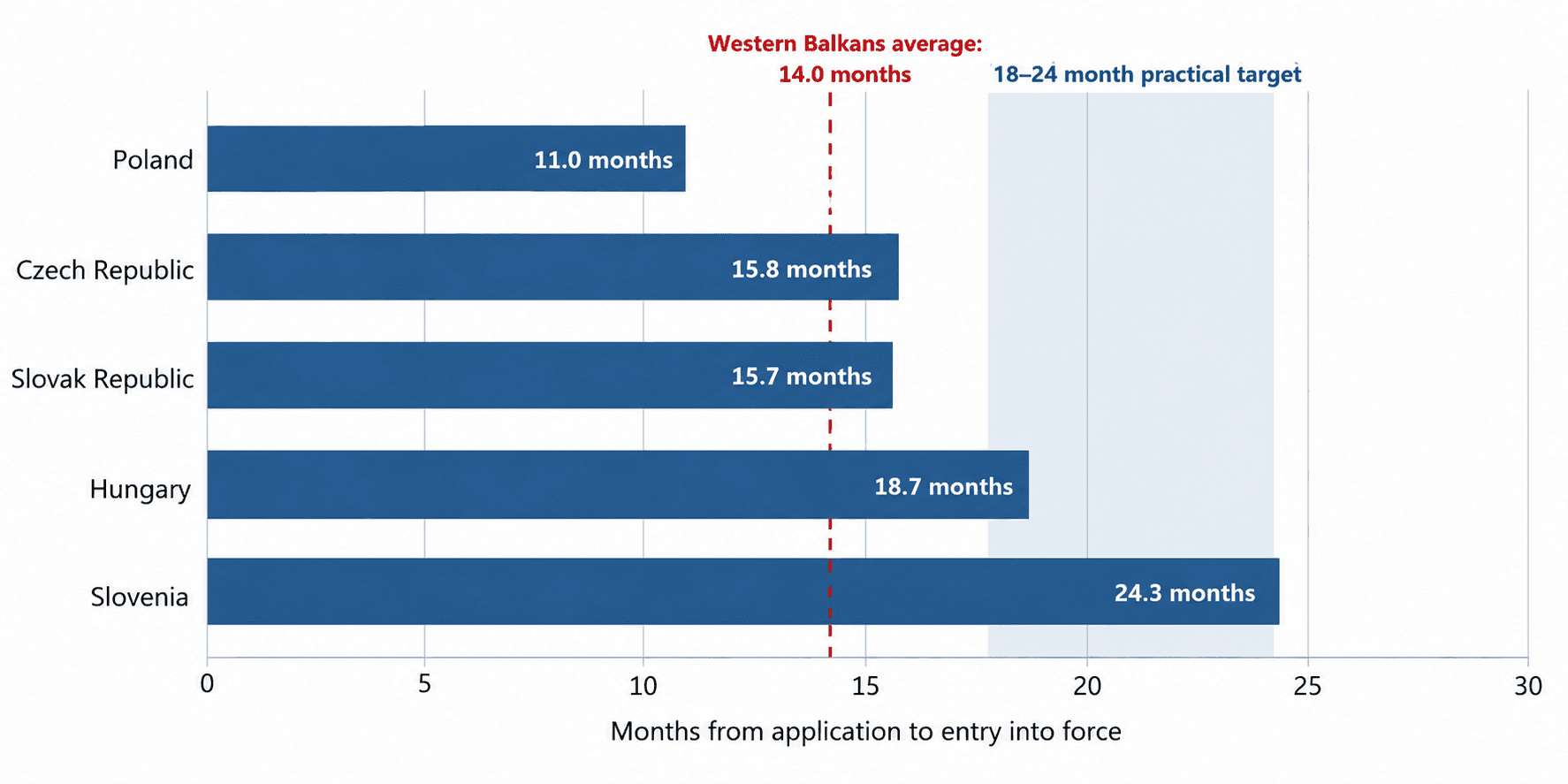
For five Central and Eastern European partners, the interval from signature to entry into force ranged from 11.0 months (Poland) to 24.5 months (Slovenia), with a median of 16.7 months and a mean of 17.4 months (Figure 2). These precedents make an 18–24 month planning target reasonable, though the actual timetable would depend on how quickly both governments appoint negotiating teams and complete domestic procedures.
Figure 2. Months from signature to entry into force for U.S. totalization agreements with selected CEE partners. Made with Plotly in Python. Source: U.S. Social Security Administration, International Agreements status table.
The First Deliverable
The totalization agreement should be the working group's first concrete deliverable. It would establish bilateral social insurance coordination without Senate involvement and build institutional momentum for the more complex income tax treaty. It also addresses the group most directly affected by the current gap, made up of professionals with employment or career histories spanning both countries. Unlike the income tax treaty, its implementation does not depend on Senate action.
Phase Two: The Income Tax Treaty
Getting into the Queue
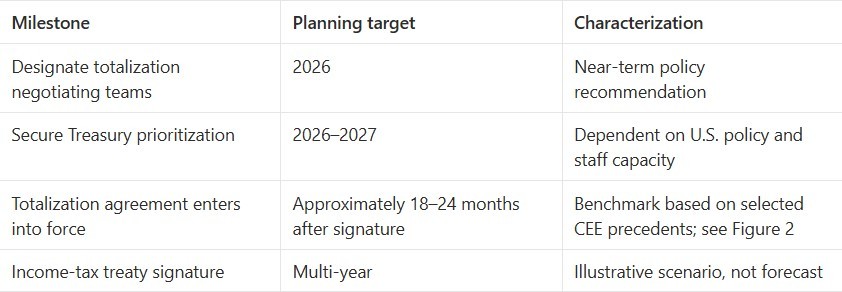
Discussion of a U.S.-Serbia tax treaty often begins with the negotiating text. The more immediate task is to secure Treasury's political support and enough staff time within the Office of Tax Policy. The Treasury does not publish a formal application queue; progress depends on direct engagement between the two finance ministries, backed by the political authority of the Strategic Dialogue. Until Serbia receives that priority, the estimated 36–48 month path to signature cannot begin.
Reference Framework: The 2016 U.S. Model
The 2016 U.S. Model Income Tax Convention provides the starting point for U.S. negotiations. It includes OECD base erosion rules, a detailed Limitation on Benefits article, and updated safeguards against treaty shopping.
Three Serbian Negotiating Priorities
Readers remember priorities, not article numbers. From Serbia's perspective, three provisions bear most directly on the bilateral relationship.
Royalty treatment is the highest-stakes negotiating point. The U.S. Model assigns royalty income to the residence country (0% at source); negotiated agreements with emerging-market partners often settle between 5% and 10%. Qualifying payments for ICT licensing, gaming IP, AI software, and technology transfers can face Serbia's domestic 20% rate when no treaty applies. Publicly available data do not allow a reliable estimate of the bilateral royalty base, but qualifying royalty flows represent the largest treaty-sensitive category in the relationship. Serbia should press for the lowest achievable rate while accepting that the OECD-Model starting position gives the U.S. leverage.
Technology investment provisions determine whether U.S. acquisitions of Serbian companies require third-country structures. The U.S. Model assigns capital gains on non-real-estate assets to the residence country; an Article 13 provision along those lines could reduce the incentive to use third-country holding structures and make direct bilateral transactions more commercially attractive. For interest, the U.S. Model generally assigns taxing rights to the residence country, effectively 0% source-country withholding; treaties with emerging-market partners sometimes retain a source-country rate of about 10%, and government-backed financing such as the EXIM Bank's 5G agreement could qualify for a full exemption. For dividends, the U.S. Model caps withholding at 5% for corporate shareholders that own at least 10% of voting stock and at 15% for other recipients, which both sit below Serbia's current 20% domestic rate.
Avoiding treaty shopping is the third priority, and the LOB Clause section below addresses the specific interaction with Serbia's domestic anti-abuse framework.
The OECD–UN Model Tension
The 2016 U.S. Model follows the OECD approach and generally favors capital-exporting countries. Serbia is a net capital importer with legitimate reasons to prefer parts of the UN Model, especially on royalties and interest, albeit a disagreement common in U.S. negotiations with emerging-market partners. Negotiators typically place unresolved provisions in brackets and return to them in subsequent rounds.
Serbia should protect its source-country revenue, but it also wants to attract U.S. capital. A royalty rate of 5–10% would be substantially lower than the current 20% domestic rate and would make Serbian assets more competitive. Pressing for the higher rates allowed by the UN Model could weaken the agreement's value for the technology, defence, and energy companies Serbia most wants to attract.
Senate Ratification Risk
A full income-tax treaty requires Senate advice and consent by a two-thirds vote, and the U.S.-Chile income-tax treaty shows how long that process can take. Signed in February 2010, it did not receive Senate approval until June 2023, a 13-year gap attributable largely to a hold by Senator Rand Paul on privacy grounds. When the Senate Foreign Relations Committee finally moved the treaty, it added reservations to reflect changes made to U.S. tax law by the 2017 Tax Cuts and Jobs Act.
The practical response is to pursue the totalization agreement first and begin Senate outreach while the tax treaty is still being negotiated. Foreign Relations Committee staff should be briefed early, with the treaty presented as a trade and investment instrument. The bipartisan Serbian Caucus (Representatives Tenney and Cleaver) provides a natural entry point. Privacy safeguards and information-exchange rules should be discussed during drafting so that Article 26 remains consistent with the U.S. Model and accepted international standards.
The LOB Clause
A robust Limitation on Benefits article is necessary to prevent third-country investors from using Serbian holding structures to obtain U.S. treaty benefits. The clause limits treaty access to qualified residents meeting ownership or active-business tests; genuine bilateral investors retain access while entities with no substantial connection to either country do not.
Dušan V. Popović, in his 2024 chapter on Serbian tax policy (in Zoltán Nagy, ed., Economic Governance, Central European Academic Publishing), explains that Serbia's domestic "principle of facticity" differs from the general LOB rules in the EU Anti-Tax Avoidance Directive and the 2016 U.S. Model. Negotiators will therefore need to address how the Model's LOB article interacts with Serbia's domestic anti-abuse framework.
Timeline
Signature could be reached within 36–48 months after the Treasury prioritizes Serbia and assigns negotiating staff. The estimate assumes two rounds of face-to-face negotiations, article-by-article review, and agreement on the main OECD–UN Model differences. A 2029–2030 signature is possible under that scenario; ratification could add another 12–18 months, or considerably more if the Senate delays.
The Strategic Dialogue as Vehicle
What the Inaugural Session Produced
The July 17 joint statement locked in Đerdap III as the first project under the U.S.-Serbia Intergovernmental Agreement on Energy, welcomed the EXIM Bank's 5G financing, confirmed Serbia's accession to the Artemis Accords, and committed $300,000 annually to the Fulbright program. It announced new Serbian consulates in Miami and San Francisco, directly relevant to the diaspora constituency discussed above. Tax and social insurance coordination were absent from the statement.
The Working Group Ask
The group's two immediate asks, a) launching totalization negotiations and b) formally requesting Treasury prioritization, are detailed in the Recommendations at the top of this paper. The Dialogue is the mechanism that makes Serbia a credible candidate for Treasury's limited negotiating bandwidth; without it, neither ask carries the necessary political weight.
Political Continuity
On June 27, Vučić announced plans to resign within weeks and trigger early presidential and parliamentary elections, inconvenient timing for every instrument described above. A totalization agreement remains the immediate priority because its negotiation is handled by social security administrations and can continue through a change of government. Tax treaty talks can proceed at the ministry level once the Treasury prioritizes Serbia. Both processes should be led by technical civil servants, not political appointees.
Risks and Mitigation
Limited Treasury capacity and Senate ratification are the main constraints. The Office of Tax Policy has a small staff and a full calendar, so Serbia will need sustained political backing to secure attention. Senate action presents a separate risk. The Chile case shows that a treaty with broad substantive support can remain pending for more than a decade. Kosovo and domestic political change create additional, but manageable, risks, especially since a tax treaty is a technical legal instrument negotiated between finance ministries, not a political signal on sovereignty. Both negotiating processes should be led at the civil-service level so that possible early elections do not interrupt them. A weak Limitation on Benefits article could allow third-country investors to use Serbia as a treaty conduit; the LOB Clause section above addresses this risk.
Recommendations
Launch totalization negotiations immediately. The Social Security Administration has a standard negotiation process; Serbia's Ministry of Labour would serve as the counterpart. Designating negotiating teams on both sides is the prerequisite to a formal launch, not a consequence of it.
Formally request Treasury prioritization. The Serbian Ministry of Finance should engage the U.S. Department of the Treasury's Office of Tax Policy (specifically the International Tax Counsel's office), through the Strategic Dialogue's political channel. This is the mechanism for getting Serbia onto the Treasury's negotiating calendar.
Create a bilateral tax working group. The Economy, Trade and Technology track of the Strategic Dialogue should establish a dedicated subgroup on tax and social insurance coordination, staffed by technical civil servants from both sides, to provide continuity across electoral cycles.
Prepare a Serbian negotiating position before formal talks begin. Serbia should identify its key priorities (royalty treatment, technology investment protections, and treaty shopping safeguards) and develop internal positions before the U.S. sets the opening framework.
Conclusion
The working groups created after the inaugural session will focus on energy, defence, science, and people-to-people ties. Tax and social insurance coordination are currently outside that agenda. The U.S.-Serbia relationship is among Serbia's most consequential economic partnerships, yet its legal foundations remain thin. Investors rely on third-country structures, while workers navigate overlapping social insurance rules alone. A totalization agreement would coordinate coverage and allow eligible workers to combine contribution periods, and a subsequent income tax treaty would reduce friction across technology, energy, and capital markets. The immediate task is to secure the Treasury's political prioritization and negotiating capacity. The Strategic Dialogue gives both governments a practical mechanism to make that request, and they should use it.
Остале анализе
Време читања:
20
минута
17. 9. 2026.
текст
Why the USA and Serbia Need a Tax Treaty?
How a tax treaty and totalization agreement can deepen the growing U.S.–Serbia economic partnership.
Време читања:
45
минута
10. 9. 2026.
текст
Silence Is Not Safety: Rights Before Politics in Kosovo
Rights Before Politics: Protecting the Serbian Community and Religious Heritage in Kosovo

Време читања:
4
минута
25. 8. 2026.
текст
Чланство без користи: место Србије у WAICO-у
Чланство Србије у WAICO носи ризике по западно технолошко усмерење, а не доноси јасну корист Србији.