Vuk Velebit
How the Carpathian Initiative Could Redefine Serbia’s Role in Europe’s Future
The Carpathian Initiative could position Serbia as a key logistics hub for Europe’s future connectivity.
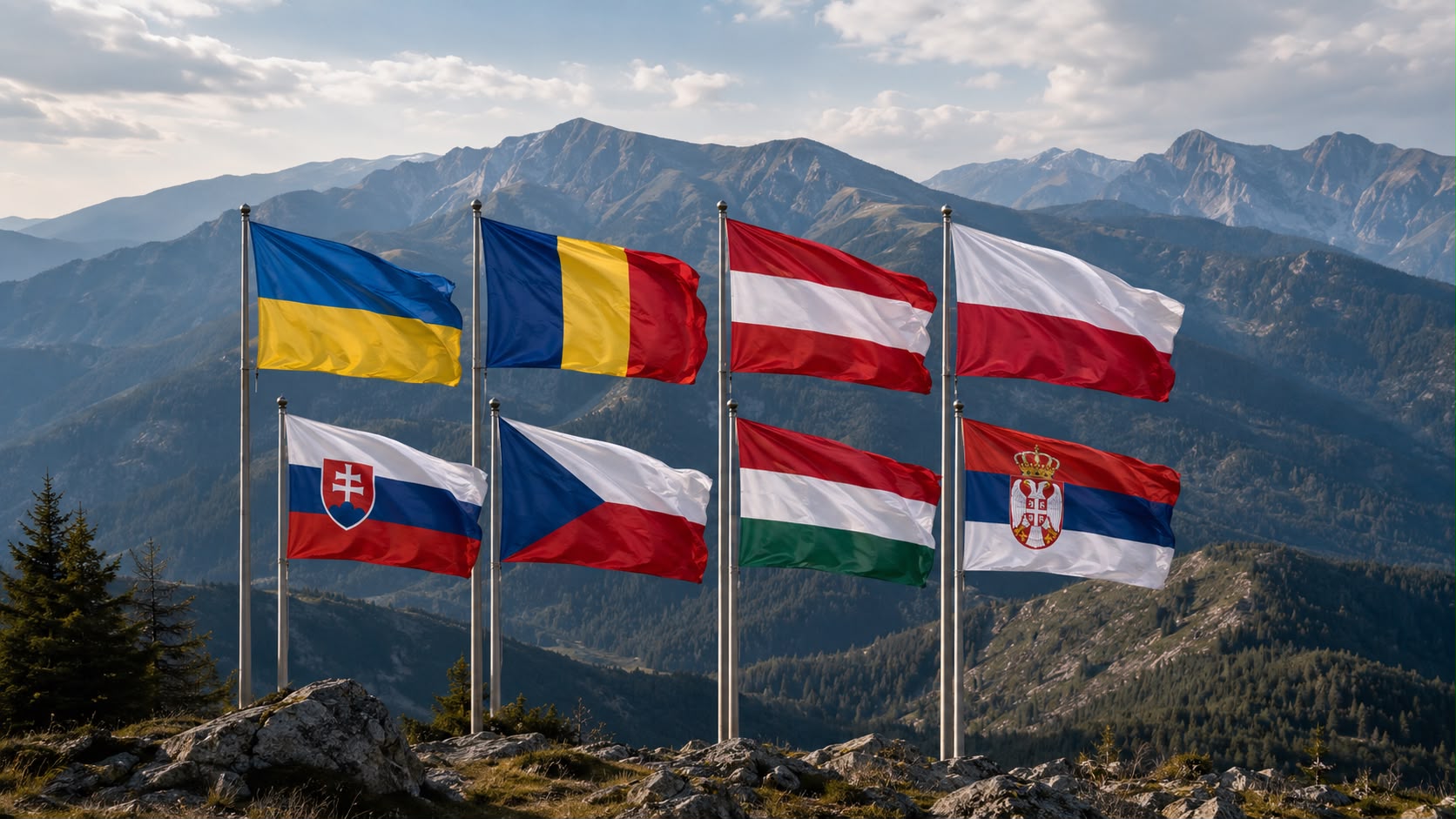
For much of the past three years, Europe’s debate about Serbia has revolved around a single question: why has Belgrade refused to join EU sanctions against Russia? It is a legitimate question, but follows a wrong lead. If sanctions become the only measure of Serbia’s European orientation, we risk overlooking a broader strategic reality that has quietly emerged since Russia’s full-scale invasion of Ukraine.
Serbia’s decision not to impose sanctions has largely been shaped by a structural constraint rather than ideological affinity: its longstanding dependence on Russian natural gas and the political and economic consequences that an abrupt rupture would carry. Whether one agrees with that policy or not, it should not obscure another fact: Serbia has steadily expanded its practical support for Ukraine and is increasingly positioning itself as a contributor to the country’s long-term recovery.
That trajectory deserves greater attention.
The past year alone illustrates how much the relationship has evolved. President Volodymyr Zelenskyy was expected to visit Serbia, reflecting a new phase in bilateral relations, while President Aleksandar Vučić travelled to Kyiv this summer for the first time in more than a decade despite continuing disagreements over sanctions. Parliamentary diplomacy has also intensified, most notably through the recent visit to Belgrade by Ruslan Stefanchuk, Chairman of Ukraine’s Verkhovna Rada. Only a few years ago, such a sequence of high-level exchanges would have been difficult to imagine.
Even more significant has been Serbia’s material contribution. According to the Financial Times, Serbian-made ammunition reaching Ukraine had already exceeded $912 million in 2024, while unofficial sources ramp up the number to even $2 billion. That figure has almost certainly increased since the newspaper’s reporting. At the same time, Belgrade has repeatedly expressed its readiness to participate in Ukraine’s reconstruction, with President Vučić publicly stating on several occasions that Serbia wants to help rebuild Ukrainian cities and infrastructure once conditions permit.
Taken together, these developments suggest that Serbia has sought to distinguish between its position on sanctions and its broader relationship with Ukraine. That distinction is often lost in European debates, yet it may become increasingly relevant as attention gradually shifts from wartime assistance toward post-war reconstruction.
This is precisely why the recently announced Carpathian Initiative deserves attention.
On paper, the initiative remains little more than a political announcement. President Zelenskyy has proposed bringing together Ukraine, Romania, Austria, Poland, Slovakia, Czechia, Hungary and Serbia around cooperation in logistics, economic development, security, tourism and reconstruction. No institutional architecture exists yet. There is no permanent secretariat, dedicated funding mechanism or formal governance structure.
But dismissing the initiative because it is still emerging would be a mistake.
Europe’s most important regional frameworks rarely begin with elaborate institutions. They begin with a shared recognition that geography creates common strategic interests. Institutions usually follow.
For Serbia, the Carpathian Initiative offers something particularly important, being an opportunity to demonstrate that strategic alignment can also be measured through contribution. Only a few months ago, Serbia was left outside the expansion of the Three Seas Initiative, despite occupying one of the most important transit positions between Central Europe and the Western Balkans. The Carpathian Initiative presents a different opportunity. Rather than defining participation through EU membership or political symbolism, it is being built around practical cooperation on reconstruction and connectivity, areas where Serbia can make a meaningful contribution.
No reconstruction effort on the scale Ukraine will require can succeed without corridors.
Ukraine will need enormous quantities of construction materials, industrial equipment, energy infrastructure and commercial goods moving efficiently between Central Europe and the Black Sea. One of the most important arteries in that process will remain the Danube, which has already become indispensable for Ukrainian exports following Russia’s repeated attacks on Black Sea ports. Serbia controls nearly 600 kilometres of Europe’s second-longest river and occupies a strategic position connecting the Western Balkans with Central Europe. Geography alone does not determine geopolitical relevance, but geography combined with infrastructure often does.
That is why Serbia’s participation should be viewed not simply through the prism of diplomacy, but through logistics.
The future of European security will not depend only on military deterrence. It will also depend on whether Europe can rebuild Ukraine quickly, reconnect supply chains, restore energy infrastructure and create resilient transport networks stretching from the Black Sea to Central Europe. Countries capable of facilitating those flows will inevitably become strategic stakeholders in Europe’s post-war order.
Serbia is one of them.
This should matter to Brussels as well.
For years, Serbia’s European path has been assessed primarily through the lens of foreign policy alignment. That will remain an important benchmark. But Europe itself is increasingly integrating its neighbours through infrastructure, energy markets and regional connectivity long before they become full members. The Carpathian Initiative fits squarely within this broader trend. It offers Serbia an opportunity to demonstrate that, despite political disagreements on certain issues, it is prepared to contribute to Europe’s most important collective challenge after the war: rebuilding Ukraine.
That message should also resonate in Washington.
The United States has consistently encouraged greater regional connectivity, energy diversification and economic resilience across Southeast Europe. A Serbia that participates in reconstruction, strengthens transport corridors and contributes to regional infrastructure serves those objectives. Practical cooperation creates confidence in ways that political declarations often cannot.
None of this diminishes the importance of Serbia’s unresolved differences with the European Union over sanctions or broader foreign policy alignment. Those questions will continue to shape Serbia’s accession process. But they should no longer define the entire relationship.
Europe is entering a new phase. The central challenge will no longer be only how to help Ukraine defend itself, but how to help Ukraine rebuild itself. That effort will require not only donors and political allies, but also engineers, manufacturers, logistics hubs, transport corridors and reliable regional partners.
The Carpathian Initiative may still be taking shape, but its underlying logic is already clear. It recognizes that reconstruction is not only a Ukrainian project, but it is also a Central European one. Serbia has an opportunity to become part of that effort from the outset.
If Belgrade seizes that opportunity, the conversation about Serbia in Europe may finally begin to change. Rather than asking only where Serbia stands on sanctions, Europe may increasingly ask a different question: who is helping build the continent’s future?
In the years ahead, that may prove to be the more important measure of strategic alignment.
Other Analysis

Read time:
20
min
Sep 17, 2026
text
Why the USA and Serbia Need a Tax Treaty?
How a tax treaty and totalization agreement can deepen the growing U.S.–Serbia economic partnership.
Read time:
45
min
Sep 10, 2026
text
Silence Is Not Safety: Rights Before Politics in Kosovo
Rights Before Politics: Protecting the Serbian Community and Religious Heritage in Kosovo

Read time:
4
min
Aug 25, 2026
text
Membership Without Benefits: Serbia’s Place in WAICO
Why Serbia’s WAICO membership creates alignment risks, with no clear economic or strategic benefits.