Vuk Velebit, Aleksa Jovanović, Petar Ivić
Membership Without Benefits: Serbia’s Place in WAICO
Why Serbia’s WAICO membership creates alignment risks, with no clear economic or strategic benefits.

What Serbia actually joined
On 16 July 2026, one day before the World Artificial Intelligence Conference opened in Shanghai, representatives of twenty-nine states signed the founding agreement of the World Artificial Intelligence Cooperation Organization (WAICO). Chinese Foreign Minister Wang Yi signed for Beijing; UN Secretary-General António Guterres attended. The body was first proposed by Premier Li Qiang at the 2025 edition of the same conference, and it is headquartered in Shanghai. Its stated purpose is to promote international cooperation and governance on AI, uphold the UN Charter, and pursue a “people-centred” approach with particular attention to closing the technology gap between rich and poor states.
Serbia was among the twenty-nine. The European contingent consists of Serbia, Belarus, and Russia. No EU member state, no G7 economy, and no other EU candidate country signed. Turkey, Poland, Greece, Italy, and Germany, states with which Serbia routinely benchmarks itself, were elsewhere that summer, signing the American AI Opportunity Statement.
This is the first fact a Serbian policy debate has to confront, and it is not an ideological one. It is a fact about the company Serbia is now formally keeping in a domain that has become the organising axis of great-power competition.
Substantive or symbolic? Both, in the wrong proportions
On the legal merits, WAICO is thin. Independent assessments published since the signing note that the full charter text has not been released, that the secretariat’s staffing and funding are undisclosed, that no budget or schedule of member contributions is public, and that it is not established whether the organisation can issue standards, certify systems, or conduct evaluations, or whether it will function as a policy forum producing recommendations. Nor is it clear when the agreement enters into force or which signatories intend to ratify domestically. What China has concretely offered members is modest and developmental: 5,000 AI training places for Global South participants over five years, cooperation centres with ASEAN, the African Union, BRICS and the SCO, and an AI-driven extreme-weather early-warning system.
So Serbia has assumed no verifiable financial obligation, no binding regulatory commitment, and no technology-procurement requirement. In narrow legal terms, the sceptics who call this a photo opportunity are largely right.
They are wrong about what matters. The signature’s value to Beijing was never contractual, it was the map. WAICO’s public materials are explicit that coordinating technical standards is part of the agenda, and Brussels analysts read the body primarily as an instrument for shaping who sets infrastructure norms and digital ecosystems over the coming decade. Serbia supplied a European datapoint for a Chinese-authored governance architecture at almost no cost to Beijing and with no identified deliverable for Belgrade. Notably, while Russia fielded a deputy prime minister and its digital development minister, and China its foreign minister, no Serbian signatory was publicly identified and no substantive government statement followed. Domestic coverage ran largely off Xinhua and Sputnik wires. A founding membership in an intergovernmental organisation that the government does not explain to its own public is a poor bargain in any framework of accountability.
The benefits ledger, honestly kept
Three arguments for participation deserve serious treatment.
First, access and optionality. Serbia is a middle-income state with real but bounded compute. WAICO’s training pipelines and capacity-building programmes cost Serbia nothing and could benefit Serbian researchers. Membership is open without values-based screening, and openness has genuine appeal to a country that has repeatedly found Western fora conditional.
Second, leverage in a bilateral relationship that produces results. Chinese investment in Serbian industry is not hypothetical. The May 2026 Beijing visit produced more than thirty agreements and memoranda, including an AI cooperation memorandum signed by the Office for IT and eGovernment with China’s National Development and Reform Commission, alongside announced manufacturing projects. Whatever one thinks of the terms, the pipeline is real, and Belgrade reasonably concluded that a signature strengthens its hand within it.
Third, the Global South argument, made domestically by several Serbian technologists: that a Chinese-led body lowers the price of AI capability for states that cannot afford Western subscription models. This is not a frivolous claim.
But the ledger has to be scored against what Serbia already has. Serbia’s National AI Platform at the Kragujevac State Data Centre is NVIDIA-based, was recognised by the OECD in 2023 among the most innovative public-sector projects worldwide, and is being expanded through a roughly €50 million project developed with France around 640 NVIDIA Grace Hopper superchips. Serbia chaired the OECD-hosted Global Partnership on AI from December 2024. Serbia’s AI Development Strategy for 2025–2030 is explicitly aligned with the European Commission’s AI framework, as EU candidacy requires. The genuinely productive infrastructure, the compute, the research partnerships, and the regulatory destination are all Western. WAICO adds seminars. More importantly, Serbia’s political destination is also Western: an open, democratic society cannot treat competing models of digital governance as normatively interchangeable.
The interest of Serbian business
For Serbian businesses, the calculation is simpler still. Serbia exported €4.55 billion in ICT services in 2025, making technology one of the country’s most important export industries, while the United States is already Serbia’s largest ICT trading partner. Serbian software developers, engineers, and technology companies therefore already depend heavily on access to the Western digital economy. The relevant national interest is not acquiring another seat in an international AI forum, but protecting access to the markets, technologies, investment, and regulatory ecosystem on which Serbia’s most successful services-export sector already depends. If WAICO provides no comparable market access or commercial benefit while creating even a marginal risk to that relationship, Serbia has little economic reason to assume that risk.
The costs, which are concentrated and near-term
The most acute risk arrived a month after the signing. On 14 August 2026, Reuters reported an undated State Department draft letter to the thirty-five signatories of the June AI Opportunity Statement stating that the Pax Silica commitment “cannot be held alongside membership in duplicative initiatives whose expectations conflict with our own,” with the blunt formulation that “to be part of everything is to be part of nothing.” A US official told Reuters the intent was to make clear that countries cannot have it both ways. The letter is undated, unsent, and the Department declined comment, it is a signal, not policy. But its logic is unambiguous: Washington now treats AI-bloc membership as a trust test with consequences for chip access and supply-chain co-investment.
Serbia’s exposure here is worse than Kazakhstan’s, the case that reportedly prompted the draft. Kazakhstan is in both camps and holds critical-minerals leverage. Serbia is in one camp only, the Chinese one, and holds no comparable leverage. Belgrade has signed neither the Pax Silica Declaration nor the AI Opportunity Statement, while the European Union signed the former in June 2026. Serbia has therefore managed to acquire the reputational cost of alignment without the hedging benefit.
The regulatory cost compounds this. The EU AI Act became fully applicable on 2 August 2026. Serbia still has no AI law (the legislative is in the adoption process), only a strategy and ethical guidelines. Every hour spent in a governance forum whose normative orientation runs toward state sovereignty and development, rather than rights and safety, is an hour not spent on the transposition work that Chapter-level accession progress will actually require.
This is not merely a regulatory divergence. The Chinese model of AI governance is embedded in a broader conception of the digital sphere in which state sovereignty, political control, and surveillance take precedence over individual rights, institutional accountability, and an open information environment. For Serbia, a European democracy whose economic, regulatory, and political future lies within the Western institutional space, deeper normative alignment with such a model would be incompatible with its long-term national interest. The question is therefore not whether Serbia should cooperate with China on technology, but whether that cooperation begins to shape the rules, standards, and values governing Serbia’s own digital society.
The security cost is also inherited. The Huawei-supplied cloud infrastructure and AI software layer at Kragujevac, funded by a roughly €11.7 million CIDCA grant, and the Safe City surveillance deployment, are already cited internationally as a template for Chinese technology-transfer influence. WAICO membership converts a set of commercial legacy decisions into a declared political posture.
Has Serbia committed to Chinese models or standards?
On the available public evidence, no. Serbia has made no published commitment to procure, prefer, or promote Chinese foundation models, and no publicly available text requires alignment with Chinese technical standards. The May 2026 memorandum with China’s National Development and Reform Commission is a non-binding instrument.
The remaining issue is transparency. Neither the WAICO founding agreement nor the NDRC memorandum has been published, meaning that the absence of obligations cannot be independently verified. Belgrade should release both texts and clarify whether they contain provisions concerning procurement, certification, data localisation, or participation in standards-setting.
Recommendations
Publish the texts. The government should release the WAICO founding agreement and the May 2026 NDRC memorandum, and state plainly whether ratification will be sought from the National Assembly. Opacity, not membership, is the disqualifying feature.
Sign the AI Opportunity Statement and seek Pax Silica accession. This is the single highest-value corrective available and costs Serbia nothing it currently possesses.
Finalize the adoption of a Law on Artificial Intelligence transposing the EU AI Act within twelve months, making Serbia’s regulatory destination legally unambiguous.
Treat WAICO as observer-grade in practice. Participate in capacity-building; decline standards-setting working groups and refuse any instrument that touches procurement, certification, or data localisation.
Ring-fence critical infrastructure. Conduct and publish a security audit of the Kragujevac platform’s Chinese-supplied layers, and adopt trusted-vendor rules for state compute, government cloud, and any public-sector model deployment.
Anchor the compute stack westward. Complete the French-partnered supercomputer expansion on schedule and pursue association with EU AI gigafactory and Horizon instruments.
Put AI on the US–Serbia Strategic Dialogue agenda as a standing item, with a concrete offer: trusted-vendor commitments and export-control enforcement cooperation in exchange for compute access and co-investment.
The problem exposed in Shanghai is not Serbia’s friendship with China, but a lack of strategic thinking within the Serbian administration. Belgrade accepted founding membership in one bloc’s institution while remaining a stranger to the other’s, despite the fact that Serbia’s economic interests, regulatory trajectory, technological infrastructure, and democratic development are overwhelmingly anchored in the Western ecosystem. That is not multi-vector diplomacy. It is unilateral exposure produced by the absence of strategic prioritisation — and it is still cheap to correct.
Other Analysis

Read time:
20
min
Sep 17, 2026
text
Why the USA and Serbia Need a Tax Treaty?
How a tax treaty and totalization agreement can deepen the growing U.S.–Serbia economic partnership.
Read time:
45
min
Sep 10, 2026
text
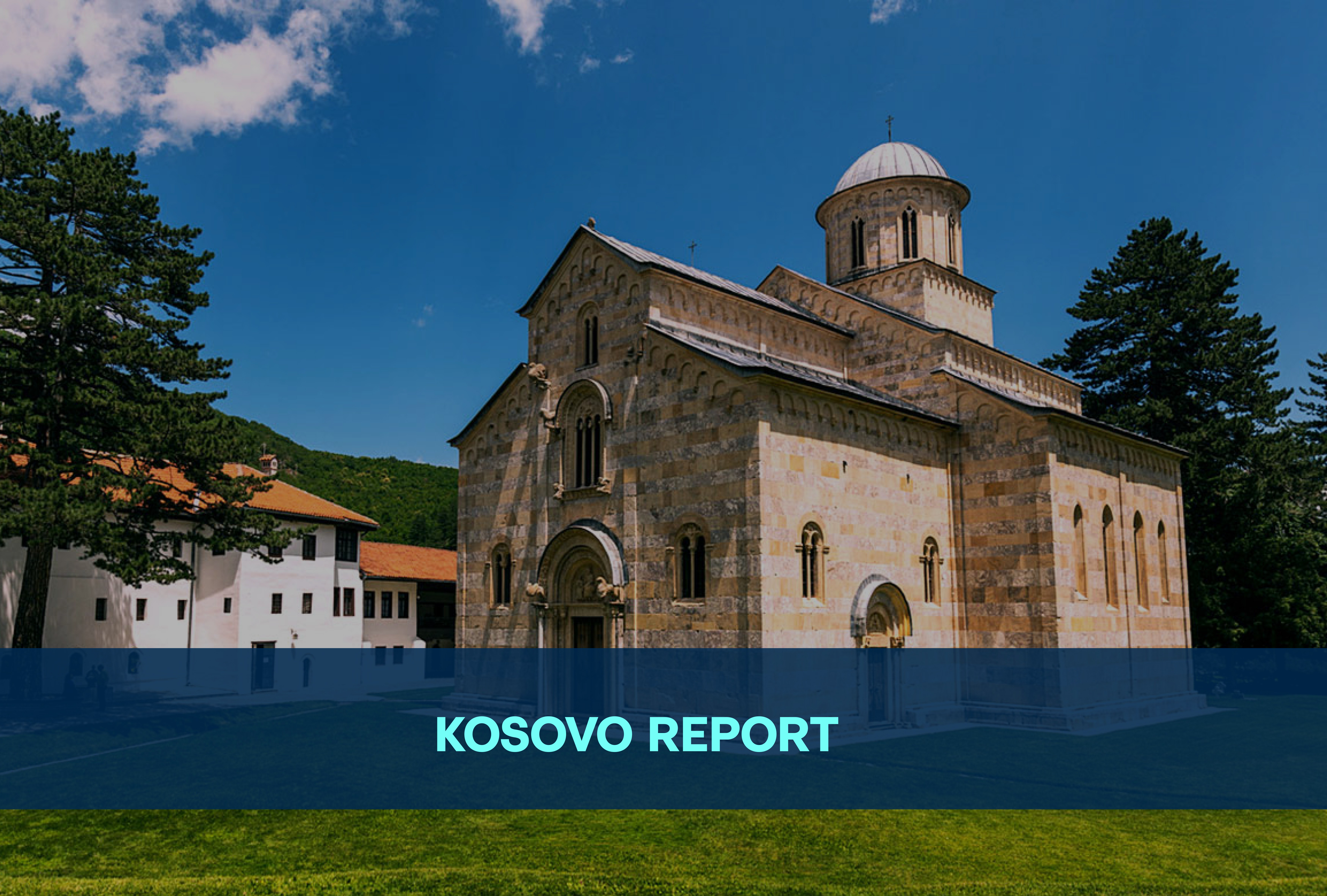
Silence Is Not Safety: Rights Before Politics in Kosovo
Rights Before Politics: Protecting the Serbian Community and Religious Heritage in Kosovo
Read time:
4
min
Aug 25, 2026
text
Membership Without Benefits: Serbia’s Place in WAICO
Why Serbia’s WAICO membership creates alignment risks, with no clear economic or strategic benefits.