Vuk Velebit, Aleksa Jovanović, Petar Ivić
Silence Is Not Safety: Rights Before Politics in Kosovo
Rights Before Politics: Protecting the Serbian Community and Religious Heritage in Kosovo
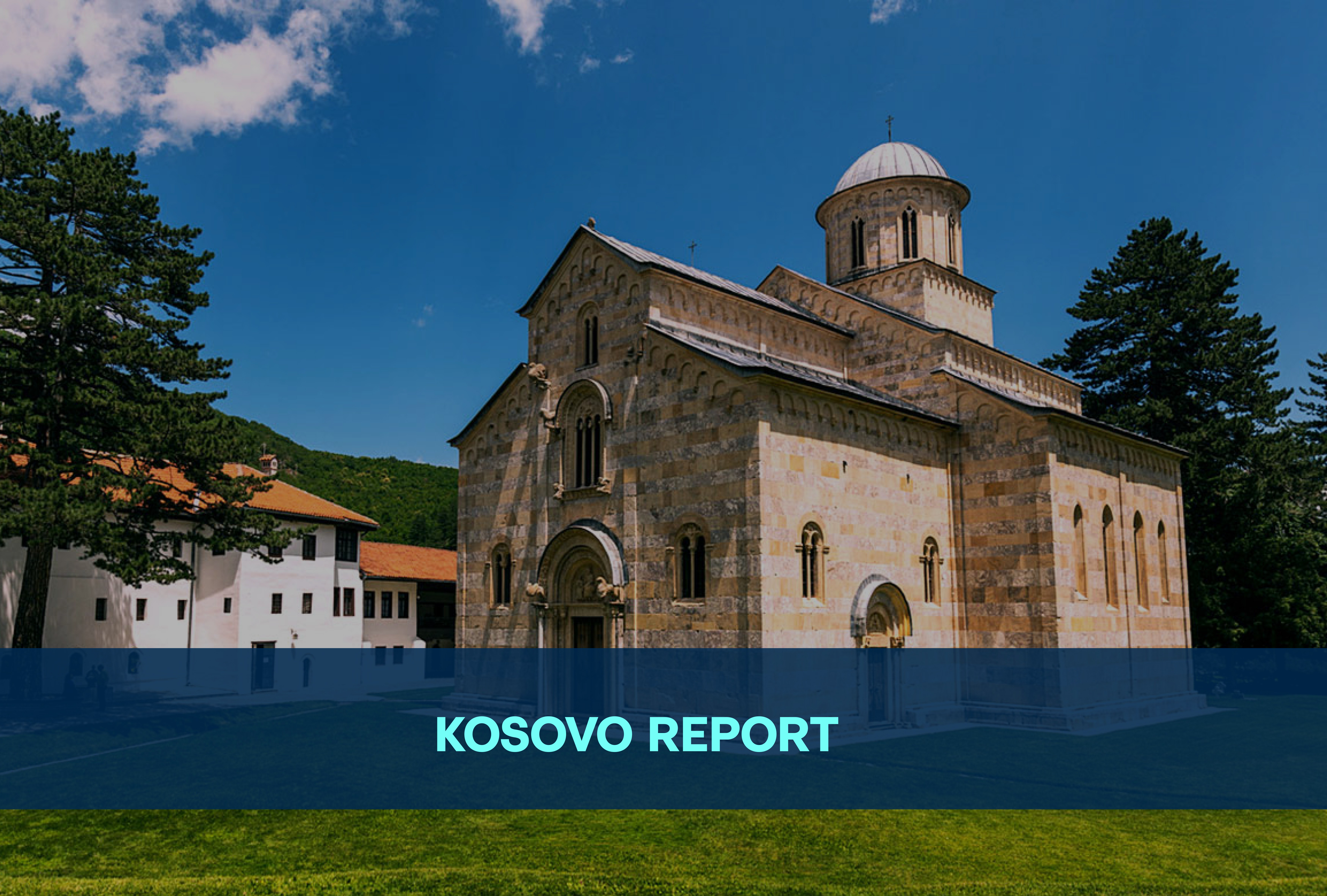
Why falling incident reports in Kosovo are not evidence of improvement, and what that means for EU and NATO decisions
1. Executive summary
In August 2026, eight days apart, two things happened in Kosovo that do not easily belong to the same story. On 10 August, KFOR announced that it was beginning a gradual transition away from its permanent presence at the main bridge over the Ibar, citing an improved security situation; the European Commission assessed that the requirement of consultation with security partners had been met. On 18 August, the Kosovo Police Inspectorate recommended the suspension of two officers on suspicion of ill-treatment in the exercise of official duty, in the case of Nenad Rašković from Dren near Zubin Potok, who was transferred to Belgrade for treatment because of the severity of his injuries.
This report does not claim that either of those things is false. It argues that they measure different things, and that international decisions increasingly rest on an indicator that systematically understates what it is meant to capture. The central finding, drawn from three testimonies gathered for this Initiative, is this: willingness to report incidents is declining, because the institution to which a complaint must be submitted is often the same one that residents identify as the source of the harm. As reporting falls, so does the visible statistic; the falling statistic is then read as improved security, and improved security becomes the basis for reducing international presence. Silence thus becomes evidence of its own justification.
The principal recommendation that follows is therefore not political but methodological: before further steps premised on “improved security”, an independent verification mechanism is needed that measures trust and access to justice, not merely the number of complaints filed. The Dren case shows that such mechanisms exist in Kosovo and can work when activated. The question is whether they will be allowed to work often enough, quickly enough, and publicly enough for the community to start using them again.
We also issue an urgent appeal. Ahead of the Kosovo Specialist Chambers judgment scheduled for 16 September 2026, a heightened risk of incidents directed against the Serbian community and its holy sites is realistically to be expected — whatever the verdict may be. We call on KFOR, EULEX, the OSCE, the European Union and the U.S. Embassy to give particular attention to the security of the Serbian community during that period, and to act preventively rather than in response to incidents already recorded.
2. Two Augusts: a paradox no one has explained
For years, debate about the position of the Serbian community has been conducted in two registers that barely touch. In the first, dominant in Belgrade, the subject is a sequence of violence and pressure intended to drive people out. In the second, dominant in Pristina and in part of the international public, the subject is the ordinary application of the law, punctuated by occasional excesses handled through regular channels. Both rest on figures whose reliability is assumed rather than tested: if Belgrade has an interest in presenting every incident as a pattern, Pristina has an interest in presenting every pattern as an incident.
International actors, under pressure to make operational decisions — on the size of a mission, on opening a bridge, on the pace of integration — reach for what looks like a neutral measure: how many incidents have been recorded. This is where the problem this report seeks to name begins. The measure is not neutral. It depends on people's willingness to approach institutions, and that willingness is itself in dispute. If it declines, the measure grows quieter precisely as conditions worsen.
When citizens see that complaints rarely lead to any judicial outcome, they gradually stop filing them. That in turn artificially lowers the visible figures and creates a false impression of improvement, instead of revealing the true scale of the problem. — Jovana Radosavljević
3. The mechanism of silence
Jovana Radosavljević, who has worked with the Serbian community in the civil sector for years, describes a closed loop: a citizen experiences an incident — during a check, a search, a detention or an administrative procedure — and then faces the question of whom to report it to, since in a significant share of cases the body he would turn to is the very one whose conduct he is contesting. He weighs the risk of further exposure against slim prospects of an outcome. And he lets it go.
The Rašković case is a textbook illustration. As she puts it: when the alleged perpetrator and the address for reporting the incident are the same institution, it is very hard to convince anyone that a complaint will help rather than expose him to further risk. The consequence is not only a personal injustice — it is a missing data point.
She places this dynamic in a clear chronology. She identifies the turning point in autumn 2021, when a large police operation conducted simultaneously in Pristina, Peć and both parts of Mitrovica — without entrusting the local police in the north — triggered unrest and established a pattern: decisions taken and executed around and above local, largely Serb institutions. Recentralisation of services that had functioned locally for decades followed, and then an institutional vacuum: in November 2022, Serb police officers, judges and municipal staff resigned en masse. That vacuum, she says, was not closed through dialogue; it was filled by a police force that in practice became an instrument of one political party rather than a neutral service for all citizens.
What exhausts the community, in her account, is not any single case but the simultaneity of pressure on several fronts at once — institutional, legal, property-related, identity-related, cultural, and on freedom of movement. “We do not have the capacity to track each of these, let alone to contest them all successfully.” A community with limited resources is forced to choose which violations it will document at all — another rarely noticed reason why the statistics show less than what occurs.
Archimandrite Sava Janjić, Abbot of Visoki Dečani Monastery, independently describes the same mechanism from another angle. He speaks of a cumulative effect: one arrest, one ban, one demolition, one check, one unanswered request — each item can be explained away individually as an isolated case. But the sum of those items produces a sense that life has become unpredictable and that institutions are not there to protect, but have become an instrument of force. His assessment of trust in the police is categorical.
People often tell us that what they need is not police protection, but protection from police pressure, threats and intimidation. An atmosphere of collective guilt attaching to Serbs is increasingly taking hold in Kosovo and Metohija, which in the long run may make the situation considerably worse. — Archimandrite Sava Janjić
These are claims that can be tested — and that should be tested, rather than simply accepted or dismissed. If they are accurate, the data underpinning international assessments are systematically biased downwards, and the more so the worse conditions become. If they are not, independent measurement will show as much, and the argument falls away. Either way, the result is something that does not exist today: a reliable basis for decision-making.
4. Gazimestan: testimony of a detained worshipper
On Vidovdan, 28 June 2026, following the memorial service at Gazimestan, the Kosovo Police detained 37 people. According to the judicial outcome, 36 of them received fines of €700 each, while some were removed from Kosovo and banned from entry for several years. Those detained were initially charged with inciting inter-ethnic conflict, and ultimately convicted of disturbing public order by singing and chanting.
The Initiative has gathered direct testimony from one of the detained worshippers. His identity is known to the Initiative and withheld at his request, owing to a well-founded fear of consequences. His account is set out below in the first person.
4.1 Arrival and the service
The witness states that he travelled to Gazimestan as a worshipper, for Vidovdan and the memorial service, together with thousands of other Orthodox believers. A heavy police presence was evident from the moment of arrival, including intervention and special units. Detailed searches were conducted at the entrance, and people were asked to remove or hand over certain items bearing Serbian and even religious insignia. Despite this, the service itself passed peacefully, in prayer and silence. Afterwards, Orthodox religious songs were played over the loudspeakers and those gathered continued to sing; chants of “Kosovo” and “Serbia” were also heard.
4.2 The closed gate
At a certain point, the witness says, officers deployed around the monument began — without prior warning — to close in on the crowd in a ring formation. People understood this as a signal that the gathering was over and moved calmly towards the exit. The exit gate, however, was closed, and people were let through one at a time, in intense heat and with no access to water. It was during that exit that the detentions began, without any clear prior warning or explanation of why particular individuals were being singled out. Two minors were among those detained.
The witness states that he was detained as he was leaving, that he did not resist, and that he was not told at that moment why he was being deprived of his liberty. He was taken to a prefabricated structure beside the exit gate, where other detainees were also being held; their hands were then bound with plastic ties, and they were transported by police vehicles to a police station near the Pristina prison. Only later, in the course of the court proceedings, did it become clearer what they were charged with.
4.3 Treatment on police premises
The witness describes rough treatment. The plastic ties were fastened tightly, leaving some detainees with injuries to their wrists. On police premises, he states, there was physical and psychological ill-treatment: people were struck, insulted and spat upon. Some detainees were forced to say “Kosovo – Albania” and “Kosovo – Republic”, and were struck again if they refused. He also describes blows to the back of the head, the use of batons, and injuries caused when the ties were removed.
In the initial phase of detention, according to the testimony, detainees were not allowed to secure legal representation or to make a telephone call; nor were they given access to a toilet or to water. They came into contact with lawyers only after being transferred to the court in Pristina, where five lawyers were engaged through the Office for Kosovo and Metohija and the Municipality of Gračanica. Defence counsel immediately drew attention to violations of the detainees’ rights and to the conduct of the police.
Photographs of injuries exist — bruising and other injuries — and the detainees, in consultation with their lawyers, drew up a document describing police conduct and requesting an urgent, independent and impartial investigation, the identification of the officers involved, and the initiation of appropriate disciplinary, misdemeanour and criminal proceedings. The Ombudsperson Institution opened an investigation on the basis of citizens' complaints, information from non-governmental organisations and media reports. The Police Inspectorate initially assessed the conduct that day as professional, and subsequently, upon receiving complaints, opened proceedings.
4.4 What the witness asks for
The most striking feature of this testimony is that the witness does not ask to be taken at his word. He states explicitly that he would not ask international institutions to accept anyone's version of events without verification — on the contrary, he asks that the facts be established. If the police acted lawfully, he says, an independent investigation can demonstrate that. But if detained people were struck, humiliated, insulted or compelled to recite political slogans, then it must be established who did so and who bears responsibility.
I went to Gazimestan that day as a worshipper, to attend a memorial service. I did not expect that it would end with me bound, detained, and in a police station. We are not asking for privileges, but for institutions to treat us in accordance with the same rules and standards that should apply to everyone. — participant in the Vidovdan gathering, detained 28 June 2026
That is, in a single sentence, the entire request of this report. Gazimestan is therefore useful not as proof of anyone's guilt, but as a test of procedure: whether the legal basis was communicated at the moment of arrest; whether access to counsel was provided; whether water, toilet facilities and medical assistance were available; whether the use of restraint was proportionate; and whether the investigations that have been opened will be completed, published and acted upon.
5. Dren: proof that the mechanisms can work
On 11 August 2026, police officers entered the home of Nenad Rašković in the village of Dren near Zubin Potok. According to his account and reporting in Serbian media, he was beaten following a search; because of the severity of his injuries, his treatment continued at the Emergency Centre of the University Clinical Centre of Serbia in Belgrade. Pristina contests the account of the event.
What followed matters more than the dispute over the facts. The Kosovo Police Inspectorate opened a preliminary investigation ex officio on 12 August and, on 18 August, recommended the suspension of two officers of the North Mitrovica Regional Police Directorate on suspicion of the criminal offence of ill-treatment in the exercise of official duty or public authority.
This is, and it should be said plainly, a Kosovo institution acting in favour of a Serb citizen — and a report that failed to acknowledge it would not deserve to be believed. The existence of the Police Inspectorate and the Ombudsperson is not a formality; these are mechanisms designed for precisely such cases, and in August they were activated. Any analysis that passes over them in silence in order to paint a darker picture forfeits its claim to credibility.
The Abbot of Dečani takes the same position, and this is perhaps the most important point of agreement in the entire body of material. He stresses that if there are any suspicions concerning weapons or criminal responsibility, they must be examined in lawful proceedings — but that no suspicion, however serious, can justify beating, humiliation, the extraction of confessions or the intimidation of a family. In other words, the Church does not seek exemption from the law for its faithful; it asks that the law be applied to both sides.
This is precisely why the rule of law is essential, because without it truth and justice are easily replaced by fear and force. — Archimandrite Sava Janjić
Yet the same case yields the opposite conclusion as well. A suspension is a recommendation in disciplinary proceedings, not a judicial outcome, and the road from recommendation to final judgment has often been broken off in earlier cases. If that road is not travelled and publicly documented, the Dren case will not repair trust — it will confirm the pattern in which proceedings are opened, media attention fades, and the file quietly disappears. One completed and published case is worth more than any declaration.
6. Heritage: when a right depends on goodwill
The same logic — the gap between a formal guarantee and its application — is clearest in the question of religious heritage. The 2016 Constitutional Court decision confirming the property rights of Visoki Dečani Monastery over 24 hectares of land was implemented only in 2024. The Abbot stresses that the ruling was not a political concession to the Church but a final and binding judicial decision, and that the fact its enforcement took eight years shows that even the highest legal acts can remain inert where there is no political will to apply the law equally to all.
If a monastery under UNESCO protection, with a clear Constitutional Court decision and with the attention of the international community, must wait eight years for a judgment to be enforced, then one may reasonably ask what less visible church communities, parishes, families and individuals without such international attention can expect. — Archimandrite Sava Janjić
Methodologically, this is the single most important observation in the document. Dečani is the most brightly lit point in the system: internationally known, legally uncontested, diplomatically monitored. If enforcement there took eight years, then visible cases are not representative of the system — they are its best performance, not its average one.
The same applies to the Special Protective Zones. Their legal purpose, the Abbot emphasises, is not the protection of monuments as architectural objects but the preservation of living religious life, monastic peace, the identity of holy sites and their natural and historical surroundings. In practice, however, they are treated as a technical or administrative matter: works proceed without timely consultation with the Church, the Implementation and Monitoring Council (IMC) is bypassed or convenes rarely, and existing agreements are not honoured. Where that is so, formal protection becomes something that depends on the goodwill of institutions.
That is not the rule of law. Rights that depend on discretionary permission are not genuinely protected rights. — Archimandrite Sava Janjić
Hence the Church's concrete request: that protection be secured through a dedicated mechanism, internationally guaranteed and resilient to administrative pressure and changes of government. The existing provisions deriving from the Ahtisaari Plan, the Abbot notes, are applied ever more selectively, and their implementation is at times openly avoided. The risk he identifies is that protection of holy sites is reduced to declaratory support while new facts are created on the ground that present the Church with a fait accompli.
How the Abbot defines religious freedom is also important, because that definition is considerably broader than what is usually assumed. Religious freedom is not merely a question of whether the Liturgy is formally permitted. It includes the ability of a priest to reach his church freely, without he and his congregation being searched and treated in a humiliating manner; that the faithful take part in services without fear; that cemeteries are not desecrated; that church property is respected; that court decisions are enforced; and that holy sites are neither renamed nor appropriated. He also points to pressure in parts of the media and on social networks, where content is circulated that incites intolerance towards the Serbian community and the Church.
7. The new security architecture and diffused responsibility
The process KFOR announced on 12 June 2026, described as an optimisation of its posture, is presented as transparent, consistent, measured and gradual. Its best-known element — the transition away from a permanent presence at the main bridge over the Ibar, begun on 10 August — has been read publicly as a withdrawal. The picture is more complex, and this report is obliged to say so: the KFOR Commander, Major General Özkan Ulutaş, stated on 25 August that the mission's presence would be increased in some areas, “including but not limited to North Mitrovica and the north of Kosovo”, and that the mission continues its regular patrols, observation posts and engagement with local communities.
This is therefore a redistribution rather than a departure. But the way that redistribution is being carried out raises two questions that are fundamental for the Serbian community. First: who takes over the tasks KFOR is stepping back from. The mission emphasises that it implements its mandate under Resolution 1244 impartially and in close coordination with the Kosovo Police and EULEX. If, however, the centre of gravity of security presence at the bridge and in the Visoki Dečani zone shifts towards the Kosovo Police, then the guarantee of impartiality is operationalised through the very institution whose conduct is the subject of Ombudsperson and Police Inspectorate investigations. This is not an accusation against KFOR — it is a description of a structural problem that all three testimonies in this report confirm from their own vantage points.
Second: who actually decides. The Commander of NATO's Joint Force Command Naples, Admiral George Wikoff, stated explicitly that KFOR has no mandate to decide whether the bridge should be opened and that this rests with the European Union and the competent Kosovo institutions. The European Commission, for its part, assessed that the requirement of consultation with security partners had been met precisely on the basis of KFOR's notification, while expecting “effective coordination and meaningful consultation” between the Municipality of North Mitrovica and central institutions. NATO's message is that any decision should take into account the needs of all communities.
Taken individually, each of these statements is reasonable. Taken together, they describe a system in which no actor carries the decision as a whole: the EU relies on a military mission's assessment, the military mission says it is not competent for a political decision, and allied command asks that account be taken of the needs of communities whose trust no one systematically measures. In such an arrangement of responsibility, the indicator “improved security situation” carries far more weight than it can bear — because, as this report argues, that indicator is systematically understated.
The consequence is concrete and dated. References to 1 September as a possible moment for opening the bridge raised anxiety in the north, and the President of Serbia announced that he would, if necessary, seek talks at every level in the United States, describing it as a question of people's lives and survival. The Initiative represents no government and takes no position on those political moves. But the very fact that the security regime at a single bridge migrates to the level of talks with the U.S. administration is itself a data point: it indicates how little trust remains in local mechanisms. International actors should treat that as a warning rather than an inconvenience.
The Abbot of Dečani makes the same point from another direction. The fact that certain monasteries still require special KFOR security guarantees after so many years, he says, “speaks for itself” — it is not a normal state of affairs, but in present circumstances it is necessary. If the Visoki Dečani zone is therefore to be folded into a new security architecture, that requires a far more serious justification than has been offered so far — and, above all, prior consultation with the community that lives there.
8. The administrative reshaping of reality
The least visible and probably most effective layer of pressure is not policing but administration — and it almost never enters incident statistics, because formally it is not an incident.
An illustration cited by Jovana Radosavljević concerns Gazimestan itself. Among those removed from Kosovo were Serbs who actually live there but who have spent years unsuccessfully trying to resolve their civil status and obtain Kosovo documents. In other words, a person can be removed from the place where he has lived for years simply because the institutions never issued him the document confirming it. The question has acquired added weight through the application of the Law on Foreigners, whose effects — treating long-term residents as foreign nationals for the purposes of residence, work and access to services — have drawn concern from international actors as well. She adds that detainees had their documents returned only after paying the fines imposed on them.
She also points to an asymmetry that is hard to explain on security grounds: while Albanian symbols are displayed freely and abundantly, Serbian symbols — a song, three fingers, lettering on a T-shirt — are treated as an offence prosecuted before a court. “It is hard to find a clearer illustration of double standards than this.”
The same pattern includes the demolition of structures on the shore of Lake Gazivode, carried out while legalisation procedures were still pending; the continuation of works in the protected zone around Dečani despite the Diocese's objections; the arrest of Dušan Arsić from Butovac just days after he filed a court claim to protect his own property, registered for years in someone else's name; and the abolition or “integration” of institutions that had functioned in Serb communities for decades. Each of those decisions has a proper administrative form. None is counted as an incident. Together, they change the conditions of life faster than any individual clash.
8.1 The closed door of the judiciary
The most significant recent development came on 27 August. The Kosovo Judicial Council rejected — by nine votes in favour, one against and one abstention — the request by Serb judges and judicial staff to withdraw their 2022 resignations and return to work, and the acting President announced that they would be dismissed forthwith. The same pattern had already been applied in the prosecution service: on 20 July the Prosecutorial Council rejected the withdrawal of resignations by five prosecutors and fifteen support staff, and a day later decrees dismissing seven Serb prosecutors were signed.
It is important to hear the reasoning on both sides here, because it illustrates the nature of the dispute well. Council member Artan Abazi held that the 2022 resignations were irrevocable and that the law and practice had changed in the meantime. Against this, member Ivana Milenković warned that rejecting the request would create a legal and institutional vacuum that, under the applicable law on courts, cannot be filled quickly — and that accepting the withdrawal of the resignations would have fulfilled a constitutional guarantee owed to citizens.
For this report's argument, that development is decisive for one reason. The mechanism of silence rests on the citizen having no one to turn to. The decision of 27 August does not mitigate that fact; it formalises it. The door to institutional return, open at least in principle since 2022, has now been closed by the judicial system itself. It is all the more significant, therefore, that on 31 August the German Embassy in Pristina urged that vacancies in judicial institutions reserved for Serbs be filled as soon as possible, describing Serb judicial staff as essential to providing legal services to the community. Unlike most declarations, that is a demand that can be measured.
In parallel, the institutional crisis that followed the elections of 7 June 2026 — with the Assembly unconstituted for months — has begun to resolve: the Vetëvendosje Movement and the Democratic League of Kosovo negotiated over a presidential candidate, reaching agreement on 31 August. An exit from the vacuum is, in itself, good news. But it is worth noting that it is unfolding as an arrangement between Albanian political actors, with representatives of the Serbian community playing no part in the process — which means institutions may be restored while the question of the non-majority community's trust in them remains exactly where it was.
9. The Hague, 16 September: a precedent that already exists
On 16 September 2026, the Kosovo Specialist Chambers in The Hague are expected to deliver a first-instance judgment against Hashim Thaçi, Kadri Veseli, Rexhep Selimi and Jakup Krasniqi. The Initiative does not prejudge the outcome: the presumption of innocence applies until the judgment is final, and a first-instance ruling is in any event not the end of proceedings — an appeal phase follows in which a judgment may be upheld, modified or overturned, while allegations of contempt of court and witness interference are being handled separately.
For this report, however, what matters is not the content of the judgment but the reason that court exists at all. The Specialist Chambers grew out of years of criticism of how war crimes proceedings were conducted in Kosovo. As the lawyer Zoran Živanović explains, after 1999 proceedings were brought mainly against Serbs, while a considerably smaller number of Albanians were prosecuted; the conclusion reached was that trials before Kosovo institutions do not produce results, because influence over investigative bodies, the prosecution and the courts is exceptionally strong. The solution was to relocate the Chambers to The Hague — while formally keeping them part of Kosovo's judicial system.
In institutional terms, that is the most expensive possible admission of a single proposition: that impartiality within Kosovo's judiciary, in politically sensitive cases implicating members of the majority community, cannot be assumed but must be constructed. That conclusion was not reached by Belgrade or by the Serbian community, but by the international actors who helped Kosovo build its institutions.
If that logic was accepted for the period 1998–2000, then the same question must be asked for 2026. We are not asking for a new international court — we are asking that verification of allegations about police conduct not rest exclusively on the institution whose conduct is contested. — Pupin Initiative
The Specialist Chambers are, in other words, a precedent for this document's central request. Verification, which in the case of war crimes was resolved by relocating jurisdiction, is today sought in an incomparably smaller and easier class of cases — Gazimestan, Dren — in a far more modest form: independent investigations, published findings, and a reporting channel outside the police chain. If the more radical solution was acceptable for the graver cases, it is difficult to explain why a milder mechanism for lesser ones would not be.
It is also worth noting what the indictment covers. According to Živanović, it charges the four accused not only with crimes against Serbs and other non-Albanians, but also with crimes against Albanians who were political opponents of the KLA — above all from the party of Ibrahim Rugova, which pursued the same political goal by non-violent means. This is therefore not an ethnic ledger but a question of how a structure of power treats the individual — precisely the frame this report defends in every preceding chapter.
Finally, one detail of those proceedings directly corroborates the thesis of the mechanism of silence. The allegations from Dick Marty's report concerning organ trafficking are not covered by this indictment; the historian Stefan Radojković notes that they relate to the period after July 1999 and that, beyond the question of political decision, what proved decisive was what could be proven at all. Securing evidence and witnesses proved extremely difficult: the level of concealment was such that, in practice, there were neither witnesses nor cooperating witnesses. It is for the same reason that separate proceedings are being conducted over pressure on witnesses.
With that, the circle closes. Where fear governs, evidence disappears — not only in the everyday cases our interlocutors describe, but in the largest proceedings as well, decades later. Silence carries an institutional cost measured in generations.
9.1 Anticipated elevated risk around 16 September
The Initiative must, however, warn of something more immediate for the Serbian community than any legal analysis. Whatever judgment is delivered, a heightened risk of incidents directed against Serbs and Serbian holy sites in the days around 16 September is realistically to be expected. That conclusion rests not on a prediction of anyone's behaviour, but on three verifiable factors.
First, both possible outcomes carry mobilising potential: a conviction will be experienced in parts of the public as an attack on the liberation narrative and on men regarded as founders of the state, while an acquittal or a lighter sentence could be read as vindication of that narrative and as an invitation to politically charged celebration. Second, conditions on the ground are already sensitive because of the announced change to the security regime at the Ibar bridge and the optimisation of KFOR's presence. Third — and most importantly — the community does not believe it will be protected: the testimonies gathered for this report agree in assessing that trust in protection does not exist, and the Abbot of Dečani points explicitly to content in parts of the media and on social networks that incites intolerance towards the Serbian community and the Church.
The risk therefore does not arise from anyone's ethnicity, nor does the Initiative accuse any community in advance. It arises from a familiar combination: a powerful symbolic occasion, an inflamed media atmosphere, a delicate moment in the security architecture, and a community with no confidence that it will be protected. In any other European setting, that combination would be grounds for heightened preventive measures announced in advance.
We call on KFOR, EULEX, the OSCE, the European Union and the Embassy of the United States to give particular attention, in the period around the delivery of the judgment, to the security of the Serbian community, its holy sites, cemeteries and returnee settlements — and to do so preventively, before incidents occur, rather than reactively once they have been recorded. — Pupin Initiative
In practical terms, this means a reinforced and visible presence at locations exposed to attack in earlier crises; temporary strengthening of protection for monasteries and churches, including Visoki Dečani; postponement of any change to the security regime at the Ibar bridge and around the protected zones for the duration of the elevated-risk period; enhanced monitoring of hate speech on social networks; and a clear public message from Kosovo institutions that any reprisal against civilians will be sanctioned. The measure of success is not the number of responses after incidents, but the absence of incidents.
Finally, the judgment of 16 September will almost certainly be instrumentalised on all sides. The Initiative's position is that it should be read as an event in the rule of law rather than as a point scored in a national contest — and that no judicial outcome, whatever it may be, can become a justification for pressure on people who have nothing to do with those proceedings.
10. Why this is a European question, not a Serbian one
A widespread objection holds that the security of Serbs in Kosovo is an instrument of day-to-day politics rather than a genuine human rights question. Our interlocutor considers that objection not merely mistaken but dangerous, and answers it with a legal argument: the obligations at issue derive not from the bilateral dialogue between Belgrade and Pristina, but from the Constitution of Kosovo, the Ahtisaari Plan and the European Convention on Human Rights. They are owed to every individual citizen regardless of whether the dialogue is advancing, stalled or, as now, effectively frozen.
Her formulation is sharp and worth quoting in full: reducing the security of Serbs to “daily politics” is a way of diluting responsibility and shifting it to a negotiating table that no one knows will ever produce results. “Whoever claims this is a matter of daily politics is in fact admitting that he does not care whether someone gets home safely today.”
From this follows her criticism of international actors, which this report conveys as her assessment but which merits a response. She considers that OSCE recommendations and EULEX reports are treated as a formality to be endured rather than an obligation to be met — and that the international community sometimes rewards before conditions have been met, whether through announcements of a reduced KFOR presence or through the assessment that conditions for opening the Ibar bridge have been satisfied at a moment when trust on the ground has plainly not been established. The message this sends, she says, is that a show of force yields better results than cooperation. A multi-ethnic Kosovo, she recalls, is an obligation of the very international community that stood behind the creation of Kosovo's institutions after 1999.
There is also an illustration that shows best why the national frame misses the point. The Rašković family from Dren: two of the brothers are married to Albanian women and, according to a statement by Visoki Dečani Monastery, the families had lived in peace until this event. What happened was not an inter-ethnic clash — it is a question of how a state body treats a citizen.
The Abbot of Dečani rounds this off with an argument that should be the opening sentence of every conversation on the subject: this is not about privilege, but about the application of already existing rights to a vulnerable community. Protecting monasteries, churches, cemeteries, property, worshippers and clergy threatens no one — on the contrary, it strengthens the rule of law, trust between communities and the credibility of institutions. “If the most vulnerable are protected, then the whole of society will be more stable.”
11. What is concretely on the table
The table below sets out the factual basis of this report, with the degree of confirmation indicated for each item.
Event/indicator | Source | Status |
|---|---|---|
37 people detained at Gazimestan on Vidovdan, 28 June 2026; €700 fines, removals and multi-year entry bans; two minors among those detained | Kosovo Police; Basic Court in Pristina; testimony of a detainee; BIRN | Confirmed |
Access to counsel and to a telephone call denied in the initial phase of detention; water and toilet access denied | Direct testimony of a detainee; submissions by defence counsel | Testimony — under investigation |
Allegations of physical and psychological ill-treatment on police premises; photographs of injuries | Direct testimony; photographic documentation; complaints by defence counsel | Under Ombudsperson investigation |
Police Inspectorate (PIK): preliminary investigation opened 12 Aug; on 18 Aug recommended the suspension of two officers on suspicion of ill-treatment in the exercise of official duty (Dren case) | PIK statement; RTS, Tanjug, Politika | Confirmed |
Nenad Rašković seriously injured; treatment continued at the Emergency Centre of the University Clinical Centre of Serbia in Belgrade | RTS; Euronews Serbia | Allegations contested — under investigation |
Dečani: 2016 Constitutional Court ruling implemented only in 2024, under Council of Europe pressure | Constitutional Court of Kosovo; Council of Europe; Diocese | Confirmed |
KFOR: optimisation of posture announced 12 June 2026; transition from the Ibar bridge began 10 Aug; presence simultaneously to be increased in North Mitrovica and the north | KFOR statements; remarks by Maj. Gen. Ulutaş (25 Aug) | Confirmed |
Kosovo Judicial Council on 27 Aug rejected the request by Serb judges and staff to withdraw their 2022 resignations (9 in favour, 1 against, 1 abstention); dismissals announced | Kosovo Judicial Council; Koha; N1 | Confirmed |
Prosecutorial Council rejected withdrawal of resignations on 20 July; decrees dismissing seven Serb prosecutors signed on 21 July | Kosovo Prosecutorial Council; reporting from Pristina | Confirmed |
Kosovo Specialist Chambers: first-instance judgment against Thaçi, Veseli, Selimi and Krasniqi expected 16 Sept 2026; appeals to follow, with separate proceedings on witness interference | Kosovo Specialist Chambers; Euronews Serbia (6 Sept 2026) | Pending — outcome uncertain |
Institutional vacuum: Assembly not constituted after the 7 June 2026 elections; agreement on a presidential candidate reached 31 Aug | Constitutional Court of Kosovo; statements by Kurti and Abdixhiku | Confirmed |
12. Recommendations
These recommendations are deliberately operational and measurable. None of them asks that anyone's version of events be accepted without verification.
Preventive measures around the Hague judgment. In the days before and after 16 September, ensure a reinforced and visible KFOR presence and enhanced EULEX and OSCE monitoring at locations exposed to risk — Serb settlements, returnee sites, cemeteries and monasteries, including Visoki Dečani — and postpone any change to the security regime at the Ibar bridge and around the protected zones for the duration of the elevated-risk period. The measure of success is the absence of incidents, not the speed of response after them.
Verification before reduction. Before further steps altering the security regime at sensitive locations (the Ibar bridge, the Visoki Dečani zone), conduct an independent assessment that measures trust and access to justice — through community surveys, non-reporting rates and case outcomes — rather than the number of recorded incidents alone. The precedent already exists: the Specialist Chambers were established precisely because impartiality in sensitive cases could not be assumed.
Complete and publish the proceedings already opened. Conclude the Ombudsperson and Police Inspectorate investigations into Gazimestan and the Dren case within a reasonable time, with publicly available findings and a clear procedural outcome. The suspension recommendation must have a judicial sequel, or a stated explanation of why it does not.
Examine the treatment of those detained at Gazimestan. Establish whether the legal basis was communicated at the moment of arrest, whether timely access to counsel and to a telephone call was provided, whether water, toilet facilities and medical assistance were available, and whether the use of restraint — including the method of binding and the treatment of the two minors — was proportionate.
Reopen the path back into the judiciary. Fill the vacancies in judicial institutions reserved for the Serbian community, in line with the German Embassy's call of 31 August, and establish a transparent mechanism for doing so — because a system in which a citizen has no one to turn to cannot generate reliable security data.
Establish a reporting channel outside the police chain. Enable incidents to be reported to a body independent of the institution whose conduct is contested, with protection for complainants, and ensure regular public reporting by EULEX and the OSCE on complaints received and their outcomes.
Strengthen the protection regime for the Serbian Orthodox Church. Ensure the regular and effective functioning of the Implementation and Monitoring Council (IMC), mandatory prior consultation for all works within Special Protective Zones, consistent enforcement of court decisions concerning church property, and consideration of a more durable, internationally guaranteed protection mechanism.
Separate administrative measures from political objectives. Monitor the effects of the Law on Foreigners, of status and property proceedings, of demolitions and of the “integration” of institutions as a distinct human rights indicator, independent of the state of the dialogue, together with a mechanism to resolve the unsettled civil status of long-term residents.
13. Note on methodology
This report draws on three testimonies gathered for the Pupin Initiative: written answers from Archimandrite Sava Janjić, Abbot of Visoki Dečani Monastery; analytical answers from Jovana Radosavljević, based on years of work with the Serbian community; and direct testimony from a participant in the Vidovdan gathering at Gazimestan, detained on 28 June 2026, whose identity is known to the Initiative and withheld at his request.
The testimonies are presented as the accounts of identified individuals and are marked as such. Where allegations are the subject of ongoing proceedings — above all the allegations concerning police conduct at Gazimestan and in Dren — this is stated explicitly, not because the credibility of the witnesses is in doubt, but because the legal outcome has not yet been established and because this report exists precisely in order to ask that it be. It is likewise stated that Pristina contests the account in the Dren case.
Statements by international actors (KFOR, NATO, the European Commission, the German Embassy) are taken from their own communications and public appearances, and decisions of Kosovo institutions from those institutions' own statements and reporting from Pristina. In the part concerning proceedings before the Kosovo Specialist Chambers, the Initiative does not prejudge the outcome and consistently applies the presumption of innocence; those proceedings are cited solely for the institutional reason the Chambers were created, not in order to assess guilt. Claims from Serbian state sources and media, including the records of the Office for Kosovo and Metohija, are used with their provenance indicated and, where possible, cross-checked against independent sources. Actions by Kosovo institutions that favoured the injured party are stated explicitly, because a report that passed over them in silence would not merit its addressees' confidence.
This document represents no party and no government, and takes no position on the political conduct of either Belgrade or Pristina. It proceeds from the view that the same human rights standards the international community demands of Belgrade must be applied consistently to Pristina — and that verification, not belief, is the only way to establish whether they are.
Other Analysis

Read time:
20
min
Oct 25, 2026
text
Why the USA and Serbia Need a Tax Treaty?
How a tax treaty and totalization agreement can deepen the growing U.S.–Serbia economic partnership.
Read time:
45
min
Sep 10, 2026
text
Silence Is Not Safety: Rights Before Politics in Kosovo
Rights Before Politics: Protecting the Serbian Community and Religious Heritage in Kosovo

Read time:
4
min
Aug 25, 2026
text
Membership Without Benefits: Serbia’s Place in WAICO
Why Serbia’s WAICO membership creates alignment risks, with no clear economic or strategic benefits.