Vuk Velebit, Aleksa Jovanović, Petar Ivić
Serbia’s Nuclear Choice: Why Western Technology Suits Best
Serbia’s nuclear choice shapes energy security, alliances, and long-term strategic autonomy today
Introduction: Serbia’s Nuclear Question as a Statecraft Decision
Ursula von der Leyen’s March 10, 2026, warning that Europe became “completely dependent on expensive and volatile imports” of fossil fuels, and that reducing nuclear energy was “a strategic mistake,” captures the core strategic dilemma facing the continent today. The point is not simply that nuclear power is low-carbon; it is that abandoning it increased Europe’s exposure to external price shocks, import dependence, and geopolitical coercion. Read in that light, nuclear energy becomes more than an electricity choice: it becomes a pillar of industrial competitiveness, strategic resilience, and political autonomy. For Serbia, this logic is especially relevant. A future nuclear program should not be evaluated only through upfront cost or vendor politics, but through its ability to reduce external vulnerability and anchor the country more securely within a stable European energy framework.
Serbia’s renewed pursuit of nuclear energy is not just an infrastructure project; it is a strategic test of national orientation. After Belgrade lifted a 35-year moratorium on nuclear plant construction in late 2024, Serbian leaders framed the nuclear option as vital to energy security and a pillar of the country’s future development. President Aleksandar Vučić has justified the push for nuclear power by citing “a dramatic surge in power consumption” and the decline of aging coal plants. But beyond energy needs, the decision of whose nuclear technology to adopt has profound geopolitical implications. As one Atlantic Council analyst observed, “whatever option Serbia chooses, it will have a geopolitical bearing”. In essence, choosing a nuclear partner means choosing an ecosystem of dependence that will shape Serbia’s foreign alignments, regulatory standards, and economic ties for decades.
Belgrade is well aware of the stakes. The government has openly courted offers from France (EDF), the United States (Westinghouse), Russia (Rosatom), China, as well as Japan and South Korea, attempting to keep all major suitors in play. This reflects Serbia’s traditional hedging strategy, balancing East and West, but nuclear energy may force a clearer choice. “Even though Serbia has not been hard on Russia like the EU has, it’s looking to preserve a balancing act with the West,” notes Stefan Vladisavljev of the BFPE think tank. That implies “distancing away from Russia for big strategic projects” even if Belgrade hasn’t aligned with EU sanctions in full. In other words, the nuclear question is ultimately a test of Serbia’s strategic trajectory, with the biggest question being will its long-term future be anchored in Western frameworks or tethered to great-power patrons in Moscow or Beijing?
This analysis argues that Serbia’s default choice should be to pursue Western nuclear technology, leveraging French and American offerings, rather than Russian or Chinese options. The rationale is not that Russian or Chinese reactors are technically inferior (in pure engineering terms, they can be quite capable). Rather, the argument is that Serbia’s strategic environment is inherently Western, and thus the decisive factor is not which reactor can be built the fastest or cheapest in isolation, but which nuclear ecosystem Serbia can reliably finance, regulate, insure, fuel, service, and politically sustain over the next 60–80 years. Nuclear energy is at least a half-century commitment. It binds the host nation to the vendor’s supply chains, safety standards, and political fortunes across generations. In Serbia’s case, the full lifecycle considerations, from regulatory compatibility and fuel security to diplomatic risk and crisis support, overwhelmingly favor a Western-aligned path. Choosing a reactor is statecraft, not just procurement.
Nuclear Choice as Ecosystem Choice
Any nuclear power project is far more than a one-off construction contract; it is the entry point into a tightly knit ecosystem that extends through the entire lifecycle of the plant. A nuclear power plant comes with an 80-year supply chain and dependency chain, including:
fuel fabrication and reloads,
maintenance services and spare parts,
operational training and certification,
safety regulation and inspections,
software updates and cybersecurity standards,
waste management and decommissioning plans,
insurance and liability frameworks,
diplomatic and crisis management protocols.
Each of these links tends to be supplied or heavily influenced by the reactor vendor and its home country over the reactor’s life. In effect, to buy a reactor is to align oneself with an entire nuclear ecosystem of technology, commerce, and policy.
Serbian policymakers have come to recognize this. In preparing to launch a nuclear program essentially from scratch, Serbia is sequencing its steps carefully to build an ecosystem, not just to erect a plant. As Energy Minister Dubravka Đedović Handanović put it, Serbia is “at the beginning of a long journey” and is focused first on “building the foundations for the future development of nuclear energy in Serbia”, including a robust legal and regulatory framework. Belgrade is developing dedicated institutional capacity for a future nuclear program, including a planned Department for Nuclear Energy and an expert working group within the Ministry of Mining and Energy, and is cooperating closely with the IAEA on the infrastructure and preparatory steps needed for peaceful nuclear-energy development. Most tellingly, Serbia is partnering with France’s EDF on early feasibility studies and institutional capacity-building, engaging Western expertise to shape its nuclear ecosystem from the ground up. Four major preparatory studies are being conducted with EDF support (funded by the French Development Agency) under an intergovernmental agreement. And in late 2025, Serbia’s venerable Vinča Institute of Nuclear Sciences signed a memorandum with EDF to cooperate on scientific research, professional training, and public outreach for nuclear energy.
This emphasis on research and training underscores that Serbia views nuclear energy as a long-term societal undertaking. “This memorandum is not just a document, it’s a pledge… to support the growth of young scientists and engineers, and to promote public acceptance of nuclear energy in Serbia,” said Vinča Institute CEO Slavko Dimović of the partnership with EDF. In cooperation with EDF’s International Institute of Nuclear Energy, Serbian engineers and students will participate in joint projects and exchanges to develop domestic expertise. Such steps show that nuclear policy is being treated as nation-building, integrating Serbia into Western-led knowledge networks and regulatory norms. Indeed, in November 2024, the Serbian Parliament not only ended the reactor ban but also “introduced robust regulatory measures to ensure any future nuclear program meets the highest standards of safety and international best practice,” aligning Serbian law with the Euratom acquis on nuclear safety and radiation protection. The independent regulator (SRBATOM) is being strengthened to meet European oversight obligations. In short, Serbia is designing its nuclear ecosystem to be compatible with the European system from day one. This approach will pay dividends when moving to reactor procurement. It will be far easier to integrate a Western reactor into Serbia’s nascent framework than to shoehorn a Russian or Chinese system that comes with very different regulatory and supply assumptions. The “full-lifecycle strategic compatibility” is simply better with Western technology by deliberate design.
Crucially, an ecosystem view highlights how dependence on nuclear energy is unavoidable – the question is on whose terms. A reactor is not a car that can be driven off the lot and serviced at any garage. It locks a country into the vendor’s orbit for fuel and spare parts, for expert support, and often for financing and political backing in emergencies. The difference between options is whether this dependence is manageable, diversified, and mutually beneficial, as it can be within a transparent, multilateral Western framework, or tightly coupled to the goodwill of a single foreign power, as is often the case with Russian and Chinese state-led projects. The goal for Serbia should be to ensure its nuclear dependence is embedded in pluralistic structures (multiple suppliers, international regulatory oversight, open-market finance, and alliance-based support) rather than in bilateral geopolitical IOUs. With that principle in mind, we turn to Serbia’s strategic environment and how each prospective nuclear partner fits (or misfits) into it.
Serbia’s Strategic Environment Favors Western Alignment
Serbia’s political, economic, and legal orientation is increasingly toward Europe, even as it maintains a balancing act in rhetoric. Belgrade’s strategic documents already recognize EU “integration” as the pathway for its energy sector. The energy law amendments of 2024 explicitly signal intent to harmonize with European Union norms, and Serbia has partially aligned its nuclear safety legislation with Euratom standards as previously noted. The government’s stated ambition is deeper integration into the EU electricity market and cross-border energy networks. This includes modernizing grid rules for compatibility with neighboring EU systems and participating in regional power exchanges. Such integration will only intensify if Serbia moves toward EU membership in the 2030s. It would be counterproductive to adopt a nuclear technology that pulls Serbia away from European frameworks just as it is aligning itself with them.
One clear example is regulation and licensing. A Western nuclear reactor design will align far more naturally with EU regulatory regimes and safety culture. European regulators have extensive experience with reactors designed by EDF/Framatome (e.g., the EPR and other French PWRs) and increasingly with US-designed reactors like Westinghouse’s AP1000. A reactor fleet sourced from allied nations would dovetail with Serbia’s adoption of EU rules, allowing easy consultation with European regulatory bodies and exchanges of operating experience. By contrast, a Russian or Chinese reactor would likely require extra steps to validate design safety according to EU norms, a process that could and will become politicized. Indeed, some European countries have grown wary of permitting Chinese designs or additional Russian units on European soil, precisely due to regulatory and security concerns. Serbia would face a higher friction path trying to license and operate non-Western technology under an EU-compatible regulatory umbrella.
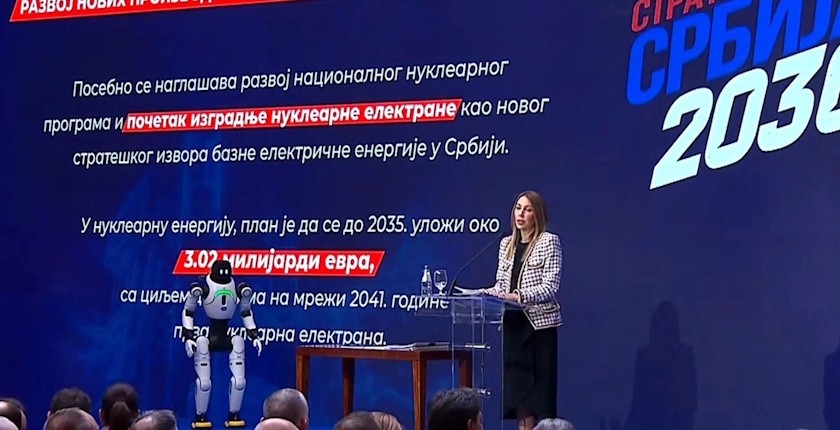
Serbia intends to allocate no less than €14.4 billion to its energy sector by 2035 and initiate the development of a nuclear power plant, according to statements from senior government officials.
Financing and insurance also tilt heavily toward Western options. Building a nuclear plant is capital-intensive (Serbia’s energy minister estimates around €3 billion will be required for the first plant), and projects often need consortia of lenders. Western-led projects can tap financing from development banks and export credit agencies in the EU, US, Japan, or South Korea, especially now as these actors respond to China’s infrastructure push. For instance, the US and Bulgaria signed an intergovernmental agreement in early 2024 to support Bulgaria’s new AP1000 reactors, and US EXIM financing is backing nuclear projects in Romania and Poland. These Western funding sources typically exclude Russian or Chinese ventures due to sanction policy or strategic screening. Serbia will find it far easier to raise funds if it’s working with EDF or Westinghouse under the political sponsorship of France, the EU, and the United States. Conversely, a Russian project would rely on Russian state loans, as the €12.5 billion loan Moscow provided to Hungary’s Paks II plant, which creates a different kind of debt dependency. A Chinese project might come with attractive state-backed loans at first, but often with less transparency and potential hidden costs (as seen in some Belt and Road infrastructure deals). Moreover, insurance for nuclear projects (and nuclear liability coverage) in Europe is intertwined with international conventions that Russia and China are not party to. Sticking to Western partners keeps Serbia safely inside the global financial and legal comfort zone. Even though the Russian or Chinese nuclear partner could be cheaper in numbers, the increased difficulty in raising funds (Western partners would hardly be eager to help) makes it harder in the long run.
Perhaps most important is the question of supply security and fuel diversity. Europe’s recent energy crisis and the war in Ukraine have underscored the importance of supply diversification. Nuclear fuel is no exception. Many EU countries operating Soviet/Russian-designed reactors have moved swiftly to diversify away from Russian nuclear fuel since 2022. Bulgaria is a case in point: in 2022, its parliament voted to seek alternative suppliers for the Russian-made VVER-1000 fuel assemblies used at Kozloduy. By 2023–24, Bulgaria’s Kozloduy plant had loaded its first Westinghouse-fabricated fuel (from Sweden) into one of its reactors, under a 10-year contract, and signed up Framatome to supply the other unit. As Bulgaria’s energy minister explained, the partnership with Westinghouse is seen as “a guarantee of Bulgarian energy security”, achieving the “common goal – to make Bulgaria’s energy sector independent”. This experience carries a clear lesson: if Serbia buys a Russian reactor, it may immediately face pressure to find non-Russian fuel to hedge against geopolitical risk. Why not avoid that headache by initially choosing a Western reactor that has multiple fuel sources available from the outset? A reactor like the EPR or AP1000 can be fueled by any qualified vendor (Westinghouse, Framatome, etc.) under Western oversight, ensuring Serbia is never dependent on a single foreign fuel supplier. A Russian VVER, while currently able to use some Westinghouse fuel in modified form, would still leave Serbia tethered to Rosatom’s designs and proprietary components, an uneasy prospect in an era when Brussels and Washington attach a “political price tag” to new deals with Russian companies.
Finally, European political alignment strongly favors a Western nuclear path. Serbia aspires to deeper EU cooperation and membership. Choosing a Western reactor would be a goodwill signal to Europe that Serbia is anchoring itself in the Western fold. It would avoid introducing a major new point of friction with the EU at a sensitive time. In contrast, a decision to buy a Russian-built plant could become a lightning rod in EU-Serbia relations, especially given Rosatom’s role in Russia’s war strategy and the EU’s ongoing debate about sanctioning Russia’s nuclear sector. Already, the only EU country currently building a Rosatom reactor (Hungary) has faced scrutiny and complications, from delays due to regulatory objections, to sanctions waivers needed for financing, to public criticism from European partners. If Serbia goes that route, it risks isolation within the European energy community, whereas a Western project would unlock deeper integration. In short, Serbia’s strategic “center of gravity” is moving westward, and its nuclear choice should reinforce, not undermine, that trajectory.
France and EDF: Serbia’s Most Anchored Western Partner
Among Western options, France, via its national champion EDF, currently stands out as Serbia’s most institutionally anchored partner in nuclear energy. France brings to the table unique advantages:
a deep nuclear culture with over 50 years of operating experience,
a leading role in European nuclear governance,
a comprehensive educational and training infrastructure,
a political commitment to supporting allies’ nuclear programs.
For Serbia, which is developing nuclear energy for the first time, France offers a partnership that goes far beyond reactor construction; it’s a gateway into the entire Western nuclear enterprise.
The ongoing cooperation between Serbia and EDF is a clear indicator of this dynamic. In April 2024, Serbia’s government signed a memorandum of cooperation with EDF, and by September 2024, EDF (with France’s Egis) had been awarded a contract to deliver a preliminary technical study on introducing nuclear power in Serbia. This study, completed under French guidance, is likely shaping Serbia’s strategic roadmap (though officials have yet to publish the details). The relationship deepened in late 2025 at the World Nuclear Exhibition in Paris, where the Vinča Institute–EDF memorandum was signed to formalize cooperation on research, training, and public communication. Notably, EDF’s Senior VP for International Nuclear, Vakisasai Ramany, personally signed for EDF, while Vinča’s director hailed the deal as “a continuation of Serbian-French friendship” and an important step to “exchange knowledge with one of the world’s leaders in the nuclear energy sector”. The involvement of I2EN (International Institute of Nuclear Energy), a French-established consortium for training, means Serbia will benefit from structured programs to train its engineers and regulators to French and EU standards. This is precisely the kind of anchor Serbia needs, a long-term commitment to building its human infrastructure alongside the physical infrastructure.
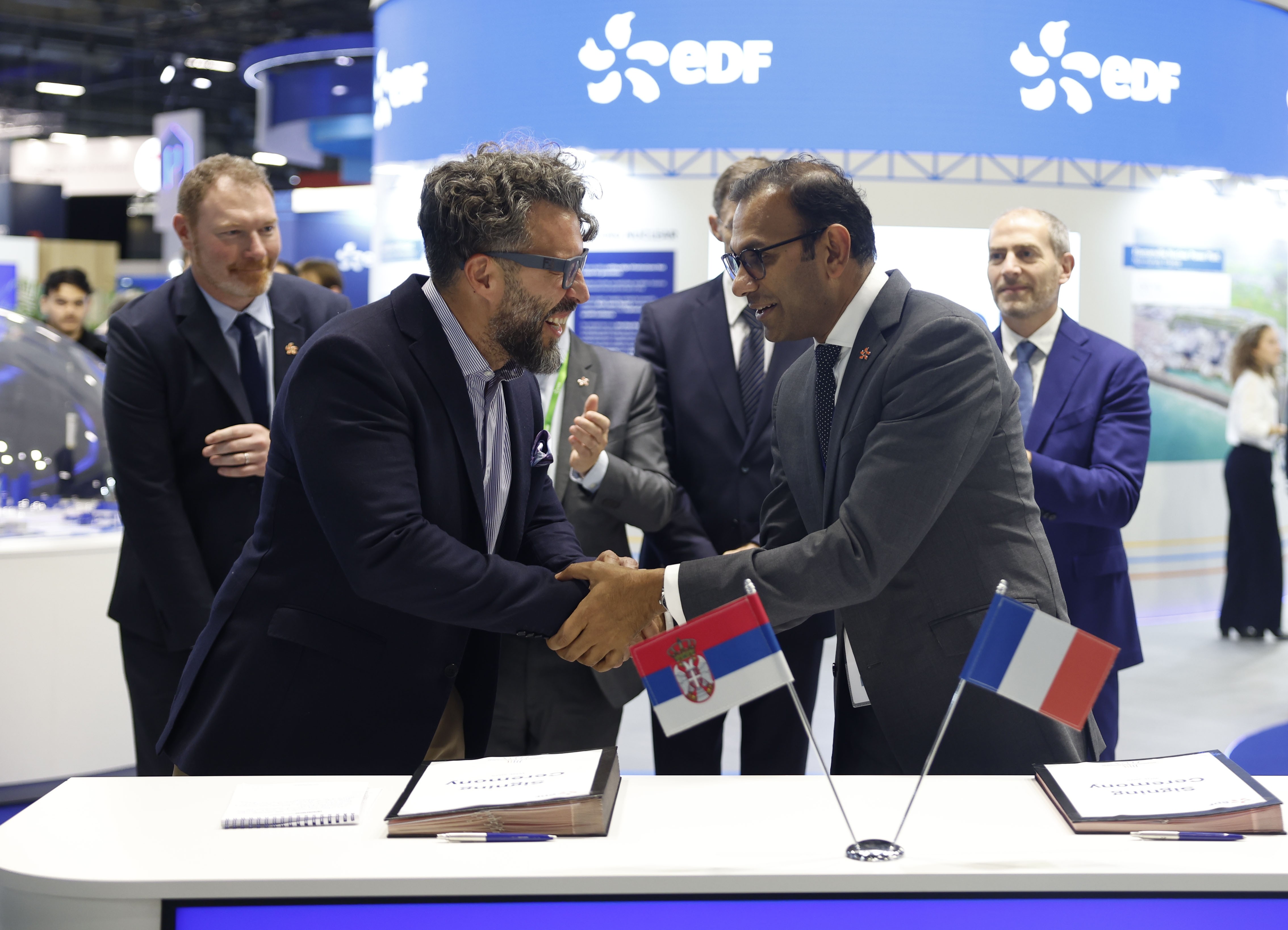
Slavko Dimović and Vakisasai Ramany (photo: Vinča)
France’s appeal as a partner also lies in its institutional clout and stability. EDF is wholly-owned by the French state and operates the world’s largest nuclear fleet (57 reactors). It has encountered and solved every operational challenge over the decades, virtually, building an enormous repository of know-how. When EDF is involved, it’s not just a vendor-client transaction. It is a state-backed relationship with one of the EU’s great powers. French diplomatic support comes in tandem. For example, if Serbia partners with EDF on a reactor project, Paris would have a stake in seeing that project through, which could translate into support within the EU for any regulatory or financial facilitation Serbia might need. We see a hint of this in how the French Development Agency (AFD) is already funding studies for Serbia. France’s President has also positioned his country as a champion of new nuclear energy in Europe (for climate goals), which means Serbian nuclear ambitions with EDF involved would be viewed in a positive light in European forums.
Technologically, EDF’s EPR is a 1,650 MW third-generation reactor with advanced safety features, making it one plausible option if Serbia eventually pursues a large nuclear unit. That said, Serbia’s own energy planning documents have modeled a 1,000 MW nuclear plant after 2040, which suggests that an EPR-scale reactor could be larger than the reference capacity currently envisaged. France is also developing the NUWARD SMR for commercialization during the 2030s, which could prove an interesting potential in the future. Cooperation with EDF and France, therefore, gives Serbia exposure to both large-reactor and emerging SMR pathways, even if no final technology choice has yet been made. Another strength of France is its integration in European safety and emergency frameworks. France plays a leading role in EUROSAFE and other multilateral nuclear safety initiatives. A Serbian reactor developed with EDF’s help would be naturally slotted into these networks. Training of Serbian operators could be done at French facilities. French advisors could sit within Serbia’s regulatory agency during early operations (as they have done in newcomer programs elsewhere). And if ever there were a technical issue, EDF’s vast engineering corps (and those of partner companies like Framatome) could be called upon.
The gravitas of having France as a partner also deters geopolitical meddling. Countries like Russia or China would find it harder to sway Serbia’s nuclear trajectory if a major NATO/EU nation is firmly co-driving that journey. It insulates Serbia from pressure, much as Finland’s choice of a Russian reactor (now cancelled) exposed it to pressure; Serbia’s choice of a French reactor would do the opposite, entwining Serbia’s program with a core EU country’s interests. Finally, one should not overlook the symbolism and legitimacy factor. If Serbia builds its first reactor with EDF, it gains a stamp of approval in European eyes. France’s nuclear regulator, widely respected, would likely collaborate with Serbia’s regulator, enhancing credibility. European publics and neighboring countries would have fewer qualms about a Serbian plant knowing EDF stands behind it (compared to if Rosatom or a less familiar Chinese entity did). When Serbia’s energy minister declared in March 2026, “We must start the construction of the first nuclear power plant in Serbia before 2035”, she also emphasized that “we must secure the funds, because it is clean energy, secure energy, baseload energy”. A Western-backed project, especially with EDF, bolsters that claim – it looks and feels like a clean, secure, European endeavor rather than a risky geopolitical gambit.
Westinghouse and the US-Aligned Option: Regional Momentum in Serbia’s Neighborhood
While France is paving the way inside Serbia, Westinghouse Electric Company represents the other major Western contender, and its growing footprint in Southeast Europe is highly relevant to Serbia’s choices. Westinghouse, a US-based firm with significant operations in Europe, is the developer of the AP1000 reactor – a 1,100 MW class PWR that is one of the leading Generation III+ designs worldwide. Importantly, Westinghouse is already active in Serbia’s immediate neighborhood, setting precedents that Serbia can observe and potentially emulate. The company’s recent successes in Bulgaria and involvement in Slovenia’s planning underline that Westinghouse is not a theoretical option but a real, operational player in the region. Serbia should leverage this by treating Westinghouse as a serious alternative (and complementary benchmark) to EDF, thereby keeping its Western options open and competitive.
The most striking development is in Bulgaria, where Westinghouse has effectively become the linchpin of Sofia’s nuclear expansion and diversification strategy. In early 2024, the US and Bulgaria signed a government-to-government agreement to cooperate on Bulgaria’s civil nuclear program. In December 2022, Kozloduy NPP signed a 10-year contract with Westinghouse to supply fuel for Bulgaria’s Russian-built Unit 5, and in 2024, the first Westinghouse fuel was loaded into the reactor, a landmark step in Bulgaria’s diversification away from Russian nuclear fuel and one of the most important EU precedents for Western fuel use in a VVER-1000 unit. Then, in 2025, Bulgaria’s nuclear regulator approved a site at Kozloduy for constructing two new AP1000 reactors, and Westinghouse (with partner Hyundai Engineering) is already in an engineering contract to deliver those units. The target is for Kozloduy Unit 7 to be operational by 2035 and Unit 8 by 2037. When Bulgarian Minister of Energy Zhecho Stankov spoke at a supplier forum, he emphasized that the AP1000 project is “key to the country’s energy security and independence” and would help preserve Bulgaria’s role as a regional energy hub. These are powerful endorsements, showing that an EU member sees Westinghouse technology as a strategic asset against energy dependence. Serbia cannot miss the significance: right across the Danube, an American-designed reactor will be built in an EU country under EU rules, creating a blueprint that Serbia could follow with far less uncertainty.
Similarly, in Slovenia, Westinghouse is actively in the mix for the planned second unit at Krško (JEK2 project). Slovenia’s current Krško-1 reactor, notably, was built by Westinghouse in the 1980s and has operated successfully for over 40 years. Building on that “decades-long partnership”, Westinghouse was awarded a contract in 2025 to conduct a Technical Feasibility Study (TFS) for deploying an AP1000 at Krško-II. Westinghouse teamed with Hyundai to examine technical, legislative, and safety requirements for the project. Importantly, Westinghouse and France’s EDF are the two finalists, a mirror of the choice Serbia faces, after Korea’s KHNP opted out of bidding. By 2028, Slovenia aims to make an investment decision, and a referendum will be held to approve the nuclear expansion. The fact that Slovenia (an EU and NATO member) is seriously considering the AP1000 speaks volumes about the reactor’s acceptability. It also means that by the time Serbia is ready to build (late 2030s), the AP1000 will be a well-established reactor type in the region, with licensing frameworks ironed out and supply chains localized.
Westinghouse’s momentum extends beyond those two countries. Poland has officially selected Westinghouse AP1000 reactors for its first three nuclear units (with the first targeted to come online in the early 2030s), in a deal backed by the US government. Ukraine, which historically operated only Russian-designed reactors, signed an agreement in 2021 to build multiple AP1000s with Westinghouse as part of decoupling from Russian technology. And as noted, Westinghouse is supplying nuclear fuel to Ukraine, Finland, the Czech Republic, and others to reduce reliance on Rosatom. This all matters for Serbia because it creates a Western nuclear ecosystem in Eastern Europe that Serbia can join as a peer. If Serbia chooses an AP1000, it can piggyback on the licensing work done for Bulgaria, tap into the network of regional suppliers Westinghouse is cultivating (Bulgarian firms are already being qualified to supply AP1000 components), and coordinate fuel procurement with neighbors. It also means there is a growing cadre of engineers and regulators in nearby countries familiar with AP1000 tech, enabling knowledge sharing.
From a geopolitical perspective, Westinghouse embodies the US-aligned option, and engaging it would naturally deepen Serbia’s ties with the United States and its Central European allies. Already, the Bulgaria AP1000 project is underpinned by a US-Bulgarian strategic agreement. One could envision a similar US-Serbia agreement if Belgrade were to signal interest in Westinghouse, especially as part of a broader balancing of Serbia’s relations. It would provide a counterweight to Russia’s influence and improve Serbia’s standing in Washington. The US has been keen to support nuclear projects in allied countries (financially and diplomatically) as a counteroffer to Russian and Chinese projects. For example, US export credit agencies are lined up to support Poland’s and Romania’s nuclear plans. If Serbia opted for Westinghouse, it could likely count on favorable financing terms from US agencies and participation in US-led initiatives for newcomer nuclear countries (like regulatory mentoring by the US NRC). It might also unlock tri-party collaborations. For instance, Serbia could partner with Bulgaria and the US on fuel cycle services or training programs. The overall effect would be to more tightly bind Serbia into the Western alliance infrastructure on the energy front.
Serbia’s Nuclear Vendor Options: Strategic Comparison Matrix
Vendor | Technology / regional reference | Financing & delivery logic | Geopolitical risk | EU / regulatory compatibility | Overall fit for Serbia |
|---|---|---|---|---|---|
EDF (France) | Strong European nuclear operator; Serbia already has an MoU with EDF on civil nuclear development, staff training, and technical knowledge exchange. | Likely strongest in state-backed European cooperation, institutional training, and long-term ecosystem building; weaker on perceived cost/speed versus some rivals. Serbia has already used EDF-linked cooperation to structure its early nuclear pathway. | Low–moderate. Dependence exists, but within a European political framework, Serbia can explain and sustain more easily. | Very high. Best fit with Serbia’s European regulatory destination and broader EU-facing energy strategy. | Best for strategic anchoring |
Westinghouse (US) | Live regional momentum: AP1000 expansion in Bulgaria and AP1000 feasibility work for Slovenia’s Krško-II. | Attractive as a competitive Western benchmark with visible nearby implementation; useful for Serbia because it can observe neighboring supply-chain and licensing experience. | Low. Politically safer than Russian or Chinese options; strengthens Western diversification. | High. Regional EU-member reference cases improve credibility for Serbia. | Best for local talent development and trends in the region |
Rosatom (Russia) | Strong export track record and still active in projects such as Paks II and Akkuyu. | Historically competitive in bundled state-backed financing and project delivery, but execution is increasingly exposed to sanctions, licensing, banking, and supply-chain disruption. | High. The EU is explicitly moving toward phasing out Russian nuclear dependencies, which cuts against Serbia creating a new one. | Low. Strategically misaligned with the direction of the European energy space. | Technically credible, strategically risky |
Chinese state vendor (e.g., CNNC / broader Chinese option) | Limited relevance for Serbia’s immediate neighborhood compared with EDF or Westinghouse; lacks a strong nearby EU-reference pathway Serbia could easily emulate. | It may look attractive on headline financing terms, but it comes with heavier political scrutiny in critical infrastructure. This is the weakest “ecosystem fit” for Serbia. | High. Would likely trigger greater strategic suspicion than practical benefit. | Low. Hardest option to reconcile with Serbia’s long-term European trajectory. | Least suitable |
Operationalizing Serbia’s Western Nuclear Strategy
Recognize Nuclear Energy as a Strategic-Political Choice, Not a Purely Commercial One - Serbia must clearly internalize, and communicate to all stakeholders, that nuclear energy is not merely a technical or commercial procurement decision, but a deeply political choice with long-term geopolitical consequences. A country that has declaratively committed to a European path would face significant political pressure, reputational costs, and potential indirect penalties if it opted for a Russian or Chinese vendor. Conversely, alignment with American or European suppliers would unlock not only technological advantages but also political support, regulatory integration, and long-term strategic stability. The dilemma is therefore not ambiguous; it is structural, and Serbia’s vendor choice will signal its geopolitical alignment for decades.
Accelerate Engagement to Secure Concrete Western Offers - At present, Russia’s Rosatom remains the only actor that has presented a concrete and comprehensive proposal to Serbia. This asymmetry must be urgently addressed. Serbian authorities should proactively solicit detailed, bankable offers from Western partners, including EDF and Westinghouse Electric Company, covering technology, financing structures, timelines, and local participation. Early exposure to these alternatives is essential not only for informed decision-making but also for establishing a credible negotiating position. Without concrete Western bids, Serbia risks drifting toward default options rather than making a strategic choice.
Preserve Western Vendor Competition While Avoiding Eastern Bidders - Serbia should maintain a competitive dynamic among Western vendors, including EDF, Westinghouse, and other aligned suppliers, to secure optimal financial, technological, and industrial terms. Premature sole-sourcing should be avoided. A structured competitive process, whether through parallel negotiations or a formal tender, will improve outcomes across financing, technology transfer, and local participation. At the same time, Serbia should avoid entering into binding arrangements with Russian or Chinese actors that could create long-term strategic dependencies or expose the country to political and financial constraints.
Launch a Targeted Diplomatic Offensive Toward EU Member States - Serbia should initiate a focused diplomatic campaign toward key EU member states to frame its nuclear program as a matter of shared European interest. The central argument is straightforward: a Western-aligned Serbian nuclear sector strengthens the EU’s broader goals of energy diversification, resilience, and reduction of dependency on geopolitical competitors. By proactively engaging capitals such as Paris, Berlin, and Brussels, Serbia can build political backing, generate interest among European industrial actors, and position itself as a contributor to continental energy security rather than a passive recipient of external influence.
Structure Financing Through Western and Multilateral Channels - Financing will be decisive, and Serbia must anchor its nuclear program within Western financial ecosystems. This includes engaging institutions such as the European Bank for Reconstruction and Development, the European Investment Bank, and export credit agencies like the US Export-Import Bank, as well as French and other European export financing mechanisms. These actors have increasingly supported nuclear-related infrastructure under frameworks tied to energy transition and security.
Embed the Nuclear Program Within the European Energy Framework - Serbia should treat its nuclear ambitions as part of a broader European energy transition strategy, rather than an isolated national project. This includes continued grid synchronization with European networks, participation in regional coordination mechanisms, and alignment with EU energy policies. Cooperation with neighboring countries on emergency planning, fuel supply arrangements, and operational standards will further anchor Serbia within the European system. As US energy envoy Geoffrey Pyatt emphasized, deeper regional integration in nuclear energy can make dependence on Russian gas “a thing of the past.”
Invest in Domestic Talent as a Pillar of Energy Sovereignty - While importing both infrastructure and expertise from foreign vendors may appear cost-effective in the short term, long-term strategic sustainability requires the development of domestic human capital. Serbia should leverage institutions such as the Vinča Institute of Nuclear Sciences to build a pipeline of highly skilled engineers, regulators, and operators. This is not only an economic consideration, but a question of national sovereignty. Notably, companies like Westinghouse Electric Company operate models that actively support local workforce development, training, and knowledge transfer. Prioritizing such partnerships will ensure that Serbia’s future nuclear sector is domestically anchored rather than externally dependent.
Sequence Technology Choices: Conventional First, SMRs as a Future Option - In line with prevailing expert assessments, Serbia should prioritize conventional large-scale reactors as the initial step in developing its nuclear capacity, given their technological maturity and regulatory clarity. At the same time, the government should actively monitor and explore the evolution of Small Modular Reactors (SMRs), which may offer greater flexibility and scalability in the future. This dual-track approach allows Serbia to secure immediate baseload capacity while preserving optionality as next-generation technologies mature.
Other Analysis
Read time:
20
min
Mar 19, 2026
text
Serbia’s Nuclear Choice: Why Western Technology Suits Best
Serbia’s nuclear choice shapes energy security, alliances, and long-term strategic autonomy today

Read time:
15
min
Mar 5, 2026
text
Serbia’s Strategic Depth in Central Asia: A C5+1+ Approach
How Serbia’s partnerships with Central Asia boost energy security, trade, and connectivity
Read time:
5
min
Feb 26, 2026
text
From the Non-Aligned Movement to a Future Alliance Between Belgrade and New Delhi in the New Global Power Game
India’s westward pivot and Serbia’s strategic bet on a deeper economic partnership