Vuk Velebit, Petar Ivić, Aleksa Jovanović, Danilo Nastić
Serbia’s Ukraine Opening
Zelenskyy’s Belgrade visit was not a gesture. It repriced Serbia’s position in three capitals at once, and it sent the bill to a fourth.
Key Takeaways
Belgrade secured a concrete diplomatic gain. President Zelenskyy publicly reaffirmed that Ukraine does not recognize Kosovo’s independence, while the two governments set an end-of-2026 target for a free trade agreement and expanded cooperation on humanitarian aid, food safety, and reconstruction.
Serbia’s Russia policy is unchanged in language but shifting in substance. Belgrade still rejects sanctions, yet Serbian ammunition has reached Ukraine, Russian ownership in NIS is being dismantled, military exercises with Moscow have stopped, and cooperation with NATO has expanded.
The central EU question is now the gap between action and declaration. Serbia supports Ukraine’s European path and reconstruction in practice, but its alignment with EU foreign policy fell to 52 percent in 2025, while accession progress remains constrained by both Serbian choices and divisions among EU member states.
Washington’s engagement-first approach is producing results. The summit followed the launch of the U.S.–Serbia Strategic Dialogue and confirmed that procurement, monitoring, investment, and sustained engagement can secure Serbian cooperation more effectively than demands for formal sanctions alignment.
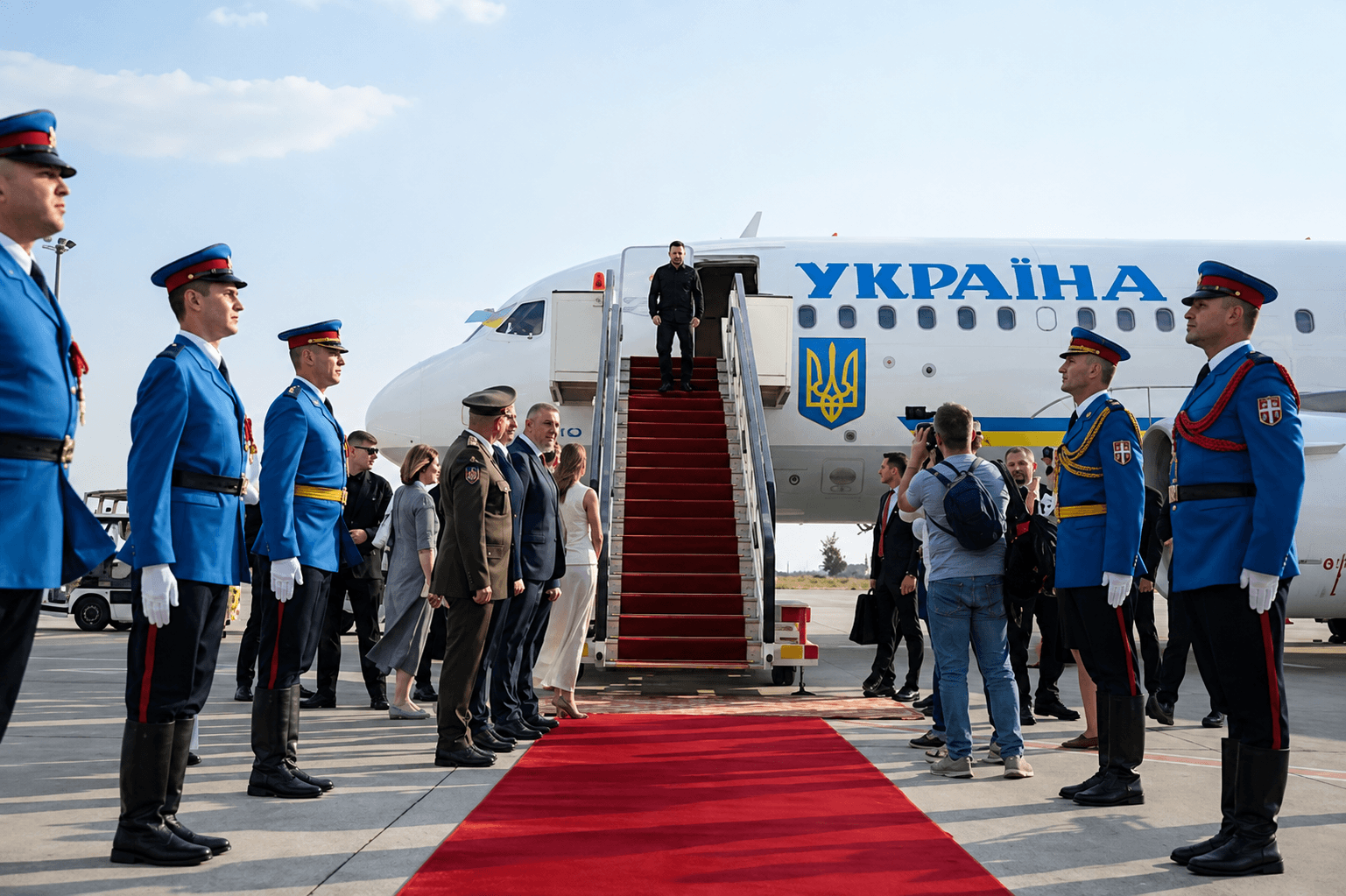
Volodymyr Zelenskyy arrived in Belgrade on August 7 and was received the next morning with an honor guard at the Presidential Palace, his first official visit to Serbia since taking office in 2019. The two presidents set a target of concluding a Serbia–Ukraine free trade agreement, negotiated on and off for more than two decades, by the end of 2026. Ukraine’s food safety service and Serbia’s agriculture ministry signed a memorandum on animal health and food safety. Belgrade pledged a humanitarian package in the medical and energy sectors ahead of winter and offered to rebuild one war-damaged Ukrainian city, which neither side named.
Two sentences from the podium did more work than the agreements. Aleksandar Vučić said Serbia upholds the UN Charter and the territorial integrity of every UN member state, including Ukraine. Zelenskyy tied that principle to Crimea, then said Ukraine’s position on Kosovo’s unilateral declaration of independence remains unchanged.
The commentary that followed treated the visit as a referendum on whether Serbia is pro-Russian or pro-Western. That framing produces heat and no information. The useful question is narrower and has four parts: what the summit changed for Serbia, for its relationship with Russia, for its relationship with the European Union, and for its relationship with the United States.
What This Means for Serbia
Belgrade left the summit ahead, and the gain was specific rather than atmospheric. At a moment when Kyiv depends on Western political and military support to a degree that constrains almost every position it takes, Serbia obtained from the Ukrainian president an explicit, on-camera restatement that Ukraine does not recognize Kosovo’s independence and respects the territorial integrity of its partners. Very few governments in Europe were in a position to extract that in August 2026. Serbia was, and it did.
The wider gain is category change. For a decade Serbia has been handled as a problem to be managed, a state whose alignment was treated as predetermined and whose cooperation therefore did not need to be sought. The Belgrade summit is evidence that Belgrade can convert its position at the junction of Europe’s energy and transport corridors into something it spends rather than something it suffers. Trade with Ukraine reached roughly $346 million in the first half of 2026, against $442 million for all of 2025; a concluded free trade agreement would compound a trajectory that is already steep.
The cost landed in the neighborhood, and it was not small. Kosovo’s foreign minister, Behgjet Pacolli, called Zelenskyy’s remarks “deeply disappointing.” On August 9, Pristina city hall removed the Ukrainian flag that had hung for four years on the facade of the Grand Hotel bearing the words “Free Ukraine.” Albania’s foreign ministry responded that Kosovo’s independence is irreversible and that its support for Ukraine’s sovereignty runs together with its support for Kosovo’s. Belgrade gained diplomatic ground with Kyiv which caused greater friction with Pristina and Tirana. Whether that trade is favorable depends on which relationships Serbia expects to need in 2035.
What It Means for Serbia–Russia Relations
Nothing was said in Belgrade that violates the letter of Serbian policy toward Moscow, and that is precisely the difficulty for Russia. Vučić restated on August 6 that Serbia set its sanctions policy nearly five years ago and would not change it “until further notice” (do daljeg). Serbia declined to sign the Kyiv declaration at the Ukraine–Southeast Europe summit on July 15, as it had abstained at Odesa in June 2025. The declaratory position is intact.
The material position is not. Roughly €800 million in Serbian ammunition has reached Ukraine through third parties, according to estimates President Aleksandar Vučić acknowledged to the Financial Times as broadly accurate, putting Serbian-made shells in the hands of the Ukrainian military fighting Russia. Russia’s Foreign Intelligence Service accused Serbian defense firms on May 29, 2025, of “an attempt to stab Russia in the back.” U.S. sanctions have forced the divestment of Gazprom Neft and Gazprom’s combined 56 percent stake in NIS, with Hungary’s MOL Group in negotiations and Serbia operating on rolling OFAC waivers. Serbia has held zero joint military exercises with Russia since February 2022 and conducted its first with NATO in 2026.
Moscow understands the distinction better than most Western commentators do. Its response to the summit was to work the symbolism rather than the substance, with Maria Zakharova attacking a question put to the two presidents by a German correspondent rather than addressing what the presidents said. That is the behavior of a government with limited remaining leverage over the file. Russia’s principal instrument in Serbia was energy ownership, and it is being dismantled by an American sanctions regime that Belgrade never joined and cannot escape.
Moscow is losing Serbia by subtraction rather than defection. The refinery, the arms market, and the presumption of alignment are gone, and none of them were surrendered at a summit — they were taken, by sanctions, by procurement, and by four years of Serbian factories filling Ukrainian orders. What Russia retains is real but thin: cultural affinity, media reach, and the Kosovo veto at the Security Council. Affinity does not refine crude, and a veto does not restock a magazine. Belgrade has not turned on Russia, and Washington never asked it to. That was always the more effective demand.
What It Means for Serbia’s Relationship with the European Union
This is where the summit’s implications are most awkward, and where Belgrade’s own record is weakest. Zelenskyy said Ukraine would welcome a faster European path for Serbia. Vučić said Serbia backs Ukraine’s European course and will not block it, then doubted that Serbia could join soon “for many political reasons,” observing that objectors can always be found: “For us they’ll find Croats, Bulgarians, Dutch, and for Ukraine they’ll find someone else.”
He has evidence. In July the European Commission recommended opening Cluster 3 of Serbia’s accession negotiations after assessing progress on judicial reform, media freedom, and the electoral framework. France and Germany backed it. Eight of 27 member states blocked it, two of them over bilateral quarrels with Belgrade unrelated to the rule of law. A process stalled since 2021 did not clear a unanimity threshold. That is a fact about enlargement machinery.
It is not the whole account, and Belgrade should not be permitted the comfort of pretending otherwise. Serbian alignment with EU foreign policy declarations and measures fell to 52 percent in 2025 from 59 percent in 2024, with non-alignment concentrated on Russia and Ukraine. Refusing to sign the Kyiv declaration was a choice, not a structural constraint imposed from Brussels. The Union’s leverage remains substantial regardless: it accounts for roughly 59 percent of Serbian trade and more than half of inward investment, with Russian and Chinese shares nowhere close.
What the Belgrade summit offers the European track is a template Serbia has otherwise refused. Belgrade supported Ukraine’s accession bid, pledged reconstruction assistance, and signed a technical memorandum aligning food safety standards. Each of those is European integration performed through action rather than declaration. The gap between what Serbia does and what Serbia signs is now the central analytical fact about its EU candidacy, and closing it is within Belgrade’s power alone.
What It Means for Serbia’s Relationship with the United States
The Belgrade summit is best read as the second event in a sequence whose first was the U.S.–Serbia Strategic Dialogue opened on July 17 by Secretary of State Marco Rubio and Foreign Minister Marko Djurić. That meeting produced a memorandum on energy infrastructure and a preliminary decision on the Djerdap III hydropower project, a $50 million Export-Import Bank loan guarantee for Telekom Srbija’s 5G rollout conditional on suppliers Washington considers secure, a Serbian request to purchase American defense equipment, Fulbright cost-sharing funded at $300,000 a year from Belgrade, new Serbian consulates in Miami and San Francisco, and American participation in Expo 2027.
The Ukraine file is older than the dialogue and largely American in origin. Christopher Hill, U.S. Ambassador to Serbia from 2022, has described how the Ukrainian ambassador in Belgrade brought him a list of urgently needed supplies, how his embassy verified that Serbian producers could fill the orders, and how Washington then supported large purchases of Serbian ammunition. Hill has also said the embassy committed considerable resources to confirming that nothing moved in the opposite direction, and concluded that no Serbian sales to Russia occurred on any scale worth noting. The Frankfurter Allgemeine Zeitung reported on August 7 that the visit could herald joint drone production in Serbia, possibly financed by the United Arab Emirates, with Zelenskyy’s defense-industry adviser Oleksandr Kamyshin having toured candidate sites. No official confirmation exists, and the claim should be treated as reporting rather than fact.
For Washington, the summit validates a method. Serbian cooperation on Ukraine was obtained through engagement, quiet procurement, and monitoring, not through demands for sanctions accession that Belgrade was never going to grant. The result is a state that has materially assisted Ukraine for four years while remaining formally neutral. Whether that is a satisfying outcome depends on whether one is measuring declarations or artillery.
What to Watch
Four indicators will show whether the Belgrade summit was a repositioning or a photograph.
▪ The free trade agreement. A signed text before December would confirm that the summit produced obligations. Slippage into 2027, which Ukrainian officials have already floated, would confirm that it produced intentions.
▪ The NIS transfer. Completion of the MOL acquisition would end Gazprom’s position in Serbian refining and retire the lever Moscow has held since 2008. The current OFAC waiver runs to August 28.
▪ Serbian CFSP alignment. The 2026 figure is the cleanest single measure of whether material convergence eventually pulls declaratory policy behind it, or whether the two remain permanently decoupled.
▪ Cluster 3. Whether the eight blocking member states move, and whether the two with bilateral grievances are separated from those with rule-of-law concerns, will determine whether Serbian reform is being assessed or merely litigated.
A state of nearly seven million people, holding the region’s largest defense-industrial base and its most contested energy infrastructure, was going to be anchored somewhere. The events of the past month indicate where. What remains unsettled is whether Belgrade will say so, and whether its partners will make saying so worth the cost.
Other Analysis

Read time:
20
min
Sep 17, 2026
text
Why the USA and Serbia Need a Tax Treaty?
How a tax treaty and totalization agreement can deepen the growing U.S.–Serbia economic partnership.
Read time:
45
min
Sep 10, 2026
text
Silence Is Not Safety: Rights Before Politics in Kosovo
Rights Before Politics: Protecting the Serbian Community and Religious Heritage in Kosovo

Read time:
4
min
Aug 25, 2026
text
Membership Without Benefits: Serbia’s Place in WAICO
Why Serbia’s WAICO membership creates alignment risks, with no clear economic or strategic benefits.