Vuk Velebit, Petar Ivić, Aleksa Jovanović
Architecture before Ambition: What the US–Serbia Strategic Dialogue should learn from Warsaw and Bucharest
How the U.S.–Serbia Strategic Dialogue can build lasting institutions, not just political momentum?

Momentum Exists
For most of the past two decades, the question of whether Washington and Belgrade would build something durable together was answered with a shrug. The question now is narrower and far more useful, and is not whether, but how. In August 2025, Foreign Minister Marko Đurić and Secretary of State Marco Rubio agreed in Washington to launch a bilateral Strategic Dialogue, an arrangement Đurić described as lifting relations to a level not seen in generations. A month later, on the margins of the United Nations General Assembly in New York, President Aleksandar Vučić and Rubio returned to the same theme, folding in American participation in EXPO 2027, which Serbia will host. By early 2026, the Strategic Dialogue had been agreed in principle but not yet formally convened. The political foundation was largely in place; the principal outstanding issue remained the resolution of the NIS ownership question and its implications for sanctions compliance, energy security, and the broader investment climate.
That sequence matters because it lands in a particular Washington. This administration has shown a clear preference for structured bilateral frameworks over sprawling multilateral choreography. And, crucially, it has kept the existing machinery running. The United States and Poland held the sixteenth round of their Strategic Dialogue in Warsaw in April 2026, signing a Critical Minerals Framework and trading commitments on civil nuclear power and liquefied natural gas. The United States and Romania convened the tenth round of theirs in Bucharest in December 2025. The instruments are alive, they are producing, and they are doing so under an administration that likes them. For Serbia, this is an opportunity. The form it should be studying already has two working examples on the same continent.
The momentum presents itself in:
Since the start of the Ukraine war in 2022, Serbia has moved further from Russian influence in practice, and even aided Ukraine. Around $800 million worth of Serbian-linked ammunition has reportedly reached Ukraine, with unofficial estimates going above $2 billion. This places Serbia inside the Western defence-industrial ecosystem, not outside it.
Energy diversification is turning that political shift into infrastructure. Serbia has historically imported more than 90% from Russia, but the trend is changing. The interconnector with Bulgaria is already operational, new links with North Macedonia and Romania are planned at around 1.5 bcm each, Serbia has a 400 million m³ gas arrangement with Azerbaijan, and access to Alexandroupolis LNG adds another 300 million m³ annually for 10 years.
Defence cooperation with Russia has stopped, while cooperation with the United States and NATO is expanding. Serbia no longer conducts military exercises with Russia, while exercises with NATO partners resumed in May 2026. At the same time, Belgrade has over 100 planned military activities with the United States, including Platinum Wolf 2024 and 2025, as well as continued cooperation with the Ohio National Guard, one of the strongest partnerships in the State Partnership Program.
The economic relationship has grown despite tariff pressure. Even with tariffs of up to 35%, Serbia’s exports to the United States did not decline. Bilateral goods trade increased by around 16% in 2025, bringing total trade close to $1 billion.
The real strategic pillar is ICT. Serbia’s ICT exports exceeded $5 billion in 2025, with the United States accounting for roughly 40 to 50% of that total. This makes the American market central to Serbia’s most dynamic export sector.
Serbia is also moving away from China in telecommunications. Through approximately $50 million in financing from the US EXIM Bank, Serbia is developing its future 5G infrastructure on Western-backed systems rather than Chinese vendors such as Huawei.
The public-opinion environment is unusually favourable. President Trump has enjoyed exceptionally high approval in Serbia, reaching around 75 percent at one point. That gives Washington a rare political opening in a country where American policy has often faced public scepticism.
Congressional engagement has intensified sharply. The Serbian Caucus is expanding by two members, with signs that more may follow. In parallel, nine members of Congress visited Serbia within the past month, while Sarah B. Rogers, US Under Secretary of State for Public Diplomacy, travelled to Belgrade.
Methodology
A discipline has to be imposed before the comparison runs away with itself. Poland and Romania are NATO members, European Union members, and hosts of significant American military infrastructure. Serbia is none of those things, and it does not intend to become the first two. A benchmark that ignores this collapses in one of two ways. Pushed too directly, it reads as a wish list Serbia should get what Poland gets) which is fatal to the realist credibility any serious Serbian argument in Washington depends on. Hedged too heavily, it disappears under a fog of caveats about why the parallel is imperfect, and the argument goes limp.
The way through is to be explicit about the object of comparison. We are not comparing the substance of these relationships. Serbia will not host an American missile-defence battery, and no honest analysis pretends otherwise. We are comparing the architecture, the cadence, the machinery, and the institutional habits through which a relationship is run. That is a legitimate comparison even between partnerships of very different weight, and it lets the argument press for the form without overpromising on the content. Four dimensions carry the load.
| 01 FORMAT Cadence & level How often principals meet, at what rank, and which ministries sit at the table.
| 02 WORKING GROUPS Institutionalised tracks The standing tracks a dialogue creates — and which produce projects, not communiqués.
| 03 DELIVERABLES The output cycle Whether each round yields a joint statement, named projects, and a follow-up mechanism.
| 04 OWNERSHIP Who carries the file Main carrier, leading sector and stakeholders of the dialogue.
The sceptic’s objection, that you cannot borrow the plumbing of an alliance without the alliance, is precisely backwards. The plumbing is the transferable part. Cadence, working groups, a deliverables cycle, and a named owner are institutional technologies that function irrespective of whether a country hosts a base or sits inside a treaty. Serbia cannot import Poland’s strategic weight, but it can import the discipline with which both Warsaw and Bucharest run their files. That is the whole reason to study the machinery rather than the mission.
Warsaw
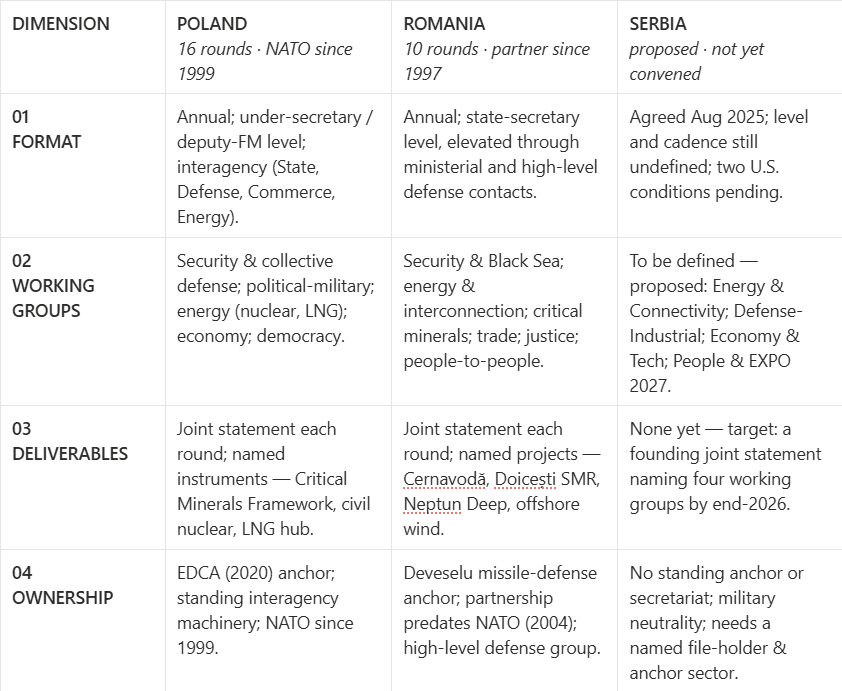
Warsaw shows what a deeply institutionalised dialogue looks like at its upper limit. Sixteen rounds in, the Polish dialogue convenes annually at under-secretary level, opened on the American side by the Under Secretary for Political Affairs and on the Polish side by a deputy foreign minister, and it pulls the State, Defence, Commerce, and Energy departments into the same room. Its working groups span regional security and collective defence, political-military affairs, energy security including nuclear power and LNG, economic prosperity, and democratic resilience. Each round closes with a joint statement, and those statements increasingly carry named instruments rather than atmospherics: a critical-minerals framework here, American support for Polish accession to the G20 there, a stated ambition to make Poland a regional LNG hub. Beneath all of it sit the Enhanced Defence Cooperation Agreement of 2020 and NATO membership since 1999, the load-bearing wall that everything else hangs from.
What that density buys is worth naming, because it is the prize Serbia is implicitly chasing. Poland’s dialogue does not merely catalogue cooperation. It sequences it, so that an energy commitment in one round becomes a signed framework in the next and a financed project in the one after. It also nests inside wider formats (the Three Seas Initiative most of all), so bilateral momentum compounds into regional weight.
The Polish case is the right aspiration and the wrong template. It is the right aspiration because it shows the destination: a dialogue dense enough to generate its own momentum. It is the wrong template because that density rests on a defence anchor Serbia will not pour. To copy Warsaw’s substance is to misread why Warsaw works.
Bucharest
It is why Bucharest, the less famous reference, is the more instructive one, and why weighting it above Warsaw is the analytically honest move precisely because it is the less obvious one. Romania matters to Serbia for three reasons Poland cannot supply.
First, sequence. Romania’s strategic partnership with the United States was framed in the late 1990s and matured across the years before its 2004 accession to NATO. The structured relationship was not a reward for membership. It was part of what pulled Romania toward the institutions in the first place. That is the single most important thing Serbia can take from the comparison, and it is that a strategic dialogue can function as an on-ramp, not a graduation certificate.
Second, profile. The Romanian dialogue is built around the Black Sea and energy, and that maps onto Serbia’s connectivity geography far better than Poland’s frontline posture does. Across ten rounds, the Romanian working groups have institutionalised Black Sea security, energy security and interconnection, infrastructure and trade, justice and home affairs, and people-to-people ties, with newer tracks on defence co-production and critical minerals. The deliverables are concrete and named, and some of them are new reactors at Cernavodă, a first-of-a-kind small modular reactor at Doicești, the Neptun Deep gas project set to make Romania the European Union’s largest gas producer, and an offshore-wind law drafted with American support.
Third, cadence under pressure. The tenth round, in December 2025, was convened by two new administrations in Washington and Bucharest and built deliberately on a ladder of preceding contacts (a foreign-ministers’ meeting, an energy ministerial, a high-level defence group), rather than appearing from nowhere. That is the texture Serbia should imitate. A calendar of smaller engagements feeding a headline round, so the dialogue becomes a habit rather than an event.
There is a fourth resonance, quieter but telling. Romania’s own strategic doctrine speaks of solidary independence (pursuing national interests while honouring its commitments), and that vocabulary travels easily to a Serbia attached to its neutrality. Bucharest also shows that a dialogue can carry a regional-stability portfolio, from Moldova to Black Sea connectivity, without the partner surrendering its room for manoeuvre. For Belgrade, whose value to Washington is partly regional, that is the more usable model: a country can be a stabiliser and a connector, not merely a host.
“A strategic dialogue can be the road into Western institutions, not a certificate handed out once you arrive.”
The Bucharest Lesson - A Comparison
Cautions
Two cautions worth flagging
Two cautions belong in any honest version of this argument, and stating them is what separates analysis from advocacy.
CAUTION 01 · ALIGNMENT
The dialogue must do more work, not less
Poland and Romania entered their dialogues with the basic question already settled, unambiguously Western-bound, the dialogue’s job being to deepen a direction rather than choose one. Serbia’s position is more textured. While Belgrade has traditionally maintained close relations with both Moscow and Beijing, the nature of those relationships has evolved. Cooperation with Russia has narrowed considerably in recent years, particularly in the energy sphere under the pressure of sanctions and shifting geopolitical realities, while engagement with China remains primarily focused on trade, investment, and infrastructure development rather than broader strategic alignment.
At the same time, Serbia’s formal military neutrality remains a fixed constraint, American sanctions on its Russian-owned oil industry have already extracted a price at the Pančevo refinery, and the two conditions Washington has placed on the dialogue signal a relationship being negotiated, not assumed. The conclusion is not that the comparison fails, but that Serbia’s dialogue must build alignment rather than merely express i
CAUTION 02 · THE ANCHOR
Choose a load-bearing sector, deliberately and early
Both the Polish and Romanian dialogues rest on a defence-cooperation spine (the EDCA, the Deveselu site) that gives every other track something to attach to. Serbia has no such spine and, given neutrality, will not acquire one in that form. It must therefore choose a different anchor. Not basing or training, but energy, connectivity and ICT, domains where Belgrade has already lifted its nuclear moratorium and where Washington has begun to treat energy security as national security, with a possible second leg in defence-industrial cooperation routed through third-country supply chains. An architecture without a load-bearing sector is only scaffolding.
But neither caution is a reason to wait. They are reasons to design the dialogue so that it does the harder job it actually faces, manufacturing alignment and inventing its own anchor, rather than copying a structure built for an easier one.
The Blueprint for Advancing the Dialogue
Year One
The test for year one is simple and unforgiving: at the twelve-month mark, can each side point to a structure, an owner, and a project that did not exist before?
RUNG 01 - IMMEDIATELY DOABLE
Name the four working groups
A founding joint statement, signed before the end of 2026, that names four tracks rather than gesturing at cooperation in the abstract: Energy & Connectivity; Defense-Industrial & Security; Economy, Trade & Technology; and People-to-People. Naming the groups is the cheapest high-value move available, because it converts intention into a structure that has to be staffed.
RUNG 02 - INSTITUTIONAL
Build a secretariat and an owner
A standing coordinator on each side, so the dialogue does not evaporate between rounds. Washington needs a senior official who carries the Serbia file day to day. Belgrade needs the mirror investment, a dedicated unit in the Foreign Ministry and, ideally, a parliamentary caucus that survives changes of government. Ownership is what turns a meeting into an institution.
RUNG 03 - STRATEGIC
Commit to one named anchor project
One flagship that makes year one tangible to people who do not read communiqués: an energy interconnection or civil-nuclear / SMR program, a defence-industrial partnership built through allied supply chains, or a capital-markets initiative, chosen so that, twelve months in, the dialogue can point at a thing and not only a document.
IN CLOSING
Architecture first
The temptation in Belgrade and Washington alike will be to lead with ambition, a grand statement, a presidential visit, a headline. Ambition without architecture is a communiqué, and communiqués do not survive contact with the next news cycle. Architecture without ambition is a filing cabinet.
The case for putting architecture first is that Serbia, uniquely, gets to build the machine deliberately — learning from two partners who built theirs under very different stars: one a frontline NATO state, one a Black Sea power that structured its way into the West before it formally arrived. Serbia is neither, and that is exactly why the form matters more than the borrowed substance.
Build the machine well, and the substance will have somewhere to live.
Остале анализе

Време читања:
20
минута
17. 9. 2026.
текст
Why the USA and Serbia Need a Tax Treaty?
How a tax treaty and totalization agreement can deepen the growing U.S.–Serbia economic partnership.
Време читања:
45
минута
10. 9. 2026.
текст
Silence Is Not Safety: Rights Before Politics in Kosovo
Rights Before Politics: Protecting the Serbian Community and Religious Heritage in Kosovo

Време читања:
4
минута
25. 8. 2026.
текст
Чланство без користи: место Србије у WAICO-у
Чланство Србије у WAICO носи ризике по западно технолошко усмерење, а не доноси јасну корист Србији.