Vuk Velebit, Aleksa Jovanović, Petar Ivić
The Belgrade–Constanța Corridor: From Dormant Track to Regional Strategic Railway
A strategic rail corridor linking Serbia to the Black Sea and Europe’s supply chains
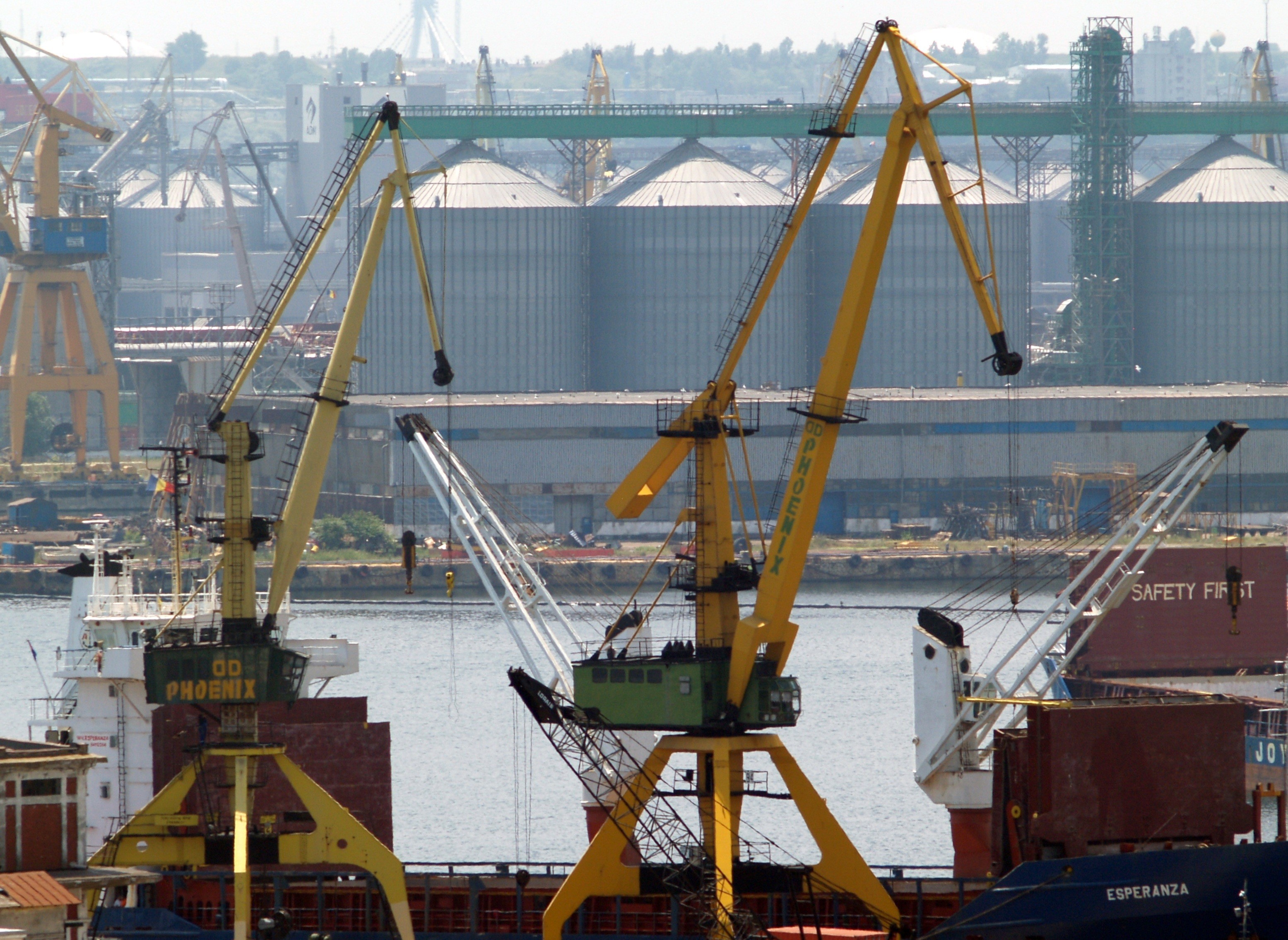
Abstract: This analysis benchmarks the prospective Belgrade–Constanța rail freight corridor against Europe's two most operationally significant freight axes, Rhine–Alpine (Rotterdam–Genoa) and Brenner (Munich–Verona), to extract transferable lessons for Serbia's rail strategy. The question is not whether Belgrade–Constanța can rival these mega-corridors in volume, but whether it can meet the market thresholds that determine whether logistics operators include it in routing decisions at all. The port-side precondition is substantially met: Constanța handles ~92.7 million tonnes and ~885,000 TEU annually. The binding constraints lie on the hinterland side. A phased approach targeting 2–3 daily freight trains is the commercially defensible entry point.
The right question to ask of a corridor
Infrastructure strategy in the Western Balkans suffers from a framing problem. Corridors are assessed against absolute scale benchmarks, tonnage rankings, port throughput comparisons, appropriate for mature networks but misleading when applied to emerging connections. The result is a binary conclusion almost always wrong in both directions: corridors are hailed as transformative on geography alone, or dismissed as irrelevant on current volumes that reflect underinvestment rather than demand.
This analysis takes a different starting point. Rather than asking whether Belgrade–Constanța can compete with Rhine–Alpine or Brenner in volume terms, a question whose answer is obviously no, and whose answer tells us almost nothing useful, it asks what the benchmark corridors reveal about the conditions under which a rail freight axis becomes a reliable commercial product. Those conditions are then applied to Belgrade–Constanța to assess what would need to be true, and in what sequence, for the corridor to reach the thresholds operators actually use when making routing decisions.
Why propose Belgrade-Constanța in the first place?
The case for revitalizing the Belgrade–Constanța corridor extends beyond transport economics. There are several reasons why it is crucial:
Increasing Strategic Connectivity in Southeast Europe: Southeast Europe remains structurally underconnected compared to Central and Western Europe, particularly in east–west rail freight infrastructure. A revitalized Belgrade–Constanța corridor would strengthen the region’s integration into broader European and global logistics flows, while providing the Balkans with a stronger Black Sea access route beyond existing Adriatic and Mediterranean corridors.
Supporting Ukraine’s Future Reconstruction: Following the end of the war, Ukraine’s reconstruction will require massive logistical capacity for the transport of industrial goods, construction materials, machinery, fuel, and containerized cargo. The Danube basin and the Port of Constanța are likely to become one of the main logistical arteries for this process. A functional Belgrade–Constanța railway would position Serbia directly along one of Europe’s most strategically important reconstruction routes.
Strengthening NATO Interoperability and Dual-Use Mobility: Across Europe, transport infrastructure is increasingly evaluated through the lens of military mobility and logistical resilience. Rail corridors connecting Central Europe, the Balkans, and the Black Sea carry growing importance for NATO interoperability, rapid deployment capabilities, and the movement of dual-use goods and strategic cargo.
Integrating Serbia and Romania into the Emerging IMEC Architecture: As global supply chains diversify and new trade corridors emerge, the IMEC framework may become one of the defining connectivity architectures of the coming decades. The Belgrade–Constanța axis would help connect the Danube basin and the Black Sea region into these future Eurasian trade and logistics networks.
A Historic Opportunity for Serbia’s Regional Positioning: Few infrastructure projects simultaneously improve economic relevance, geopolitical positioning, regional integration, and long-term strategic importance. The revitalization of the Belgrade–Constanța corridor represents a rare opportunity for Serbia to strengthen its role as a regional connector between the Balkans, Central Europe, and the Black Sea region.
Two benchmark corridors, two formulas
Rhine–Alpine: the port-industry spine
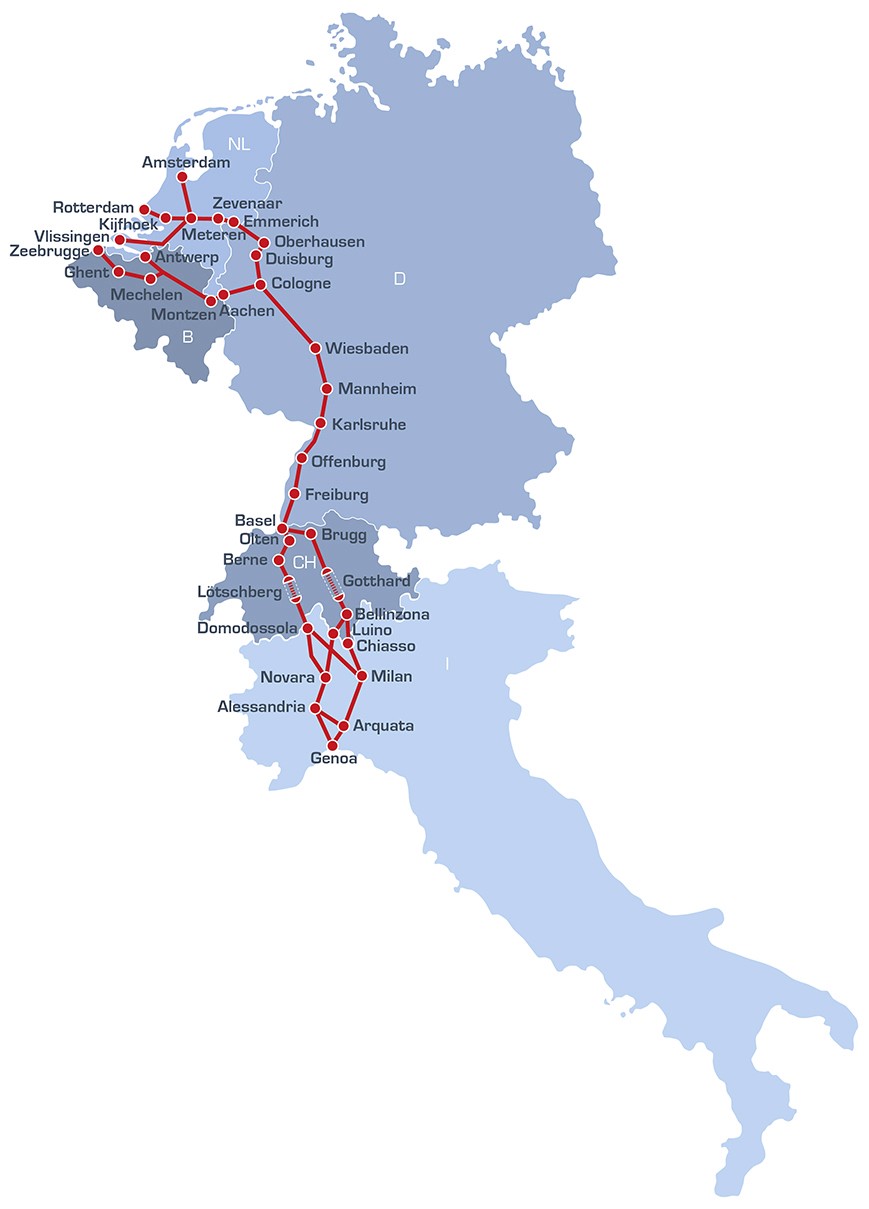
Figure 1. The Rhine–Alpine Corridor within the Trans-European Transport Network (TEN-T). Source: Corridor Rhine-Alpine Official Website
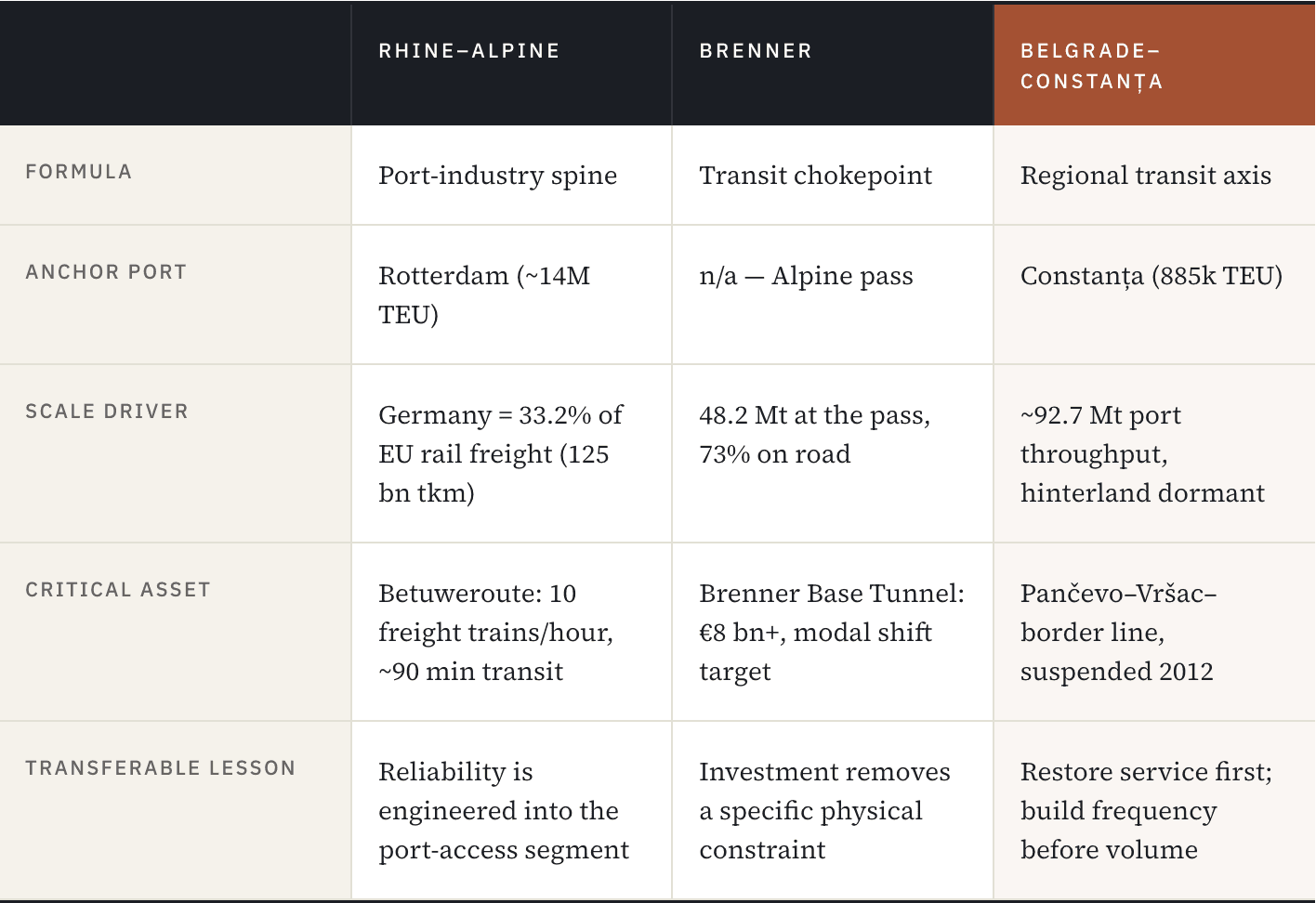
Rhine–Alpine connects Rotterdam and Antwerp to Genoa through Europe's most industrially dense economic geography. Germany alone generates 125 billion tonne-kilometres of rail freight, 33.2% of the EU total, and this is not incidental to the corridor's importance, it is the corridor's importance. The most instructive element is not the corridor as a whole but a single component: the Betuweroute, the dedicated freight railway from Rotterdam port to the German border, designed for 10 heavy freight trains per hour in each direction with ~90 minutes transit. The principle is transferable at much smaller scale: dedicated design of a critical port-access segment transforms reliability characteristics of the entire corridor, and reliability is what allows operators to build commercial commitments around rail.
Brenner: the transit chokepoint
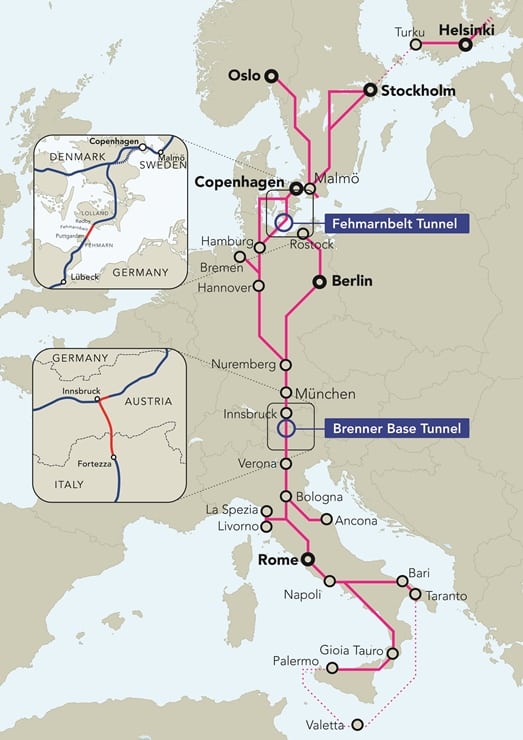
Figure 2. European mega-projects and transport cooperation within the TEN-T network. Source: Tunnelling Online – European Mega Projects Cooperation
A structurally different formula. Where Rhine–Alpine derives value from economic density, Brenner derives strategic importance from the absence of alternatives, there is no plausible north-south rerouting that avoids the Alps. The pass handles 48.2 million tonnes annually, of which 73% moves by road. This figure does double duty: it confirms the corridor's significance and reveals that existing rail infrastructure is failing to capture the majority of traffic geography should naturally attract. The €8+ billion Brenner Base Tunnel is not about creating new demand; it is about removing the gradient constraint preventing existing demand from shifting from road to rail. More directly applicable to Serbia: Austria's rail freight system shows a 31% transit share, its performance is judged by capacity to absorb international flows, not by domestic freight. Speed at borders, interoperability, reliability of handover between operators: these are transit-orientation parameters, entirely distinct from those of a domestic freight market. Serbia is positioning itself as a transit corridor, not building a domestic rail market. Austria's evaluative framework, not Germany's, is the relevant one.
The common pattern
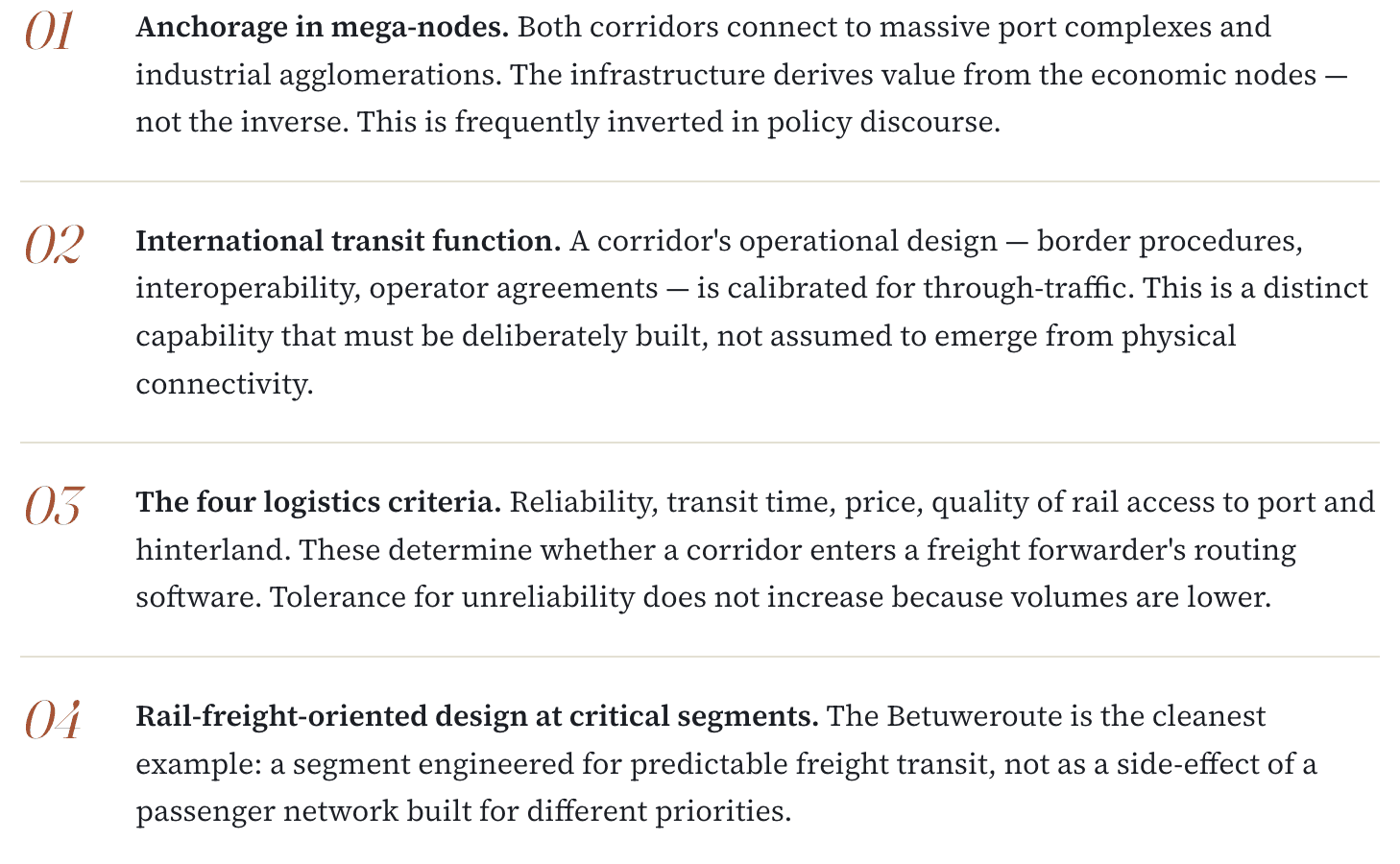
Read together, both corridors share four structural characteristics. The absence of any one is sufficient to prevent commercial viability regardless of how favourable the geography appears on a map.
The port precondition: Constanța
Before the hinterland connectivity question can be meaningfully addressed, the port-side precondition must be established: is Constanța of sufficient scale to anchor a stable rail freight product? On the data, the answer is clearly yes — and this matters, because port size is the one element of the corridor Serbia cannot influence through its own policy.
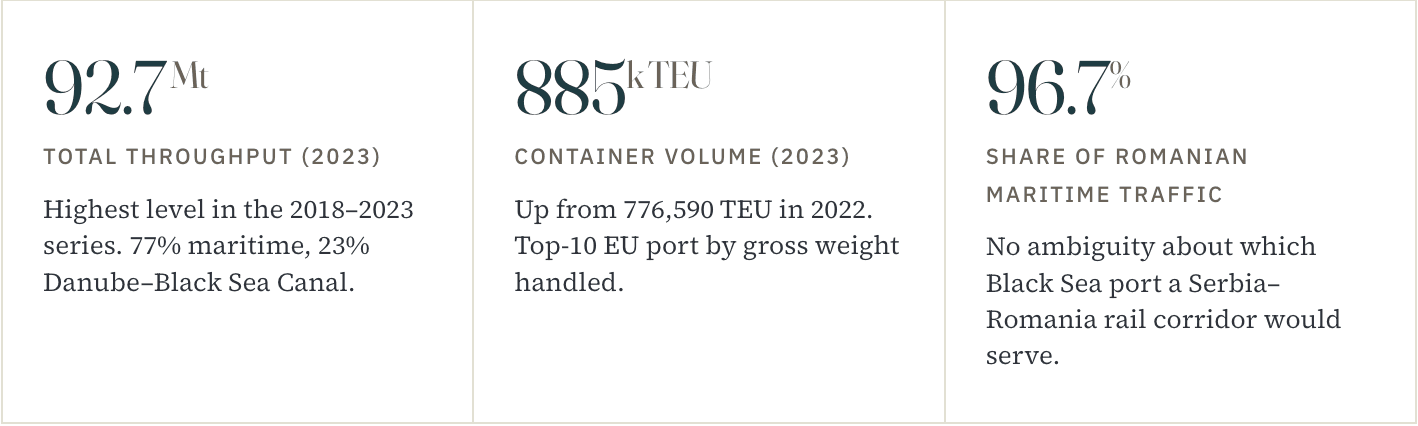
The implication is direct: the constraint on Belgrade–Constanța is not insufficient port capacity. A corridor anchored at Constanța is anchored at a genuinely major European port, connected to the Rhine-Main-Danube TEN-T corridor and the national rail network. Investment and policy attention should redirect away from the port end - where the case is already made - toward the land side, where it is not yet made.
The hinterland reality
Any analysis must begin with the operational baseline, which is substantially more constrained than geography suggests. Rail service between Belgrade and Timișoara was suspended in 2012, and Serbia has been considering restoration of two regional lines to the Romanian border, including Pančevo–Vršac. A corridor whose basic international service has been dormant for over a decade is not a functioning transport product, it is a geographic possibility requiring reconstruction before it can be assessed as a commercial offer.
The natural skeleton runs Belgrade → Pančevo → Vršac → border → Timișoara → Bucharest → Constanța. The most significant near-term development in the corridor's prospects is occurring not in Serbia but in Romania:
Caransebeș–Timișoara–Arad modernization - 155.6 km, ~€1.2 billion in Recovery and Resilience Facility financing, target completion March 2026. Reduces western Romanian transit time.
Bucharest–Constanța upgrades - enable speeds up to 160 km/h passenger and 120 km/h freight on the port-access segment. The same design logic as the Betuweroute: making the port-access segment the high-performance anchor of the corridor.
The combination means the Romanian leg's performance is improving materially over 2025–2027, largely independent of Serbian investment decisions. The critical path therefore runs through Serbia's own policy choices, restoration of the cross-border service, terminal quality, and operator readiness.
Market thresholds: what the numbers actually mean
The most operationally useful output of the Transport Community's rail market assessment for the Western Balkans is its grounding of service viability in specific frequency thresholds, drawn from observed logistics behaviour in this region, not extrapolated from Rhine–Alpine.
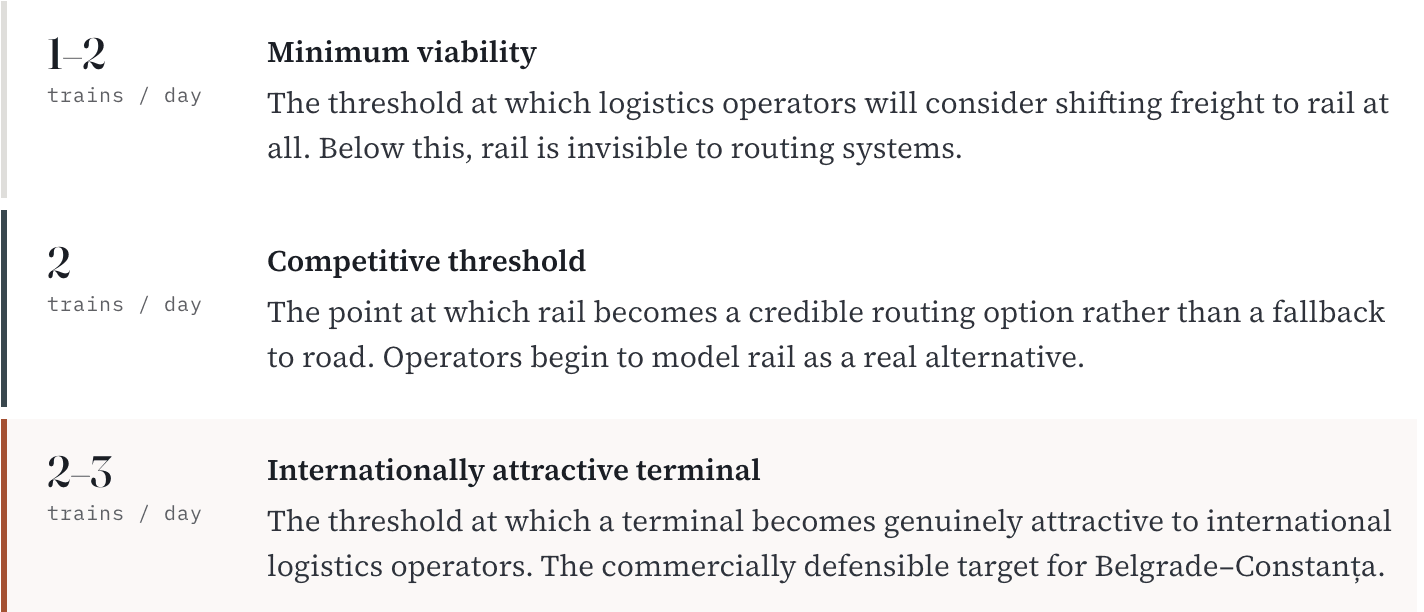
The practical implication: the initial performance target is measured in service frequency, not total tonnage. A commitment to 2–3 daily block-train departures, with reliability sufficient to enter freight forwarders' routing systems, is commercially more significant than an annual tonnage averaging irregular service across 365 days. The former is what operators use to book freight; the latter is what ministries use to report to parliaments. The gap is where rail development strategies frequently fail.
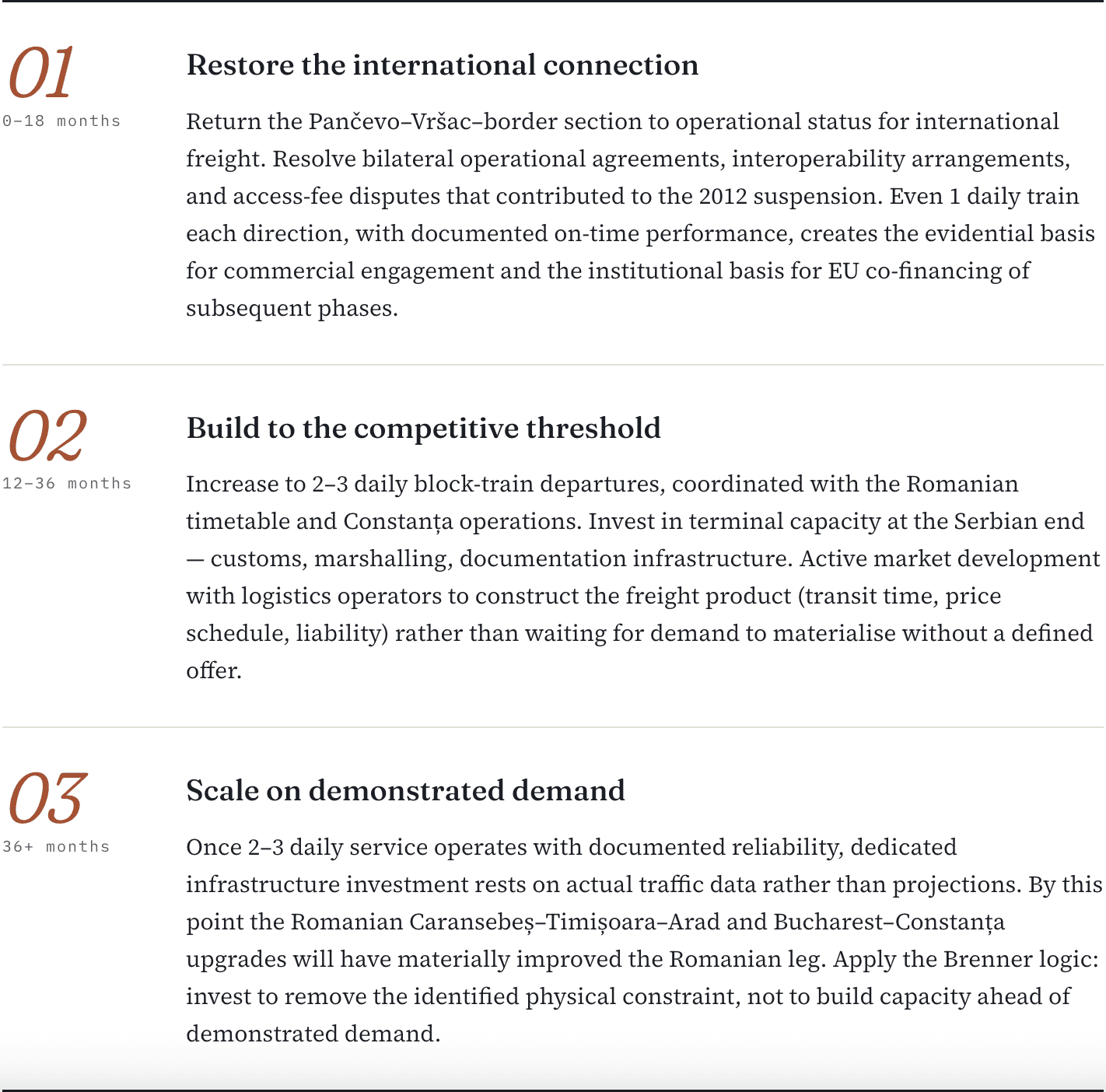
A phased operational roadmap
Each phase must generate the track record that justifies the next phase's investments. No phase is complete until its market thresholds have been demonstrated in actual service data - not feasibility projections.
What success looks like
The ambition appropriate for Belgrade–Constanța is not parity with Rhine–Alpine or Brenner. It is a regionally strategic axis giving Serbia, its neighbours, and Central European shippers a reliable alternative Black Sea port access route, supplementing, not competing with, Mediterranean and Adriatic options. Concretely, four operational conditions:
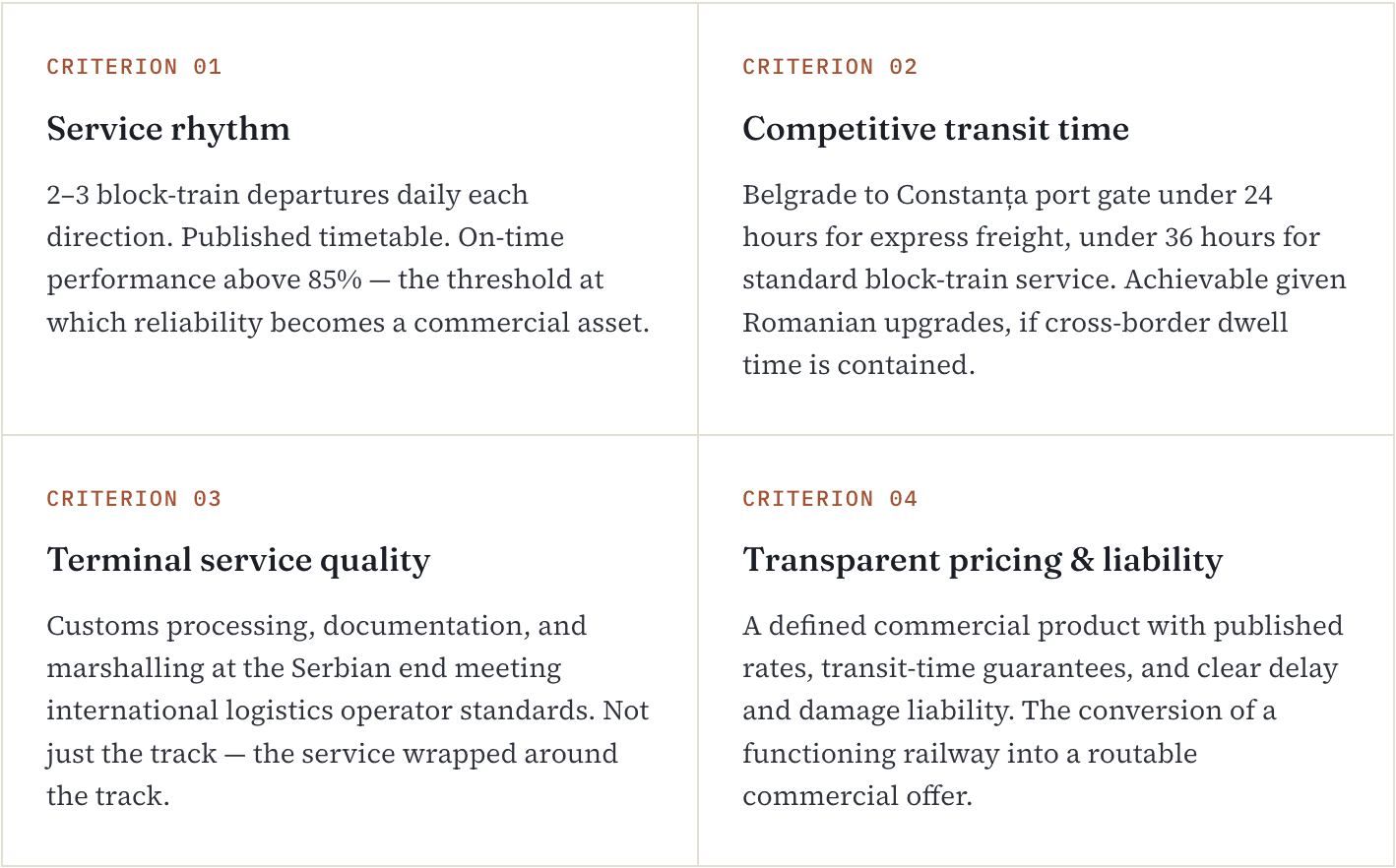
Conclusion
Rhine–Alpine and Brenner represent different formulas for the same underlying result: a rail freight axis that logistics operators treat as a reliable commercial product. Rhine–Alpine achieves this through port-industry density and dedicated infrastructure at the critical port-access segment. Brenner achieves it, partially, with modal split revealing how much remains unrealized, through transit chokepoint position, with €8+ billion invested to remove the remaining gradient constraint.
Belgrade–Constanța is neither a scaled-down Rhine–Alpine nor a smaller-scale Brenner. It is a regionally strategic corridor with a strong port anchor, Constanța's 92.7 million tonnes and near-total dominance of Romanian maritime traffic provide that, and a weak hinterland connection dormant since 2012. Romanian investments are improving the Romanian leg materially regardless of Serbian decisions. The critical path runs through Serbia's own choices: restore the international connection, build frequency to the 2–3 daily threshold, and construct the terminal service quality that allows a functioning railway to become a commercial offer.
Остале анализе

Време читања:
20
минута
17. 9. 2026.
текст
Why the USA and Serbia Need a Tax Treaty?
How a tax treaty and totalization agreement can deepen the growing U.S.–Serbia economic partnership.
Време читања:
45
минута
10. 9. 2026.
текст
Silence Is Not Safety: Rights Before Politics in Kosovo
Rights Before Politics: Protecting the Serbian Community and Religious Heritage in Kosovo

Време читања:
4
минута
25. 8. 2026.
текст
Чланство без користи: место Србије у WAICO-у
Чланство Србије у WAICO носи ризике по западно технолошко усмерење, а не доноси јасну корист Србији.